
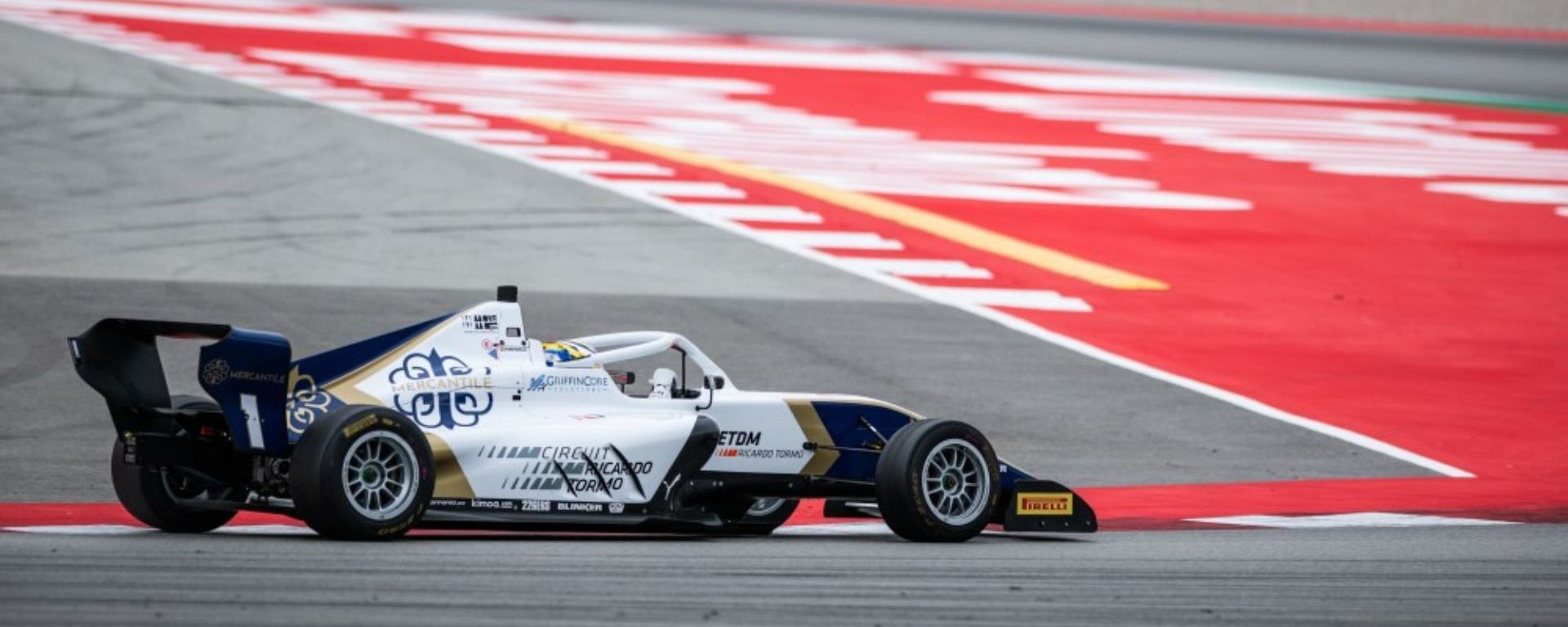
Early in 2023, the Circuit de Barcelona-Catalunya announced a major change to the final sector of its grand prix circuit configuration in advance of the 2023 Spanish Grand Prix taking place this weekend. But will it help the racing? F1 Academy’s latest round at Barcelona earlier in May offers some clues.
By Jan Husmann
The changes the Circuit de Barcelona-Catalunya announced earlier this year mean that drivers now bypass the complex formerly composing the right-hander at Turn 13 and the chicane at Turns 14 and 15 in favour of a single, high-speed right hander at Turn 13, now the penultimate corner on the circuit.
This corner configuration was last used for grand prix racing at the 2006 Spanish Grand Prix. After the reconfiguration of Turn 10 ahead of the 2021 Spanish Grand Prix, the latest change results in a new layout measuring 4.657 kilometres for the upcoming grand prix weekend.
On the previous layout, it had become increasingly difficult for modern F1 cars to stay close to one another through the slow corners in the final sector, hindering overtaking opportunities on the subsequent main straight.
The slow corners also deviated from the otherwise high-speed, flowing nature of the circuit.
Many F1 fans reacted positively to the change on social media, believing that it would improve the on-track product for a race often regarded as dull. Followers of junior single-seaters got a glimpse of it in the middle of May when the Formula Regional European Championship by Alpine (FRECA) and new all-female F4 series F1 Academy visited the Circuit de Barcelona-Catalunya. And the first impression the new layout made was sobering, as very few overtakes happened across both categories.
Drivers’ reactions
ART Grand Prix’s Léna Bühler, winner of F1 Academy’s third race in Barcelona, previously competed on the circuit in Spanish F4 in 2020 and FRECA in 2021. “It is more difficult with this new layout to overtake,” she told Feeder Series in the virtual winner’s press conference. “Before, there was the chicane, so you can prepare the last corner well without the dirty air. Now it is a fast corner. So now, when you are close to the car in front, you have dirty air and you miss a bit of [front end].”
Race one winner Emely de Heus of MP Motorsport, who finished eighth in race two and sixth in race three, echoed Bühler’s sentiment.
“I knew my speed was good, but in the dirty air, each time I lost a bit. In Turn 3, you can drive a bit of a different line so you keep close, but in the last two corners it is really hard, so every time I lost a bit on the exit of the corner. That’s why I couldn’t overtake on the straight.”
De Heus’ teammate Amna Al Qubaisi, winner of the reverse-grid race two, was less critical of the changes but regarded them as insignificant.
“I would say it was the same,” she said. “Whenever you were behind a driver, you got a lot of understeer, so it was really difficult to overtake into the first corner unless you had a really, really good slipstream. Then you could overtake. But overtaking in this corner is really difficult unless you have better tyres or a really good exit.”
Carlin racer Abbi Pulling had more positive words for the new final corners. “I was hoping [it would help overtaking], and I think it probably did,” she told Feeder Series.
“It has made the straight a little bit longer if you get a run coming out of the last corner. But then it’s a bit similar to Turn 9 with the aero wash because it is not a flat corner. You have got to be a bit clever with how you enter and exit that corner if you’re following someone because there’s quite a lot of aero wash. I definitely prefer it, I definitely prefer the faster last sector.”
While these comments primarily reflect the behaviour of the Tatuus F4-T421 that F1 Academy uses, they suggest only a small improvement, if any, for overtaking.
Formula 1 is trying to reduce the effects of dirty air while following another driver closely and DRS will help the drivers complete overtakes on the straight, but the fact that F1 Academy cars, which have much simpler aerodynamic features, struggled to stay close through the last two corners should worry F1 fans about whether the circuit changes actually improve the racing.
Other improvements
The final sector was not the only area addressed during the winter as Pulling added, “Some of the sausage kerbs have gone. That makes Turn 1 a little bit different because you can really, really, really abuse that apex in the races to hook you around… legally!”
Despite her negative impression of the overtaking possibilities, De Heus still thought the changes improved the track overall. “I like the track more like this,” she said, “because otherwise, you need to slow down the car really a lot. It is now more racing.”
Additional reporting by Jim Kimberley
Header photo credit: Campos Racing
Make a one-time donation
Make a monthly donation
Make a yearly donation
Choose an amount
Or enter a custom amount
Your contribution is appreciated.
Your contribution is appreciated.
Your contribution is appreciated.
DonateDonate monthlyDonate yearly Feeder Series