
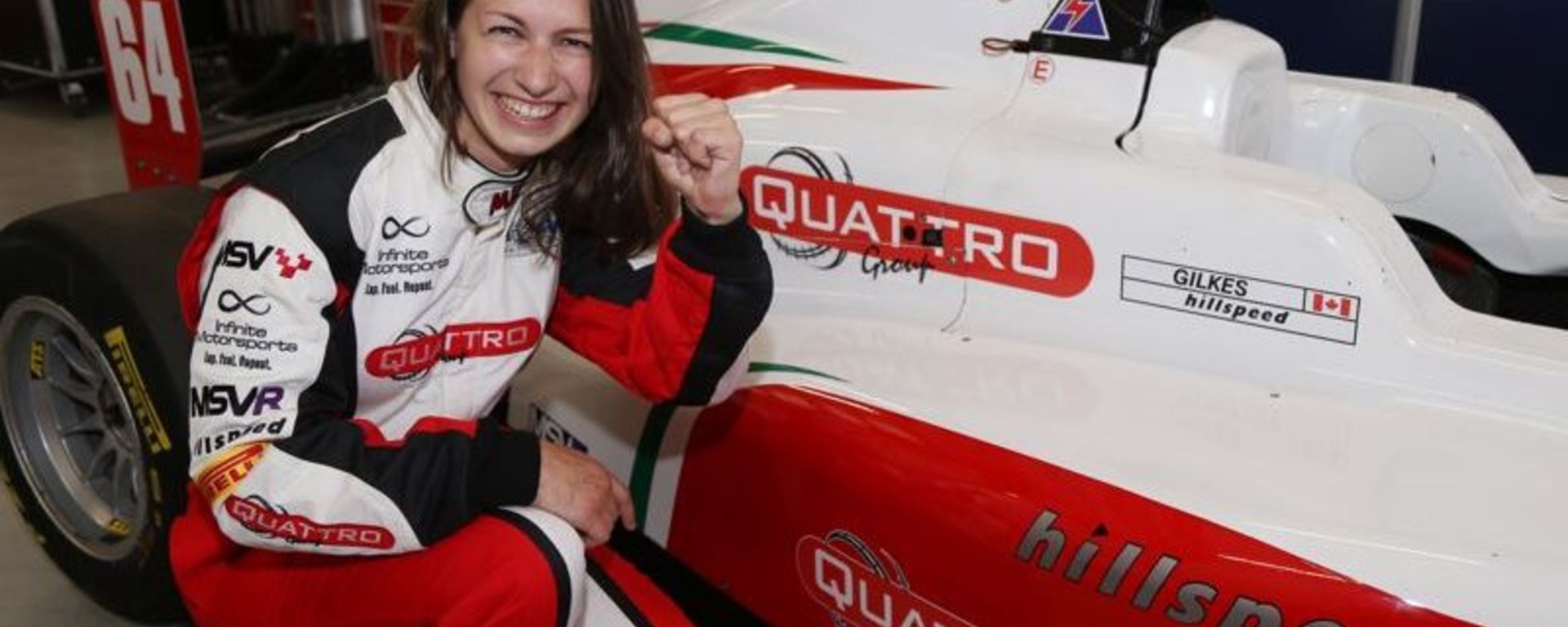
When Megan Gilkes isn’t engineering in Formula 1 as a placement student in Aston Martin’s Trackside Support Department, she can be found racing for Rodin Carlin in the first-ever F1 Academy championship. Currently thirteenth in the standings with a best result of fifth in the eighteen races so far, she is keen to “step it up” ahead of the season finale in Austin. The Canadian spoke exclusively to Feeder Series about her journey to F1 Academy, the importance of the series in increasing female participation within motorsport, and her goals for the future.
By Nida Anis
Gilkes’ journey to F1 Academy began at the age of nine, when she took up karting whilst growing up in Barbados. “It was a small field, but actually quite a good field that I was racing against. Zane Maloney is now an F2 driver for Rodin Carlin as well, ironically,” she said, referring to the Red Bull Junior Team member and Red Bull Racing Reserve Driver who competed against her.
“[He] was my main competition when I was karting, so it was really cool that we had those battles as little kids in karts. Now he’s progressed up to F2, which is just fantastic to see, and I’ve gotten into the F1 Academy so now I’m getting to do a race on the F1 calendar. It’s really cool to see these two kids who were battling out in Barbados racing in the big leagues now.”
After winning the 2011 Barbados EasyKart 60cc half-season championship, Gilkes received an invitation to the EasyKart 60cc World Finals in Milan. However, an injury sustained during the event put her on the sidelines. “Unfortunately, I broke my wrist and had a concussion from a crash that I had in qualifying, so that put me out for a few years.”
Despite this setback, she was determined to keep on racing. “I moved back to Canada and managed to convince my mum and dad to let me have a go racing again, and just did some four-stroke karting in Canada that sort of helped set me on the path to then moving in cars – which was ultimately my goal ever since I started racing!”
From Formula Vee to W Series
Gilkes competed in two seasons of Formula Vee in Canada in 2017 and 2018. “Formula Vee is essentially 1960s Volkswagen Beetle engines and front suspension,” she explained. “They have no downforce, they have treaded tyres, so essentially road tyres, so it’s all about mechanical grip – and only 60 horsepower.
“It’s a great series to learn how to race and learn racecraft, as the slipstreaming is really important. You’re not hanging back behind someone because of dirty air from downforce, you’re able to really have great races with big packs of cars.”
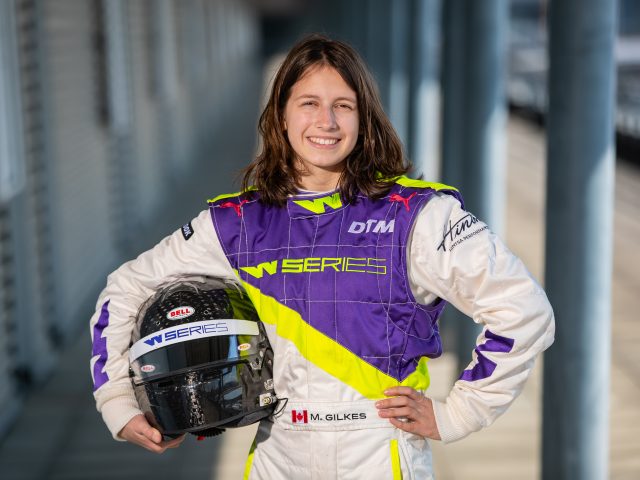
The first-ever W Series season in 2019 presented another opportunity for Gilkes to develop her racecraft.
“I got selected to be one of eighteen drivers on the grid for the inaugural W Series, and that was a really neat experience,” she said. “In hindsight, probably a little bit soon for me having just come out of Formula Vees and done a little bit of testing in one race in an F2000, but other than that, that was the extent of my slicks and wings experience.
“So yeah, it was a tough start to the season, but then I ended up winning the reverse-grid race in Assen, which kind of set me on a path and gave me the name that I needed to be able to continue racing worldwide after that. I was really lucky to have had the chance to do that series, but I was pleased that I got a win out of it because beyond that, it was quite a difficult season.”
Racing in Formula Ford and the GB4 Championship
A COVID-19-disrupted 2020 season saw Gilkes relocate back to her home country of Canada, where she raced in Formula Ford 1600.“I was hoping to be able to race at the Canadian Grand Prix because Formula 1600 was one of the support races on the support bill for the Grand Prix, but unfortunately with COVID the Grand Prix didn’t happen.
“So I did Formula Ford in Canada, came second in that championship which was a really good lead-in for me to be able to race in the UK in Formula Ford the year after. And yeah, I competed in the British Formula Ford Championship, the Walter Hayes, and the Formula Ford Festival,” she said.
The Walter Hayes Trophy at Silverstone and the Formula Ford Festival at Brands Hatch are two of the most prestigious trophies in Formula Ford racing, with drivers from around the world fighting for a chance to stand on the top step of the podium in the Grand Final.
“After that, the following year [in 2022], I didn’t really have any set-in-stone plans, but the opportunity to do GB4 came up,” she said, reflecting on the start of her campaign with British outfit Hillspeed. “Just for one round, initially, and so I thought ‘oh, what a great opportunity!’
“They offered it to me at a pretty reasonable price for the first round of the championship, and I won the final race of the weekend. And from there, some sponsorship came onboard – Quattro Group were supporting me last season and it was fantastic.
“It allowed me to do the whole rest of the season when I was only really expecting to do one race. So I was really pleased that I got to do that championship. It’s so low-cost, GB4, for F4 racing, and some pretty strong teams do it.”
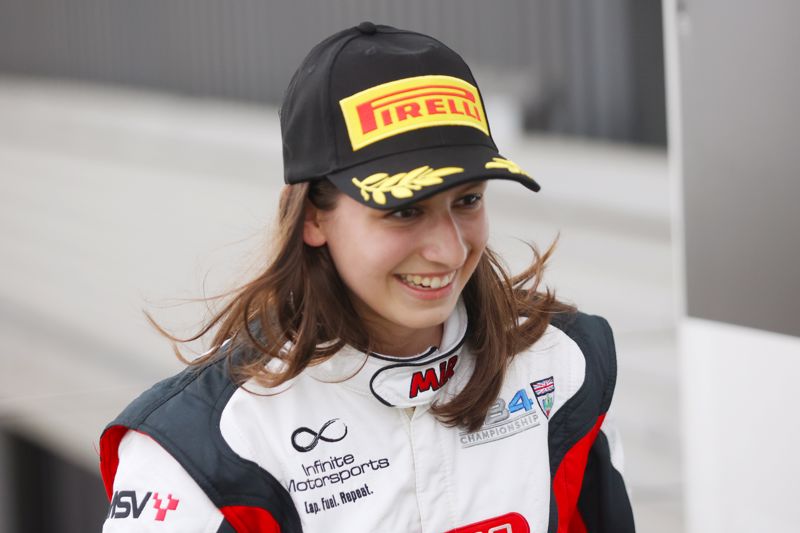
Gilkes is the most successful female driver in the GB4 Championship to date, with two other female drivers from the 2022 season – Jessica Edgar and Chloe Grant – also joining the inaugural F1 Academy grid.
“This year came up with the F1 Academy, and that opportunity, well I thought ‘that looks like a great way to race F4s around the world at a pretty low budget’, so I grabbed that opportunity with both hands – and here we are!”
Competing in F1 Academy with Rodin Carlin
Gilkes spoke to Feeder Series about her experiences competing in F1 Academy with Rodin Carlin, where she is joined by Alpine Academy driver Abbi Pulling and fellow GB4 Championship alumna Jessica Edgar. “It’s been fantastic working with Rodin Carlin,” she said. “I’ve got an amazing engineer right now, Mark, who’s been really influential in helping me improve as a driver.
“I love to come back after a session, debrief with him, not just to see what to do with my driving in the upcoming sessions but also just to hear his thoughts on the setup of the car – that’s just kind of the engineer in me wanting to know, you know, what would he do and that sort of thing.”
The Canadian reflected on the support that she has received from the British outfit, which currently fields teams competing in six different motorsport championships throughout the feeder series ladder. “Alongside that, there’s simulator time at the Rodin Carlin factory and things like that, that they help us out with to prepare for events,” she said.
“So definitely, when you sort of step into the big leagues with a team like Rodin Carlin, then you really get to see how they prepare junior drivers for racing in the various series that they compete in. It is fantastic to be able to work with teams like Rodin Carlin who are so experienced in so many different categories.”
I think the testing has been massive, not just for me, but for a lot of the girls less experienced on the grid
Megan Gilkes
Gilkes also talked about the significance of F1 Academy’s focus on driver development and testing, with the series mandating 15 days of testing outside of track time on race weekends. “Definitely, I think the testing has been massive, not just for me, but for a lot of the girls less experienced on the grid, because you saw quite a big spread at the start of the season in terms of lap times.
“I mean, we started the year in Austria, and there were some big lap time gaps for such a short circuit. So to now have been to Paul Ricard, and the top fifteen be separated – well, the top fifteen, that’s the whole grid! – be separated by six tenths of a second, it’s amazing, and it shows that with that much testing, you can get all the drivers really close, you can get everyone to a good level.
“I think the testing has been a major influence for me, and for all the drivers, being able to improve our driving and work on the setup of the car.”
Balancing F1 Academy with a full-time job in Formula 1
Gilkes is in the unique position of balancing her racing commitments with a full-time engineering role in Formula 1, where she works as a placement student within Aston Martin’s Trackside Support Department.
“Essentially, what that is, is race engineering but from the factory,” she explained, “so we support all the race engineering and trackside teams from the factory and from Mission Control.
“My day job as well, when I’m not in Mission Control, is really cool. I help with some of the setup scans to try and help us determine what direction we’re going to go with the car. I get to do a lot of the driver feedback, driving notes as well, which is really neat. And yeah, it’s really amazing that I can be in a department that’s so spread out across the whole car.”
The Canadian driver spoke about the impact that her engineering role had on her approach to racing. “From my placement, I’ve learned how to be an engineer,” she added. “And in terms of taking that into my racing, it’s really helpful to have sort of seen how an F1 team does it, and kind of have that now underlying understanding of engineering and motorsport engineering.
“So I’m able to give quite tailored feedback to my engineers when I come in from a session on what the car has been doing and stuff, have a discussion with them on how we can help that. But at the same time, I also have the leave my engineering hat at home a little bit and let the engineers at Rodin Carlin do what they do and make their setup decisions.
“I’m really lucky that I’m working with a really experienced and fantastic engineer, so he’s really able to make decisions that, you know, if I come in and say the car is doing this or that, he’s able to make a setup decision that will help improve that – and I don’t even have to think about ‘oh, what would I do?’ or anything like that.
“It makes it really easy for me to just go out and drive, which is just as a driver what you need to do.”
The importance of F1 Academy in promoting women in motorsport
F1 Academy’s primary objective is to develop female drivers and help them progress to higher levels of competition. “It’s a really good series with really noble goals, to get women up the racing ladder and also to get more women into motorsport,” Gilkes said.
“I think the F1 teams coming onboard next season is fantastic for all the girls that are going to be racing, because it really puts some backing behind them from some teams which can then take them further as well.
“As the series continues to grow and as more young girls see the F1 Academy as a stepping stone in their future, they’ll get involved in karting and then progress up towards and through the F1 Academy, and then hopefully beyond it as well.
“Hopefully we’ll see some girls in some top-level junior formulae like FIA F3 and F2 soon,” Gilkes continued. “And then, eventually, once you start seeing a lot more girls in the feeder series directly below F1, hopefully some of them will progress to F1.”
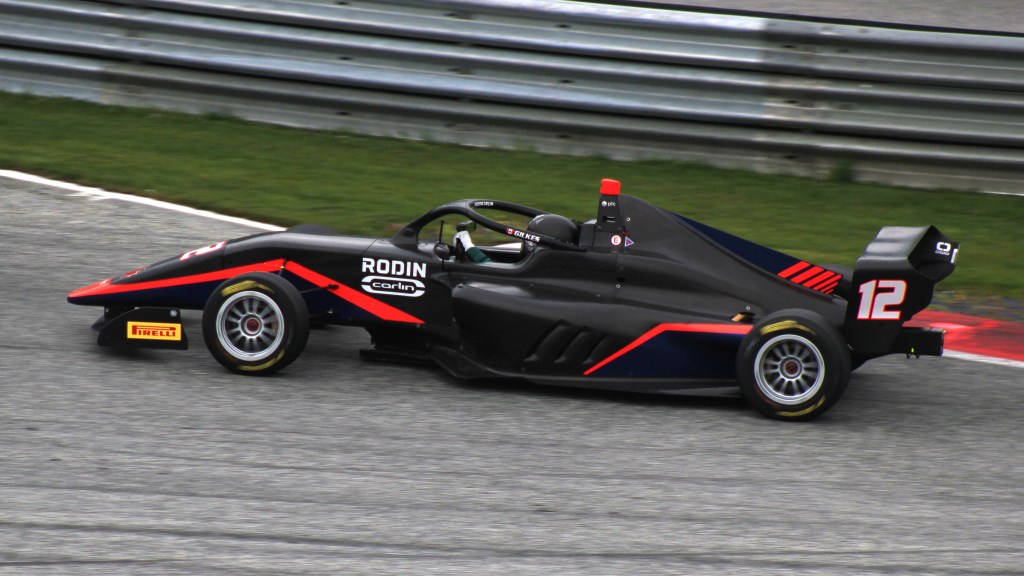
Earlier this year, the all-female series launched ‘Discover Your Drive’ – a global initiative and talent identification programme to find and support promising young female karters.
“You see loads of young girls at the circuits now coming to these events, you know. You speak to them, they’re like ‘yeah, I’m in karting at the moment and someday I want to be an F1 Academy driver’, and that’s really nice to see,” Gilkes said.
“So it’s great that they’re really increasing the involvement in karting for girls to be able to come up through the F1 Academy and beyond in the future.”
Looking ahead to Austin and beyond
Sitting in thirteenth in the standings – one point behind ART Grand Prix’s Chloe Grant and twenty-five points adrift of Carrie Schreiner in eleventh – Gilkes admitted that her 2023 F1 Academy campaign had not produced the results that she hoped for at the start of the year.
“I’ve had a pretty rough start to the season,” she said. “I have not had the results that I have wanted prior to the year by any means. So definitely, I’m hoping to really step it up for Austin. I’m definitely going to have a lot more time now with the F1 shutdown currently and stuff.
“Not being in work at the moment, it gives me a bit more time to go on the simulator, go to the gym. Things that with trying to juggle a full-time job, which, you know, you put in a lot of hours because you really love doing it and stuff, and you want to make a good impression there, you’re sort of balancing a high workload – which, you know, you wouldn’t have it any other way! – with a racing career.
“And so it’s quite difficult to juggle the two and the racing had to go a little bit on the back burner when things got busy at work, so that I could put in 100% for Aston Martin and do what I can there.”
I think I might be the only girl on the grid who has a full-time job!
Megan Gilkes
With the F1 shutdown currently in full swing, Gilkes hopes to maximise her preparations ahead of the season-ending round in Austin as the series joins the support bill for the Formula 1 race weekend. With the championship being broadcast live for the very first time, putting in a strong showing is more important than ever.
“I’m going to definitely be able to put a bit more time into the simulator work, and I know that there’s a lot of girls on the grid – I think I might be the only girl on the grid who has a full-time job! – so it makes it quite difficult to be able to put in the level of intense preparation as what some of the other girls do. But now with the shutdown, I think I’ll have the time to really be able to get ready for Austin.”
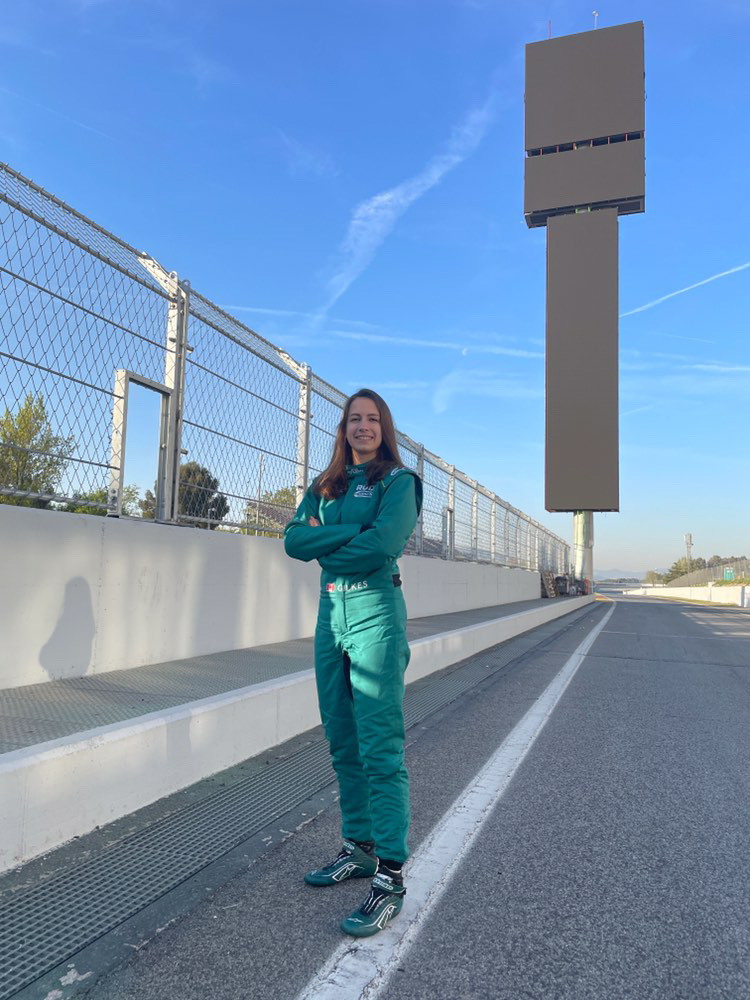
Beyond Austin, Gilkes’ driving plans for next year aren’t set in stone. “From a driving perspective, I’m just going to sort of see what happens for next season. We’ve still got one race to go, just kind of push on for that race, get as good results as I can for it, and then from there see what opportunities are going to open up.”
However, the Canadian has a clear goal in mind as she pursues a career in motorsport engineering. “My goal is to become a full-time engineer in F1 once I graduate,” she added. “I’d love for it to be with Aston Martin because I just love my time there so much, and the race engineering, trackside support side of things is the most interesting part of the F1 teams’ engineering.
“I love that it involves the whole car and the level of data analysis and sort of being able to learn how to set up the racing car and things like that, optimising it to get your base car to the best state that it can be in for a race weekend when you go to all these different kinds of circuits when there’s so much variability in the setup. I think that’s the bit that really interests me.
“So I’d love to be able to get a job as a performance engineer, as a race engineer, something like that. Looking way down the line, that’s kind of where I want to go with my career, on the race engineering side of things!”
Header photo credit: Jakob Ebrey Photography
 Feeder Series