
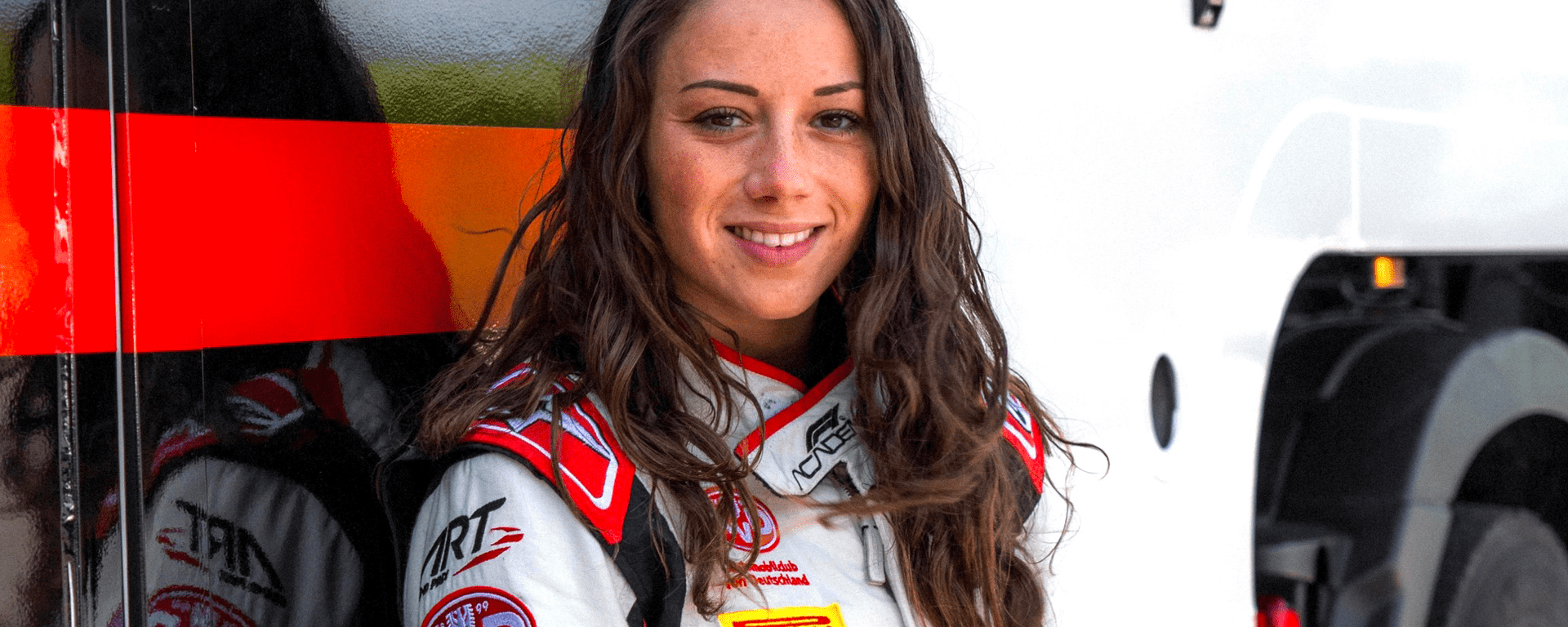
After a six-year absence from open-wheel racing, Carrie Schreiner returned to single-seaters for this year’s inaugural F1 Academy season with ART Grand Prix. In an exclusive interview with Feeder Series, the 2018 Lamborghini Super Trofeo Middle East and DMV Gran Turismo Touring Car Cup champion discussed her path to F1 Academy, her ongoing involvement as a driver in Giti’s ‘Girls Only’ GT racing team, and how F1 Academy’s emphasis on track time and testing allowed her to “[learn] so much this year”.
By Nida Anis
After taking up karting at the age of ten, Schreiner quickly developed a passion for motorsport. “At the beginning, of course, it was just driving because I needed a little bit of time to adapt to everything,” she said. “But it was the only sport where I was really passionate about it, that it was worth for me to try, like, 300 kilometres at the racetrack just for training.”
It wasn’t long before she made her mark on the German junior motorsport scene. Between 2011 and 2014, Schreiner competed in the ADAC Kart Masters – the highest-rated and most popular German karting series.
“After a few years, I had my first success,” she continued. “My biggest was 2012, the win of the biggest German karting championship, national karting championship. I’m still the only woman who won this, so after that I knew I really wanted to achieve more, not only in karting. I knew I also wanted to drive in single-seaters, and my goal is to be a professional racing driver!
“It was the next step for me to drive single-seaters in 2015.”
A challenging transition to single-seaters
Schreiner transitioned from karting to single-seaters in 2015, when she entered the ADAC Formula 4 Championship with German-American outfit HTP Motorsport. The following year saw her continue to compete in the series with US Racing, whilst also competing in selected rounds of the British F4 Championship with Double R Racing. She ended her first two years of Formula 4 racing with a best race finish of fourth at Thruxton.
Speaking to Feeder Series, Schreiner reflected on her challenging transition to from karting to two years of single-seaters. “The change from karting to single-seaters was not really easy for me, because it’s a real car now, it’s heavy, especially I’m really small and a girl so in the beginning I was not strong enough to drive these cars. So I needed a bit of time.
“And on the other hand, the generation I was driving was huge, because many of the drivers that I was driving against are still in F3, F2, and F1 already. It was a really, really, really strong generation, so it was not easy for me! But in the end, I was not too far away. I was not so bad! I learned a lot, even when it was a tough challenge for me.”
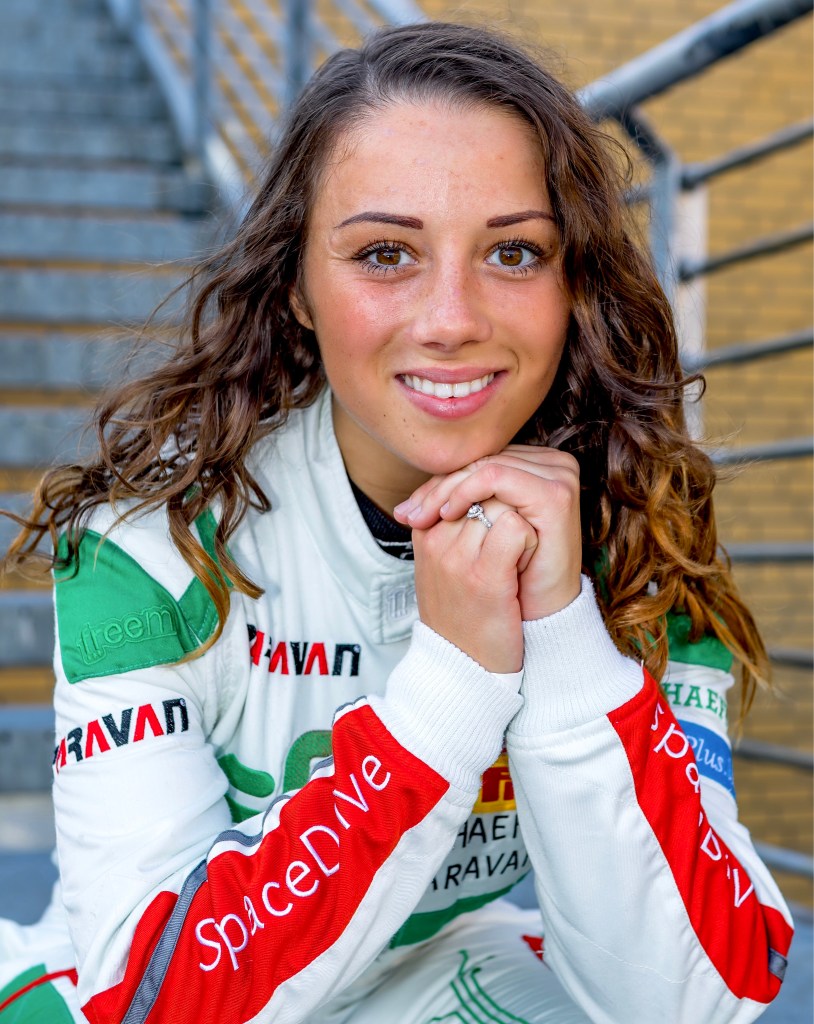
After six years of closed-wheel racing in GTs, Schreiner made her return to open-wheel racing in F1 Academy. “So when I knew I drove these two years in single-seaters and I was not too bad, I had the feeling that normally it wouldn’t be a problem to try single-seaters again now into F1 Academy,” she said. “But to be honest, adapting to the F1 Academy car was quite a challenge.
“It’s six years ago that I drove single-seaters last time. And the other drivers, all the other drivers, drove at least one season in the last couple of years, minimum three, some of them drove for five-years single-seaters,” she continued.
“In the beginning, it was really tough, but I worked really hard to close the gap. Now I think I made a good progress, and I’m there.”
The only driver in F1 Academy who had not competed in single-seaters prior to joining the series was Prema’s Chloe Chong, who stepped up to the series after competing in the British Kart Championship. Chong had tested Formula 4 cars in 2022 as part of the FIA Girls on Track – Rising Stars programme, where she was one of four drivers in the final shootout in Maranello.
Transitioning to GT racing
2017 saw the German driver move to GT racing. After finishing runner-up in the Lamborghini Super Trofeo Middle East, she went on to win the Lamborghini Super Trofeo Middle East Pro-Am and DMV Gran Turismo Touring Car championships in 2018.
Comparing GT cars to single-seaters, Schreiner said, “I think the biggest difference is the corner speeds. You can drive so much quicker into the corner with a single-seater. You have no ABS, no traction control, it’s much lighter than a GT car. The weight is also a bit different. Standing start, of course. But these are the biggest differences.
“With the experience in single-seaters, Lamborghini Super Trofeo is completely different. Suddenly the Lamborghini has so much power, more than 600 horsepower and a lot of weight compared to the Formula 4 car and of course, it has not so much aerodynamics so it’s really difficult to drive, it’s not an easy task.
“It was a huge difference, but I’m happy to say that in the second year I could win the Middle East championship. It was a really good moment, in the Pro-Am class. I adapted to it at one point, and for that what was coming after it, GT3,” she continued.
“When I drove single-seater and Lamborghini. The combination of both is similar to driving a GT3 car! This helped me a lot, to win the the GTC series and the GT3 class in Audi GT3 in my first year.
“All the experiences I made helped me to get where I am now.”
Being a part of Giti’s Girls Only team
In 2019, Schreiner joined Giti Tire’s Girls Only project. The team uniquely consists of an all-female crew: its drivers, team managers, mechanics, engineers, PR personnel, and photographers are all women. Between 2019 and 2022, the team finished third in class twice in the 24 Hours of the Nürburgring – and notably took an SP8 class victory in the 2021 edition.
Speaking about her involvement in the project, Schreiner said, “I started with the Nordschleife. I mean, the project is on the Nordschleife, the Nürburgring. It’s the, I would say, the toughest race track in the world and also the longest. When you want to be a professional GT driver you must be quick there, because other factories put a lot of weight in it.
“I started there and one year after, I got a request from the team owner [of WS Racing], Thorsten Willems, that he has the idea to create a full women team. Not only the drivers, also the mechanics,” she continued.
“In the beginning, I was a bit, ‘okay, that is very ambitious’, but I said yes! I’m in it, I’m a part of the project, so 2019 was the first year. I helped them a lot to find the girls also, and, yeah, I tried to help them a bit.
I’m really happy to be a part of it
Carrie Schreiner on being a part of Giti’s Girls Only project
“2019 we were the first time in the 24 hour race, unfortunately we had an engine blowout during the first few hours of the race, so we had to repair it the whole night. We were the first female lineup in the history – not only drivers, also mechanics and engineers – and now we are an important part of the Nordschleife scene because now we have the respect, because we also had a lot of good results so far.
“It’s the fifth year now where the team competes. I’m really happy to be a part of it. And they show the biggest intention of the team is to give the girls who are interested to work in motorsport that they are [able to] trust in themselves, and just be brave enough to try it!”
Competing in F1 Academy
Up until she received a call-up from ART last year, Schreiner never expected to return to single-seater racing. “Last year, ART contacted me,” she explained. “I didn’t know about the series and in the beginning, I was not sure if I should do it because normally it was not my plan to go back to single-seaters because I did not see a reason for it.
“But when I thought about it, to be a part of the first own championship from F1 for women, I had to do it. Also, the team, ART, it’s one of the best teams in the single-seater. So I was quite quick to decide that I have to do it, and I’m really happy about this decision because I learned so much this year. One is driving so much – fifteen test days, always with the same car! – it makes a huge difference.
“After all I was driving the last years, this was a really good thing.”
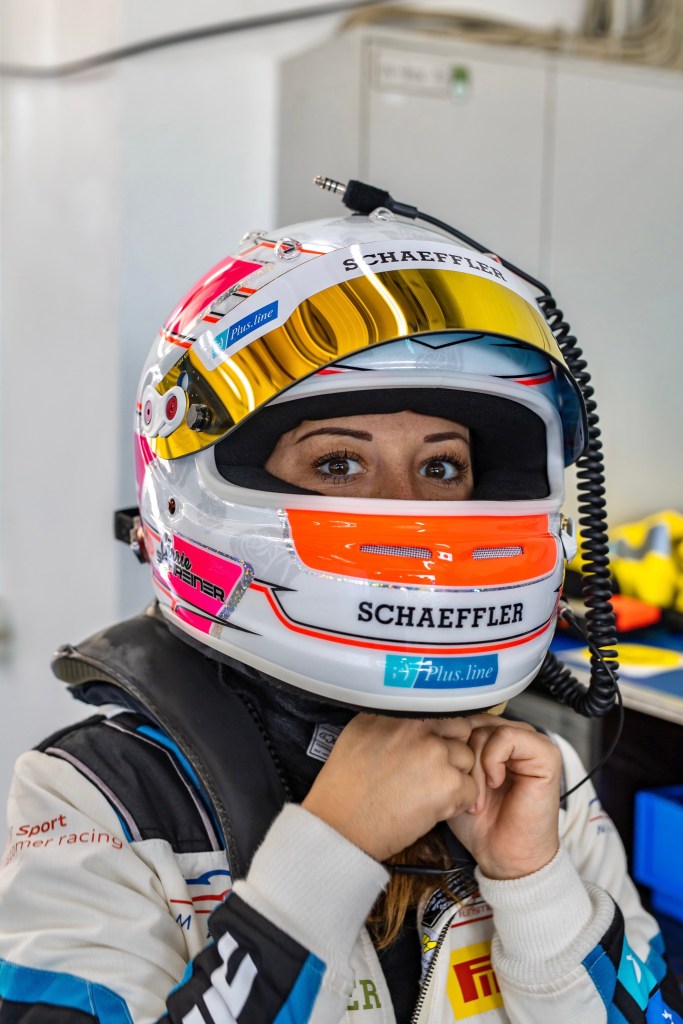
Like many other drivers on the F1 Academy grid, Schreiner has been preparing herself mentally and physically ahead of her races in the championship. “One of the most important things to prepare is the physical training.
“I have a trainer, he’s in Austria. I also do fitness camps before the season, during the season, but I think the physical part is the biggest one,” she continued. “Next to it, simulator training at home and with ART.
“I also work together with a mental coach. He helps me a lot to create some techniques to be focused before a race. The biggest part I do with ART beside the simulator sessions is to work on strength, to analyse the sessions, the training, the races”.
Unlike other regional F4 championships, F1 Academy races at tracks around the world – many of which are current or former Formula 1 circuits. So how does Schreiner adapt to the worldwide nature of this championship?
“I think the biggest part was just simulator driving. Some of the tracks, most of the tracks, we’ve tested before. We had a lot of time and the possibility to adapt to every track. That’s the huge difference between W Series and F1 Academy, that you have this amount of driving time. It makes such a huge difference and is a really good opportunity for female drivers to drive and evolve.”
Joining the F1 support paddock for Austin
The first-ever F1 Academy season finale in Austin sees the series join the Formula 1 paddock for the first time. With the series being broadcast live from now onwards, the upcoming race weekend presents a big opportunity for drivers to make their mark.
“Yeah, it’s amazing!” Schreiner said. “I’ve never been there, but I think it’s really, really nice to be with the F1. It’s the biggest series in the world. And I’ve never been to Austin, but I’ve also never been to America for racing, so I’m really excited for this. And I mean, I can tell you more after it. I can imagine it would be amazing.”
Young girls came to me and said, ‘I saw you driving, I saw you winning, and now I’m brave enough to start’
Carrie Schreiner on being a role model for young women in motorsport
Beyond F1 Academy, Schreiner aims to continue driving in motorsport – with the ultimate goal of securing a factory contract. “Of course, I would like to live for motorsport – it’s my biggest goal,” she continued. “In which series and which car this will be, I’m open for it.
“It would be great to be a factory driver, to have a factory contract. Before last year I’ve never expected to be back in a single-seater. It’s hard for me to say, ‘I want to be in this car in this series’, so I’m just open for it. Because every car has its own things what make it special.”
With her success in GT racing and her involvement in F1 Academy, Schreiner has become a role model for younger female drivers aspiring to follow in her footsteps.
“I’ve had these situations a few times already before F1 Academy that young girls came to me and said, ‘I saw you driving, I saw you winning, and now I’m brave enough to start’. The series is really important to give them more trust in themselves.”
Header photo credit: Carrie Schreiner
Make a one-time donation
Make a monthly donation
Make a yearly donation
Choose an amount
Or enter a custom amount
Your contribution is appreciated.
Your contribution is appreciated.
Your contribution is appreciated.
DonateDonate monthlyDonate yearly Feeder Series
2 thoughts on “ART’s Schreiner: Track time is ‘the huge difference between W Series and F1 Academy’”