

Drivers in the junior motorsport ranks will encounter increasingly powerful, higher-downforce machines to test their abilities as they move up the ladder. Understanding the differences between the different junior series cars can be difficult, so Feeder Series is here to break them down.
By Juan Arroyo
FIA Formula 2 Championship

The pinnacle category of the junior series ladder, Formula 2, uses the purpose-built Dallara F2 2018 chassis. It was introduced, as its name suggests, in 2018, with the aim of being closer to Formula 1 cars in aerodynamic philosophy and safety features, such as with the “halo” cockpit protection device. F2 cars are the closest of this list in size to F1 cars, falling just 0.4 metres short in length.
An F2 car has a “shark fin” above the engine cover to make the rear wing more effective by acting as an airflow straightener, essentially cleaning the air that reaches the rear wing and making the car more stable in high-speed corners.
Just like an F1 car, the Dallara F2 2018 uses the drag reduction system (DRS) to assist in overtaking. The F2 front wing has other parts, such as turning vanes and flaps, that make it the most similar to an F1 front wing as well.
Mecachrome, the life-long engine supplier for the former GP2 series, developed a new turbocharged engine for the F2 car when it was introduced. It is one of the most powerful engines in the junior categories, generating over 620 horsepower and helping F2 cars top out at speeds of 335 kph.
F2 cars originally carried over their traditional 13-inch wheel rims from 2017. However, as Pirelli remained the tyre supplier for both F1 and F2 and was looking to gather data on bigger tyres for the former, F2 switched to 18-inch wheel rims in 2020.
A new F2 car will be introduced in 2024.
FIA Formula 3 Championship

When Dallara made an overhaul to their FIA-sanctioned chassis, the Formula 3 car was next on their list. The F3 2019 chassis is a slight evolution of its GP3/16 predecessor, as the design stayed largely identical but a few notable elements were added or changed. It is very similar to the F2 car aerodynamically but slightly shorter in length.
The safety “halo” was added as part of the FIA’s growing safety measures from 2018. The front end was also altered in the push for drivers’ protection inside the cockpit, making new suspension configurations possible. The engine cover and shark fin were extended as the rear wing’s design was slightly modified, but the rest of the car stayed largely the same. DRS also remained.
Mecachrome builds the 3.4L naturally aspirated F3 engine that has been in use since 2016 and runs at 380 brake horsepower, helping the F3 cars top out at speeds of 299 kph.
Formula Regional

Formula Regional cars are where things get a bit more mixed up. No worries, just stick with us.
As they stand between Formula 3 and Formula 4, they are designed with a performance middle ground in mind. Some have higher minimum weights than F3, and drivers describe certain models as more difficult to handle than others. Nevertheless, Formula Regional cars share many of the design features of the F3 2019. Most of them are the same length as the cars raced in F3 and include all the same safety features.
Three manufacturers make up chassis construction for the championships that abide by FIA Formula Regional regulations: Tatuus, Ligier and Dome. Of those, Tatuus cars are the most used.
Tatuus CEO Gianfranco de Bellis told Feeder Series earlier this year, “Formula Regional is a very important step for the drivers. Drivers can learn a lot from driving a car that has low downforce, that has a very efficient braking system and also an engine that delivers a lot of power. Of course, the weight of the car due to the safety rules makes it a little bit heavy, so to handle the car, drivers need to follow a good physical preparation.”
The Tatuus F3 T-318, arguably the Italian manufacturer’s most successful model, has raced in the Formula Regional Asian, European, Middle East, W Series, Eurocup-3 and Oceania Championships, albeit the latter was with a slightly modified version with similar levels of power. This model has been powered by Alfa Romeo, Oreca and Toyota engines in various series. A push-to-pass system was introduced to the Formula Regional European Championship in 2022.
French manufacturer Ligier is contracted to make the JS F3 for the Formula Regional Americas Championship. It is very similar to the Tatuus in specifications, but the JS F3 generates 30 more horsepower, around 300hp, with its 2.0L Honda engine. Meanwhile, Dome, a name not commonly associated with single seaters today, is in charge of building the F111/3 for the Formula Regional Japan Championship, mounting a 270hp Autotecnica engine in the back of its cars.
Formula 4
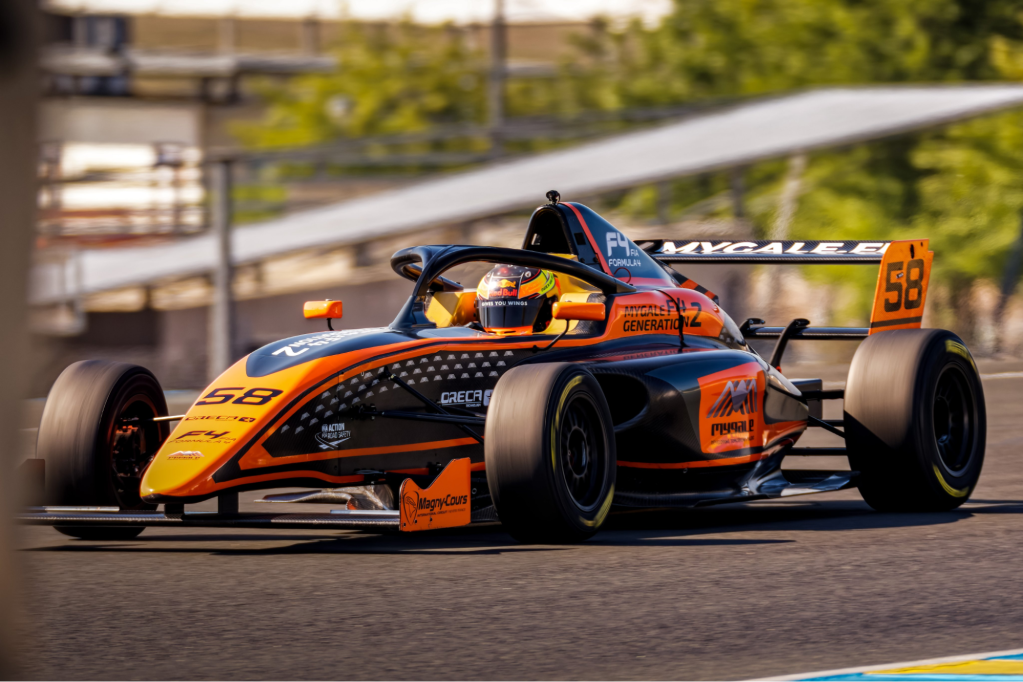
FIA Formula 4 cars are a slightly less complicated story. Still, you have to pay attention to keep up with the names. You’ve gotten this far, so hang with us for this final corner.
These cars are built with affordability in mind, meant to be entry-level machines for drivers stepping up to their first single-seater outings. They are the lightest of the FIA ladder, featuring little aerodynamic complexity and topping out at speeds of just over 250 kmh.
As with Formula Regional cars, Tatuus dominates the F4 market, manufacturing chassis for the majority of F4 championships worldwide. The Italian chassis-maker introduced the F4-T421 in 2022, an update to the previous T014 that introduced a number of safety features, including the halo. The Italian, British, Spanish, UAE, Central European, Brazilian and Euro-4 F4 championships all use the T421 chassis. F1 Academy uses a version of it with modified front and rear wings.
French manufacturer Mygale also has a presence in these championships. Having been with British F4 before the championship transitioned to Tatuus, Mygale currently supplies the Chinese, NACAM, Danish, French and Indian F4 championships. The M21-F4, an update to their previous M14-F4 chassis, was introduced in 2022 to make the car lighter and add the halo.
Ligier and Dome use the same cars for Formula Regional and F4, supplying the US and Japanese F4 championships with their JS F4 and F110 chassis respectively. Both series will utilise new chassis in 2024.
Editor’s note, 19 September 2023, 18:50 CEST: This article was updated to clarify that F2, Japanese F4, and F4 US will feature new chassis in 2024. Additionally, a section on the Dallara 320 used in Euroformula Open – a series not on the official FIA ladder – was removed after publication. The headline has been adjusted to reflect the increased specificity of the article.
Header photo credit: Formula Regional European Championship by Alpine, Formula Motorsport Ltd, XPB Images, FIA; collage by Feeder Series
Make a one-time donation
Make a monthly donation
Make a yearly donation
Choose an amount
Or enter a custom amount
Your contribution is appreciated.
Your contribution is appreciated.
Your contribution is appreciated.
DonateDonate monthlyDonate yearly Feeder Series