
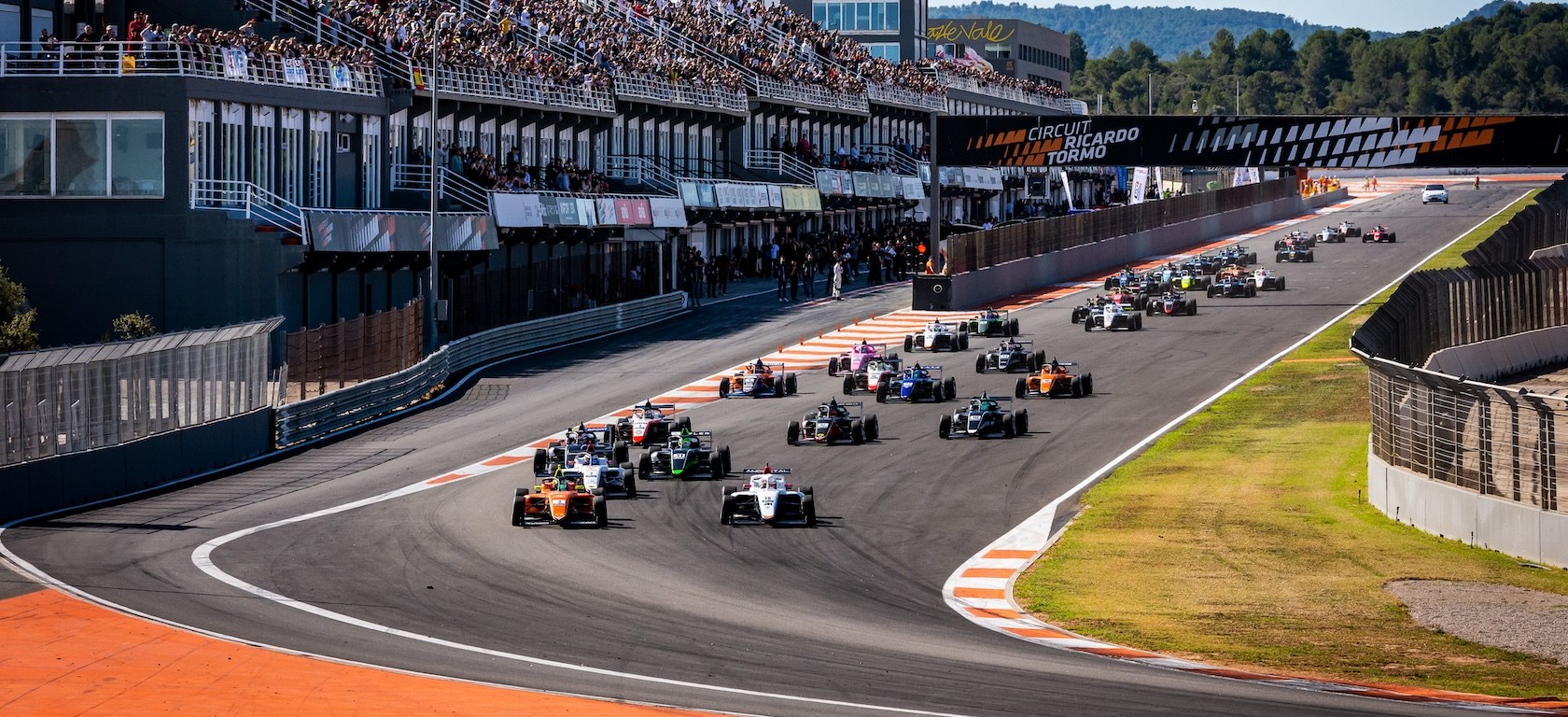
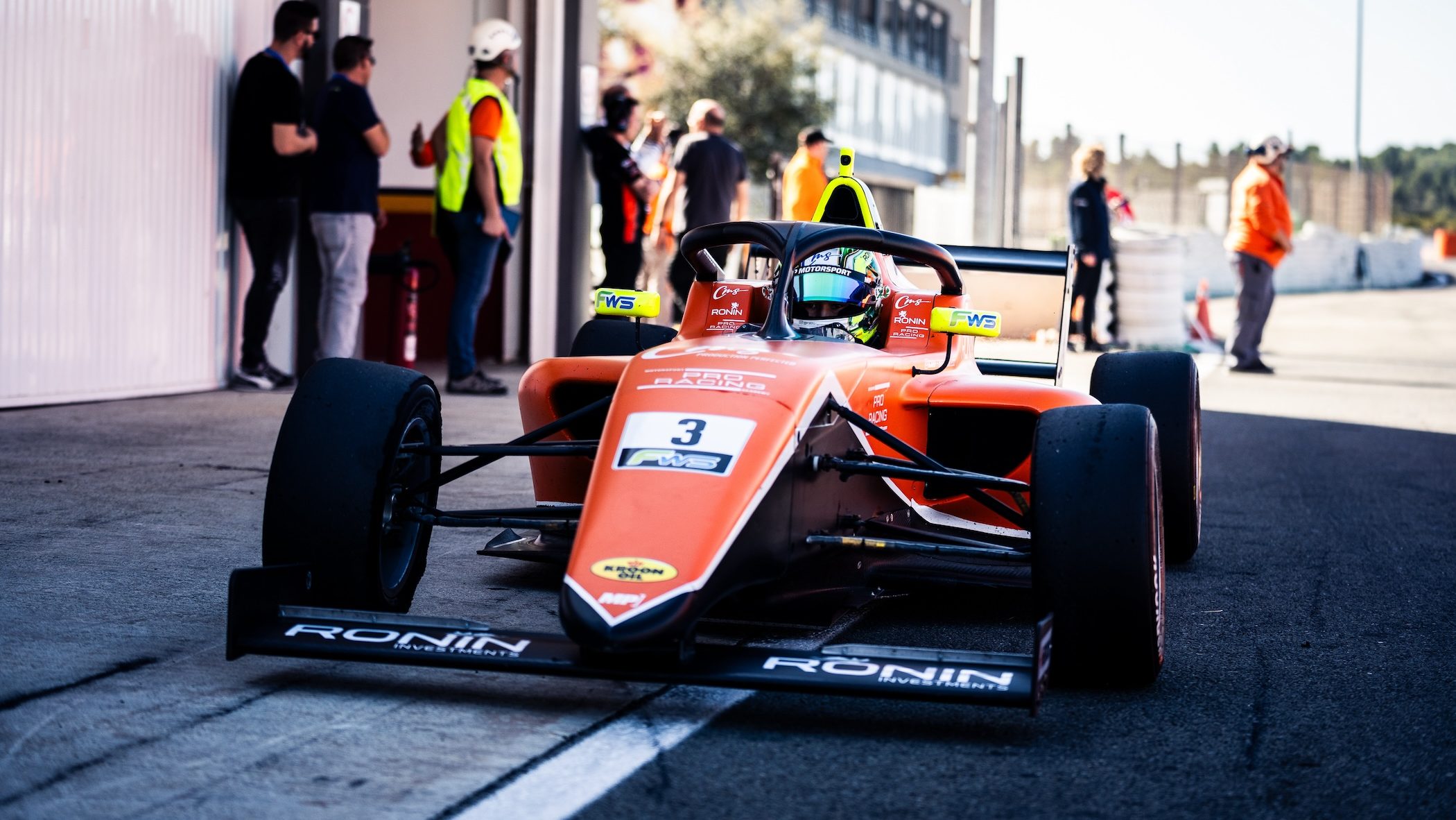
The results sheets from last weekend’s Formula Winter Series round at the Circuit Ricardo Tormo in Valencia may seem ordinary at first glance. But what finishing positions and a tie for the drivers’ championship lead hide are the chaotic scenes that unfolded in the stewards’ and timekeepers’ offices over the weekend as track limits, mass disqualifications in qualifying, red flags and broken transponders wreaked havoc on the field’s 38 entrants.
By Finjo Muschlien and Michael McClure
Formula Winter Series, or FWS for short, is a F4-level winter series intending to prepare drivers, especially F4 rookies, for the main seasons of national F4 championships, particularly Spanish F4. Founded in 2023 and organised by German company Gedlich Racing, FWS holds four rounds in Spain over five weekends in February and March.
The first round at Jerez featured 38 cars, more than four times as many as had entered last year’s season opener there. The 2024 Jerez event proceeded with little in the way of controversy, but the Valencia round a week later, from 15 to 18 February, was an altogether different story.
The 14-turn, 4.005-kilometre Circuit Ricardo Tormo in the Valencia suburb of Cheste, built in 1999, is one of many modern racetracks to have expansive run-off areas and track limits defined by white lines and painted kerbing rather than grass, gravel or concrete walls. The ease of exceeding track limits, particularly in and around the opening turn, adds an extra layer of difficulty for drivers.
This was proven last year when Valencia hosted FWS’ second-ever round, featuring a season-high 15 cars. All of them lost at least one lap in the first qualifying, and nine lost at least one in the second. Six drivers earned time penalties in the first race, while seven did so in the second race, with Patrick Heuzenroeder earning a 20-second penalty for racking up four infractions over the limit. The four private practices across Friday and Saturday also saw most drivers lose at least one lap in each session.
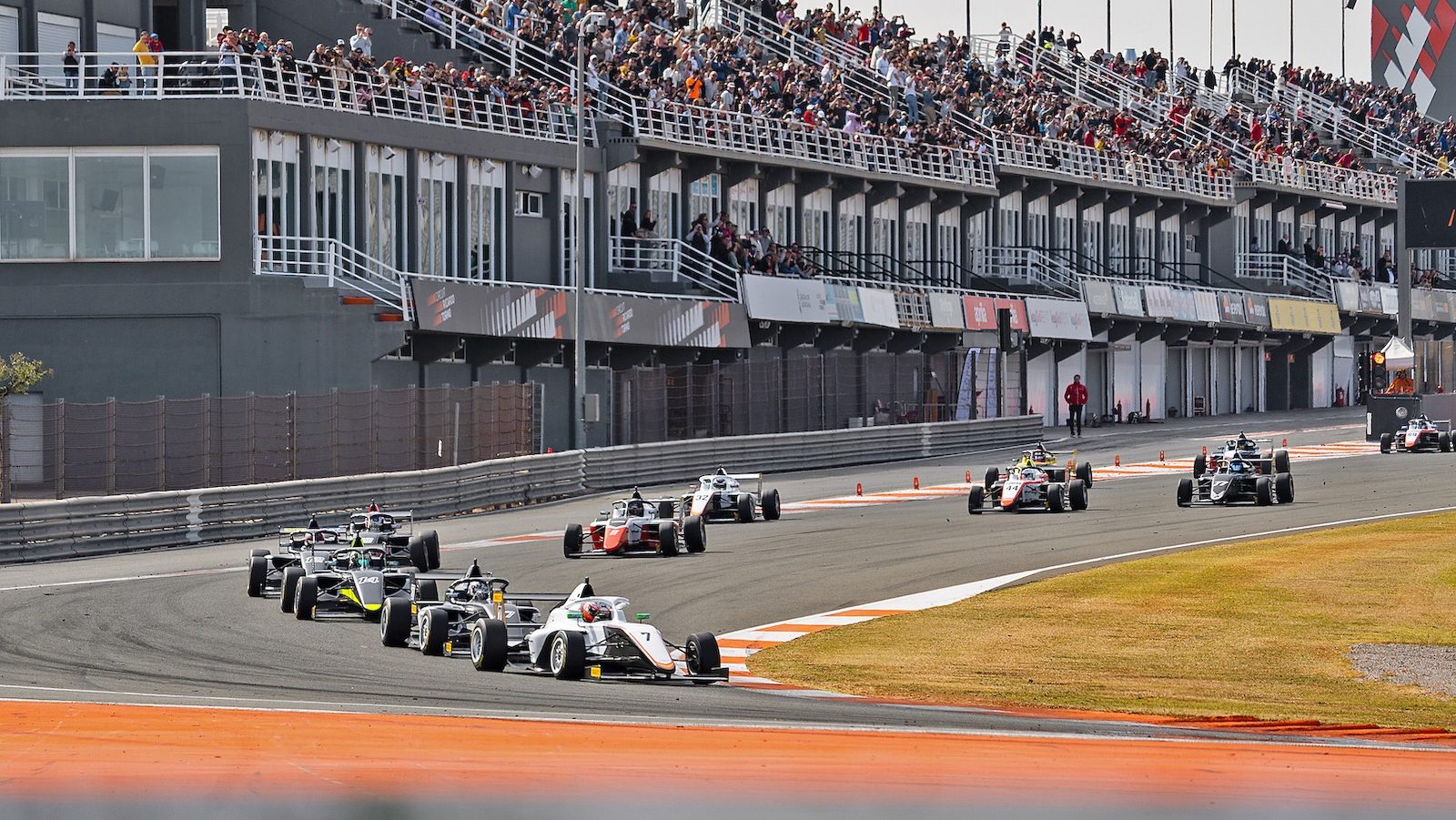
The series had adopted a new format and new rules for 2024. A notable change was that Valencia’s infamous track limits would only be monitored in the two qualifying sessions and three races, not in the two collective test sessions on Thursday or the four Friday practice sessions, officially called “previous tests”.
Nevertheless, the drivers’ briefing on Friday did include discussion about track limits. The presentation at the briefing quoted the text of article 6.4 of the race director’s event notes, which states the following: “Turns 1, 6 and 14 will be reinforced with judges of fact. The track limits penalty at turn 14 will be considered on the current and the immediately following lap”.
Separate rules were in force for the white line at pit exit, located on the outside line just before drivers reach the first corner. A note from race director Luis González published 13 February at 11:30 included the following:
“For safety reasons, cars on the straight approaching turn 1 may not [cross] by any part of the car […] the white line shown below (edge of the track line). There will be a 3 minutes stop and go penalty in the first offence with zero tolerance.
This will apply for qualifying 1 and 2 and races and will be reminded in the drivers’ briefing.
Drivers must respect the same indications for safety reasons during collective and previous test in order to follow the same criteria throughout the meeting.”
Article 2.6 of the race director’s event notes, published Friday at 19:00, reinforced those pit exit policies.
Qualifying 1
Just two minutes into the 20-minute first qualifying session on Saturday morning, chaos began to emerge. A flurry of “relevant laptime disallowed” notifications popped up on live timing, with more than half the drivers affected just five minutes into the session.
By the time the red flag came out with 5:28 to go, 11 drivers had been given the black flag, meaning that they were not permitted to return to the circuit for qualifying. That count increased to 18 moments later even with the session still under red-flag conditions.
All drivers who had not received the black flag rushed out onto the track in the final five minutes and got between three and four laps in. But over those remaining few minutes, they were progressively black flagged until every driver had been disqualified.
FWS organisational coordinator Stefan Lehner confirmed to Feeder Series that black flags were handed out based on the number of track limits violations. Appendix 1 of the Sporting Regulations states that in qualifying sessions, the first three laps featuring at least one track limits violation are deleted, with the third also incurring a warning. The fourth infraction results in the deletion of all times and the issuing of a black flag to the offending driver.
This set of penalties differs from the one used in races, when drivers are given a warning after three individual infractions regardless of lap, a five-second penalty after five, a 10-second penalty after seven and a black flag after nine. Track limits in testing and practice are not monitored.
Post-qualifying negotiations
The response from the paddock after qualifying was immediate – and strong.
Shortly after the session’s conclusion around 10, a meeting with the stewards and all team managers took place. In the meeting, which sources say lasted anywhere from one hour to two and a half hours, several team principals and some technical directors offered suggestions to resolve the dilemma. But achieving a clear resolution proved far harder.
A post from Campos Racing debutant Jan Przyrowski’s X account at 10:25 read, “that qualifying… let’s say was unique!…”
Przyrowski then clarified his first post in a reply 12 minutes later. “The black flag received was due to trespassing the white lane in the braking point of turn 1. We got it after the red flag period. But the lap-time was not improved. So we are on hold for the final results,” the reply read.
Przyrowski’s fastest lap, set on the seventh of 12 laps he completed, would have put him 11th in the classification.
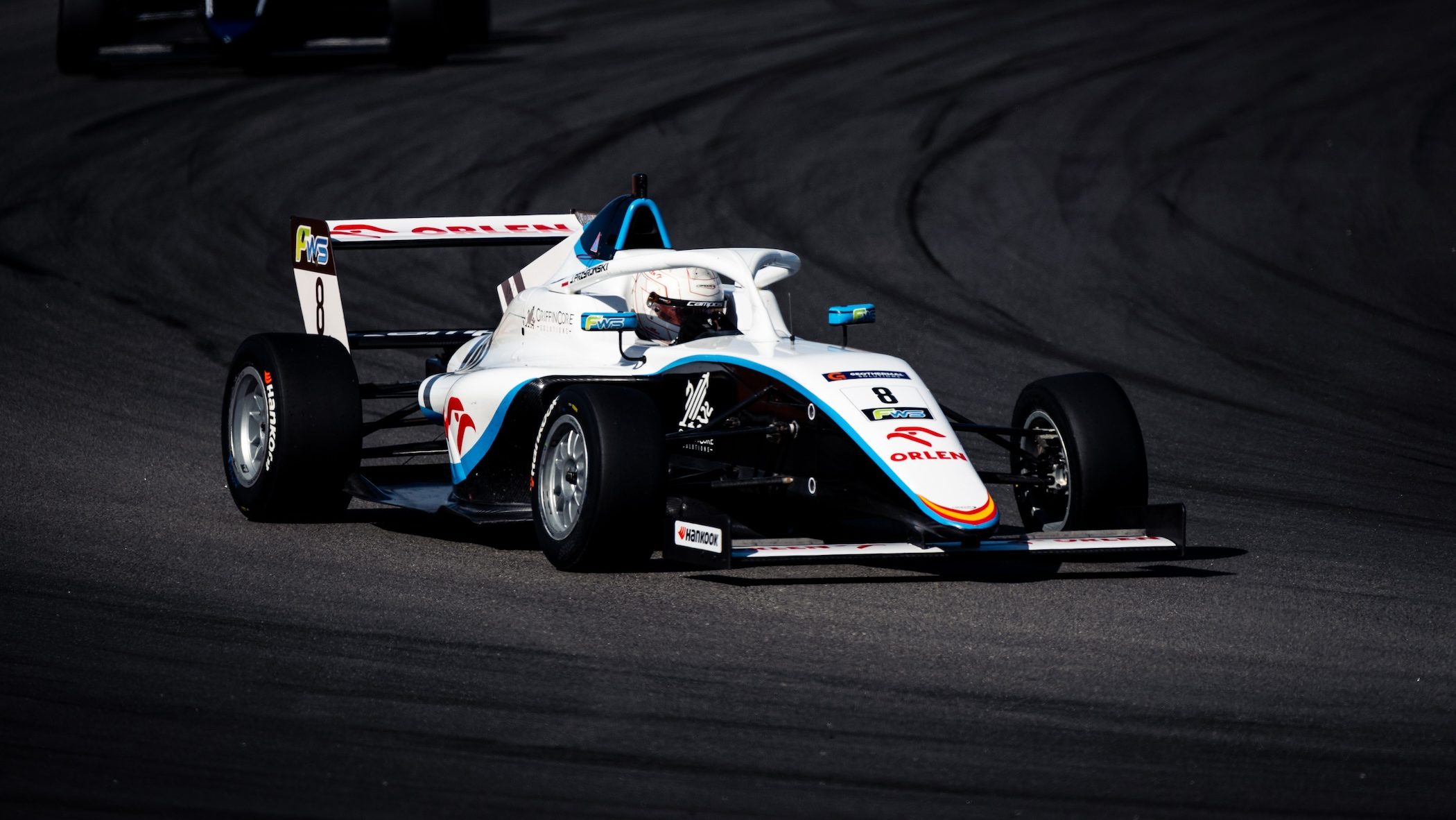
Arnau Viñals, who handles media relations for both Przyrowski and the two-car Tecnicar team, offered updates from on site via his personal X account. At 12:01, he wrote that teams expected qualifying 1 to be redone, a report that had been corroborated by others in the paddock earlier that day.
Then at 12:27, he walked back his earlier words in another update that read, “Official. The 38 drivers of FWS have no oficial [sic] lap. The grid will be used with practice results combined.” Subsequent posts from Przyrowski’s account three minutes later and from Tecnicar’s account four minutes later reaffirmed that the grid would be formed from combined practice results, though an X post from Jenzer Motorsport at 12:42 noted the “cancellation” of the qualifying session and said news about the grid for race one would be “coming soon”.
Official confirmation of a decision from the series or its organisers, however, did not come out until more than an hour later at 13:45, 50 minutes before the first race was due to start and 35 minutes before the beginning of the grid procedure. All drivers were disqualified from Q1 in accordance with article 20.16 of the sporting regulations, which reads as follows:
“Drivers must use the track at all times.
“White lines defining the track edges are considered to be part of it, but kerbs are not.
“A driver will be judged to have left the track if no part of their car remains in contact with it. A driver must not leave the track without a justified reason.
“Should a driver leave the track for any reason, the driver may re-enter, but this may only be done in a safe way and without gaining any advantage.”

To set the new grid, the stewards turned to article 31.4 of the series’ sporting regulations, which states that “if [the first qualifying session] couldn’t be carried out, the Starting Grid of the first race will be made using the combined classification of the official previous tests.” Meanwhile, the starting grid of the second race, which would usually be based on the second fastest lap of the first qualifying session, would be set by the fastest laps from the first race of the weekend, again following the guidelines set forth in article 31.4.
Several teams had grown dissatisfied over the procedural delays as confusion reigned. One source told Feeder Series that in the early stages of the discussions, González was unaware of article 31.4, which exacerbated the nearly four-hour difference between the end of qualifying and the publication of the race one grid. The same source also said another team appealed the final decision to implement the rule and that some teams suggested either redoing the qualifying session entirely or sorting the grid by the number of track limit violations accrued by each driver.
Lehner told Feeder Series that the delays came from checks to see if the qualifying results could in any way be used to form a grid. That plan was abandoned when organisers realised that, according to Lehner, “it was the only possibility to use the times from testing sessions”.
There was one further update from the series at 13:00. A race director’s communication document signed by González was published, reiterating the track limits policies outlined in the event notes albeit with one notable change in wording: the usable track limit once defined as “the track edge white line” and referencing appendix L of the FIA’s International Sporting Code would now be delineated by “the kerb (red and white)”. This update also included a diagram showing the limit of acceptability for track limits.
Race 1
The combined practice results, and thus the race one grid, was published at 14:00, 20 minutes before the grid procedure was to begin. Having set the fastest time across the collective tests, Campos racer Andrés Cárdenas started from pole position.
In a race largely devoid of the track limits violations that had plagued the day’s earlier running, Cárdenas secured his second win of the season ahead of Drivex’s Juan Cota and MP Motorsport’s Griffin Peebles.
The race crucially came to an early end, however, with 4:28 of the scheduled time to go. Campos’ Pacôme Weisenburger and Drivex’s Francisco Macedo had separate off-track excursions and got stuck in gravel traps, bringing out the red flags.
In accordance with article 35.7 of the sporting regulations, the race was not restarted as more than 70% of the originally scheduled time of 30 minutes had elapsed. The article further stipulates that the final classification be taken from the penultimate lap the leader completed before the suspension, meaning that lap 12, not lap 13, would decide the results.
While this development would cause drama later in the weekend, talk in the paddock still remained on the debacle in qualifying. German outfit US Racing were particularly aggrieved; with the qualifying results annulled and the practice results used to set the first race’s grid instead, Akshay Bohra had fallen from pole to fifth, Matheus Ferreira from third to 10th, Kabir Anurag from sixth to 17th, Gianmarco Pradel from ninth to 12th and Maxim Rehm from 12th to 21st. Both Ferreira, who finished the race sixth, and Anurag, who finished 16th, branded the situation a ‘mess’ on Instagram.

In a post on Instagram and Facebook published at 16:53, one and a half hours after the first race ended, US Racing criticised the organisers’ handling of the situation.
“If 38 cars (the whole field) got disqualified in Qualifying something must have been severely wrong,[ ]right?” the post read. “Good experiences and handling of track limits from last years [sic] race director have been ignored before qualifying and have been implemented from race 1 onwards.” The 2023 FWS race director was Werner Aichinger, currently the race director for the GT Winter Series (GTWS).
At 17:01, eight minutes after the publication of the posts, FWS organisers posted a document summoning the US Racing team manager to the race director’s office. The timing raised eyebrows, but a representative from Gedlich Racing later told Feeder Series that there was no relation between US Racing’s social media posts and their summons. The outcome of the meeting was not made public, nor were its contents, and US Racing did not respond to Feeder Series‘ request for comment about it.
Race 2
The grid for the second race was to be set based on the fastest laps from race one. But it wasn’t long before there were disruptions on that front too.
At 10:35, as the starting procedure for the second race was to begin, a notice appeared on live timing that the procedure – and therefore the start of the race itself – had been postponed. No reason was initially given, but the notice came so late that drivers were already seated in their cars and firing up their engines in preparation to drive to the grid.
At 10:56, a new notice appeared, saying that the pit lane for race 2 would open at 12:30 “TBC” [to be confirmed]. The pit lane opening for GTWS at 11:35 was unchanged from its original time, meaning that FWS would instead occupy the time slot originally reserved for a lunch break and pit walk.
Amid confusion in subsequent minutes about what would happen next – including a report on X from Jenzer at 11:00 that race two had been cancelled – the potential cause of the delay emerged.
In a post on X at 11:17, Viñals wrote that the original grid for race two had been formed using laps with track limits violations as well as the annulled final lap of the race. Feeder Series understands that GRS informed the stewards that they erroneously included the lap times from the final lap, which had been invalidated in accordance with article 35.7.
It was the latter explanation that proved true. Fifteen drivers’ times listed on the original grid had in fact been the final ones they set, which did not appear in the lap-by-lap breakdown of race one.
Lehner later confirmed to Feeder Series that the incorrect grid was the reason for the delay and that the erroneous lap inclusions were “due to miscommunication between stewards and timekeeper.”
A new grid using only legal times from the first 12 laps of the race was thus published at 11:36, with the second race’s new start time announced as 12:45. The drivers who lost out with the annulment of the first race’s final lap included Cota, demoted from second to seventh; Oleksandr Savinkov, demoted from 17th to 23rd; Nathan Tye, demoted from 12th to 24th; and Flavio Olivieri, who finished race one a lap down, demoted from 10th to 27th.
An error on the original grid had also listed two-time female trophy winner and McLaren junior Bianca Bustamante 35th rather than 21st after her best time was entered as 2:00.095 rather than 1:35.095. She ultimately started 17th for race two once the grid was adjusted before skipping race three to fly to Jeddah for an F1 Academy test along with GRS teammate Lia Block.
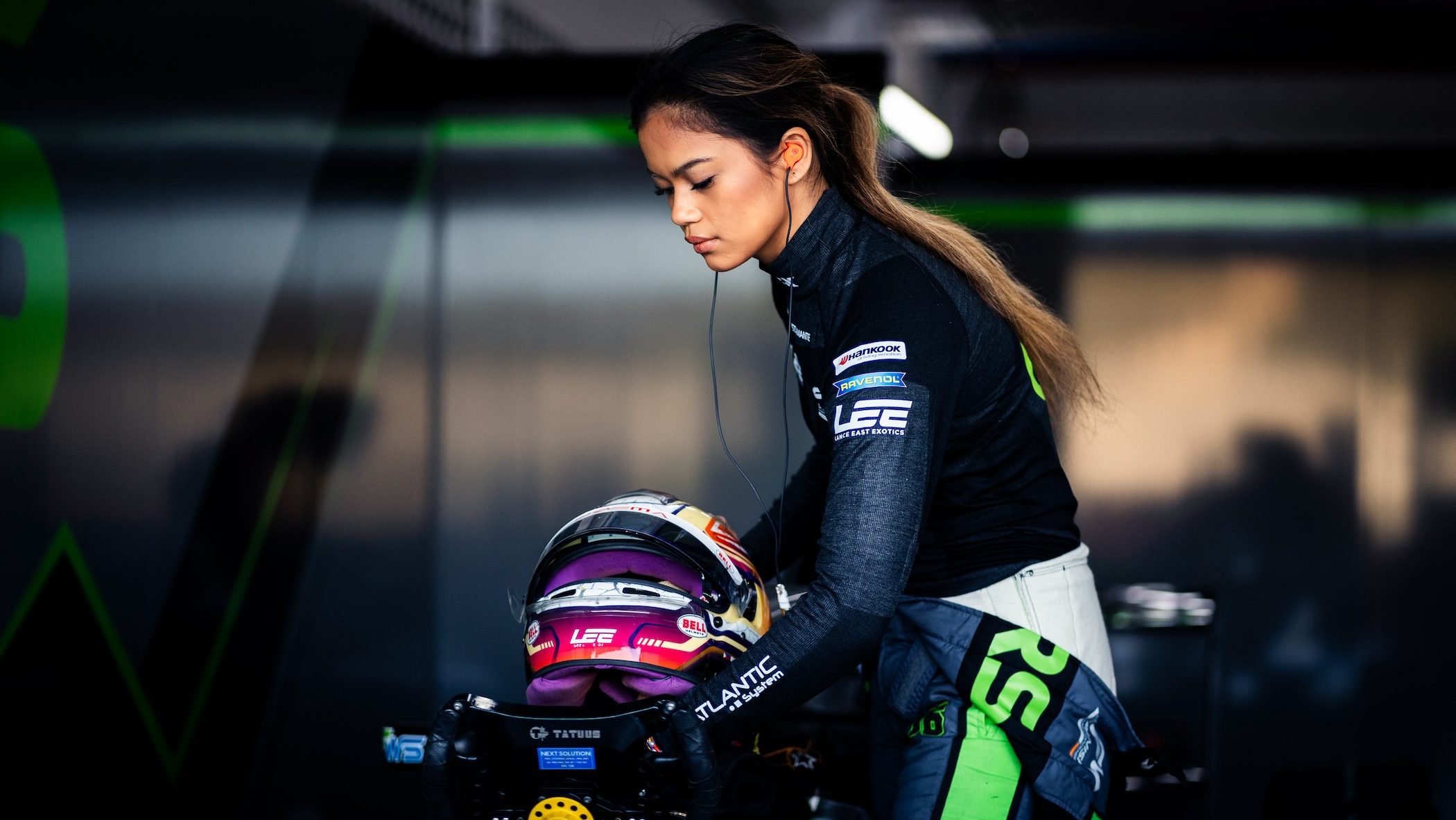
An hour later, the pit lane finally opened at 12:37, per a communication from the race director posted at 12:23. With a new grid that put Peebles on pole ahead of Cárdenas and MP driver Maciej Gładysz, the second race finally got underway at 12:50, two hours after its originally scheduled start time.
The race saw four safety car periods, ending in a one-lap shootout in which Peebles defended his lead from Cárdenas and won by seven-tenths of a second.
Gładysz finished third on the road but was initially demoted to 15th after receiving a five-second penalty for being out of his grid position at the race start. Pradel thus stood on the podium in third, and everyone else behind moved up a place.
The penalty, however, was not recorded in the official documents, and Lehner subsequently confirmed to Feeder Series that a review of the incident using onboard cameras led to the penalty’s cancellation and Gładysz’s reinstatement to third later that afternoon.
Qualifying 2 and Race 3
Before race two, of course, was the second qualifying session at 9:00, which set the grid for race three as originally planned. No driver had more than two lap times deleted across the session, which had one red flag come out with seven minutes to go; only 20 of the session’s 423 total laps were disallowed for track limits infractions.
Cárdenas once again took pole by just one thousandth over Ferreira, while GRS Team driver Douwe Dedecker set a time identical to Przyrowski’s best lap but, pursuant to article 31.2 of the sporting regulations, was classified ahead having set his time first.
That was the presumed order after the session, at least.
One car had a nonfunctional transponder: Peebles, who lay second in the championship behind Cárdenas. The initial qualifying order had put him 38th and last, which would have become 36th on the race three grid with Bustamante and Block’s early departures. Peebles’ car was the second from MP to experience transponder issues; Mattia Colnaghi’s device befell a similar fate in the first qualifying session before the session was nullified and the combined practice times put him 13th.
When an updated version of the qualifying results was published at 14:14, Peebles was suddenly first with a weekend-best 1:32.866, set on his ninth lap of nine. His remaining data from qualifying was never published.
“My transponder didn’t work so there [were] no times,” Peebles wrote in a message to Feeder Series, “but they recovered my laps from their system so it was a secret pole.”
The grid was likewise updated at 14:22 to put Peebles on pole alongside Ferreira. It was an all-new front row; at 11:47, Cárdenas was given a five-place grid drop for overtaking under the red flag during the session, as were his Campos teammates Przyrowski and Tye.
The race began as scheduled at 16:00, and Ferreira beat polesitter Peebles off the line. An early safety car deployed because of a collision on lap one neutralised the field, but Ferreira kept his lead at the restart and held it throughout the race. He led home Peebles and Dedecker, who secured not just his first points finish but also his first podium of the season.
Having faced the prospect of starting last and losing crucial ground in the championship just a few hours earlier, Peebles was now atop the standings on 108 points, tied with Cárdenas, who finished fifth. It was a pivotal result; the two bonus points for pole position gave him what he needed to establish the tie, and having two second places to Cárdenas’ one ensured he could break it.
That there are such fine margins atop the standings at the championship’s halfway point seems apt considering the theme of the weekend. The on-track action proved pivotal as always, but it was the small, oft-overlooked details – whether a driver dipped a wheel over the line, whether a tiny box inside the car recorded data properly, when a driver recorded their fastest race lap – that made for the biggest talking points.

FWS drivers were not the only ones to face challenges with track limits last weekend. The more experienced drivers in the GT4 Winter Series and in GTWS, Gedlich’s flagship championship, also struggled to keep their cars within the limits, which for both series included kerbs beyond the white lines.
Just under one in six race laps in GT4WS and roughly one in ten in GTWS were cancelled. A number of drivers received time penalties for too many violations in each race, with Cup2 class racer Yves Godard in GTWS taking the most extreme post-race penalty of 50 seconds after exceeding track limits on 13 of the 19 laps he completed in race two.
FWS’ rate of lap deletions across green-flag running stabilised at roughly one in eight across the three races. The first two races each had 28 deletions; the third, which had nearly twice as many green-flag laps as the first two races, saw a corresponding increase in deletions to 56. Only one driver earned any kind of post-race penalty: Gładysz, who had five seconds added to his race three finishing time but retired with four laps to go, rendering the penalty moot.
The on- and off-track chaos that dominated the weekend’s headlines was unusual in its scope even for relatively lower-budget F4 series such as FWS. Some will view the series of events as a colossal failure of organisation on the championship’s part, and certain questions about why things transpired the way they did may forever remain unanswered. But the sharp decrease in violations following the first qualifying session shows that the full field’s disqualification fulfilled its purpose, however didactic it may have been.
For the two-thirds of the grid classified as rookies, the saga offered a harsh warning about the added care that open-wheel racing demands. Those returning to Valencia in September for Spanish F4’s fifth round will prove whether the lessons from last weekend have truly been learned.
Header photo credit: Daniel Bürgin
Make a one-time donation
Make a monthly donation
Make a yearly donation
Choose an amount
Or enter a custom amount
Your contribution is appreciated.
Your contribution is appreciated.
Your contribution is appreciated.
DonateDonate monthlyDonate yearly Feeder Series
That was certainly an excellent writeup on a crazy, chaotic weekend.
LikeLike