

Feeder Series’ former F3 editor argues that Nikola Tsolov’s three-place grid penalty for his collision with Alex Dunne in the F3 practice session in Melbourne is an overly lenient one with worrying implications for driving standards across junior single-seaters.
By Michael McClure
Editor’s note: The opinions presented in this article are those of the author alone and should not be taken to represent the opinions of Feeder Series or its other staff members.
You have probably seen the incident by now: A Formula 3 driver, upset about having been impeded while on a fast lap during a practice session, swerves into his rival’s path upon passing him and sends him hurtling into the wall at speeds in excess of 100 miles per hour. The session ends early under red flag conditions, and in an interview a few minutes later, the driver responsible for the crash denies that the manoeuvre or the resulting incident were deliberate.
What exactly transpired in Nikola Tsolov’s head in the roughly five seconds between when he encountered a weaving Alex Dunne ahead of him exiting Turn 10 of Australia’s Albert Park Circuit and when the pair touched wheels will likely remain a mystery. The matter of more pertinent concern is the response thereto by the event stewards, who apparently felt that the tangible consequence of a three-place grid drop for the following day’s 30-car, roughly 35-minute race and the intangible consequence of two penalty points on the 17-year-old’s racing record would suffice as punishment for his actions.
As a metric of comparison, offences in F3 last year that received the same set of penalties included Mari Boya’s impeding of Zak O’Sullivan in qualifying in Monaco, Grégoire Saucy’s ignoring of yellow flags in the other part of that same session, and Christian Mansell’s crossing of the white line at pit entry during qualifying in Spielberg. Dangerous though these errors may have been, none showed quite the visible level of disregard for fundamental racing standards as Tsolov’s manoeuvre did.
Many online have called for Tsolov to sit out the weekend’s racing or worse. Such harsh penalties have been dished out before. In 2022, three F2 drivers received one-weekend bans for accumulating 12 penalty points before the end of that season. Just last year, an F4 US driver was banned from the final race of a weekend and the entirety of the next one for a bump-drafting manoeuvre gone wrong. In 2015, Dan Ticktum was famously suspended from racing for a year for overtaking 10 cars to crash into rival Ricky Collard under safety car conditions in a British F4 race.
Few individuals, not even the drivers responsible, argued with the severity of those punishments. Considering the offences were not repeated, the harsh penalties seemed to have served their purpose. One wonders whether the lenient logic used by the Melbourne F3 stewards would have yielded the same result.
Why take that risk?

To be sure, it often takes two to tango in such an incident, as shown by Dunne’s receiving a reprimand for initially impeding Tsolov. The stewards’ documents say the 18-year-old MP Motorsport driver was “unaware” and “not actively looking in his mirrors” while weaving on the track – a “lapse” for which he apologised. ART Grand Prix driver Tsolov, meanwhile, “wanted [Dunne] to be aware of his presence and that he was being impeded”, per the document. To do so, he “deviated from his normal racing line to drive close to Car 9 [Dunne] to highlight his presence”. This move was, according to the stewards, “unfortunately misjudged”.
The collision may indeed have been unintentional, but his choice to “highlight his presence” evidently wasn’t. Tsolov had already slowed to avoid ploughing into the back of Dunne; there was nothing preventing the Bulgarian driver from passing his rival perfectly calmly, continuing with his lap, and seeking him out for a conversation in the paddock afterwards. That the stewards justify what happened with such doublespeak as “the actions of Car 25 [Tsolov] were unintended” shows the frightening lack of cogency in their decision.
They instead direct their didacticism towards Dunne, who is told in a separate decision that he “unnecessarily impeded Car 25 and potentially may have affected his lap” and must “exercise better judgement and awareness” going forward. Most concerningly, they say the “actions of Car 9 led to the following collision and retirement of his car”. There is no acknowledgement therein of the retaliatory motivations of Tsolov’s initial manoeuvre, which, because of its poor execution, was what ultimately put Dunne’s car into the wall.
The lesson the decisions and their language teaches is that you can put your rivals in danger if you’re angry and that you deserve a harsher penalty if your clumsiness provokes another. The insidious precedent this logic sets is that drivers can put their rivals’ lives at risk and walk away with only a few places lost on the next race’s grid and a sixth of the penalty points they would need for a race ban.
The oft-cited example of Sebastian Vettel’s swerve under safety car conditions into Lewis Hamilton at the 2017 Azerbaijan Grand Prix earned the Ferrari driver a 10-second stop-and-go penalty and a visit to Paris for an FIA hearing two weeks later. There, the governing body of motorsport said it was “deeply concerned by the wider implications of the incident, firstly through the impact such behaviour may have on fans and young competitors worldwide and secondly due to the damage such behaviour may cause to the FIA’s image and reputation of the sport”. The harm his rashness caused was swiftly and clearly acknowledged.
Vettel is an F1 great, a four-time champion seen as a standard-bearer in the sport, but the incident nonetheless sullied his reputation. For a driver on the ladder still aspiring to similarly glittering accolades – even one like Tsolov with the backing of the Alpine F1 Team and a Spanish F4 title under his belt – the impact of such an error is far greater.
One could argue that the ignominy of being the driver who swerved into his rival during F3 practice is punishment enough for Tsolov and that, by handing him only a grid penalty rather than some sort of suspension, the stewards are allowing him to recover some amount of goodwill on track. But Tsolov could do exactly the same without having endangered his rival, and a three-place grid penalty theoretically does little to deter Tsolov from repeating his actions the very next day. Where is the learning in that?
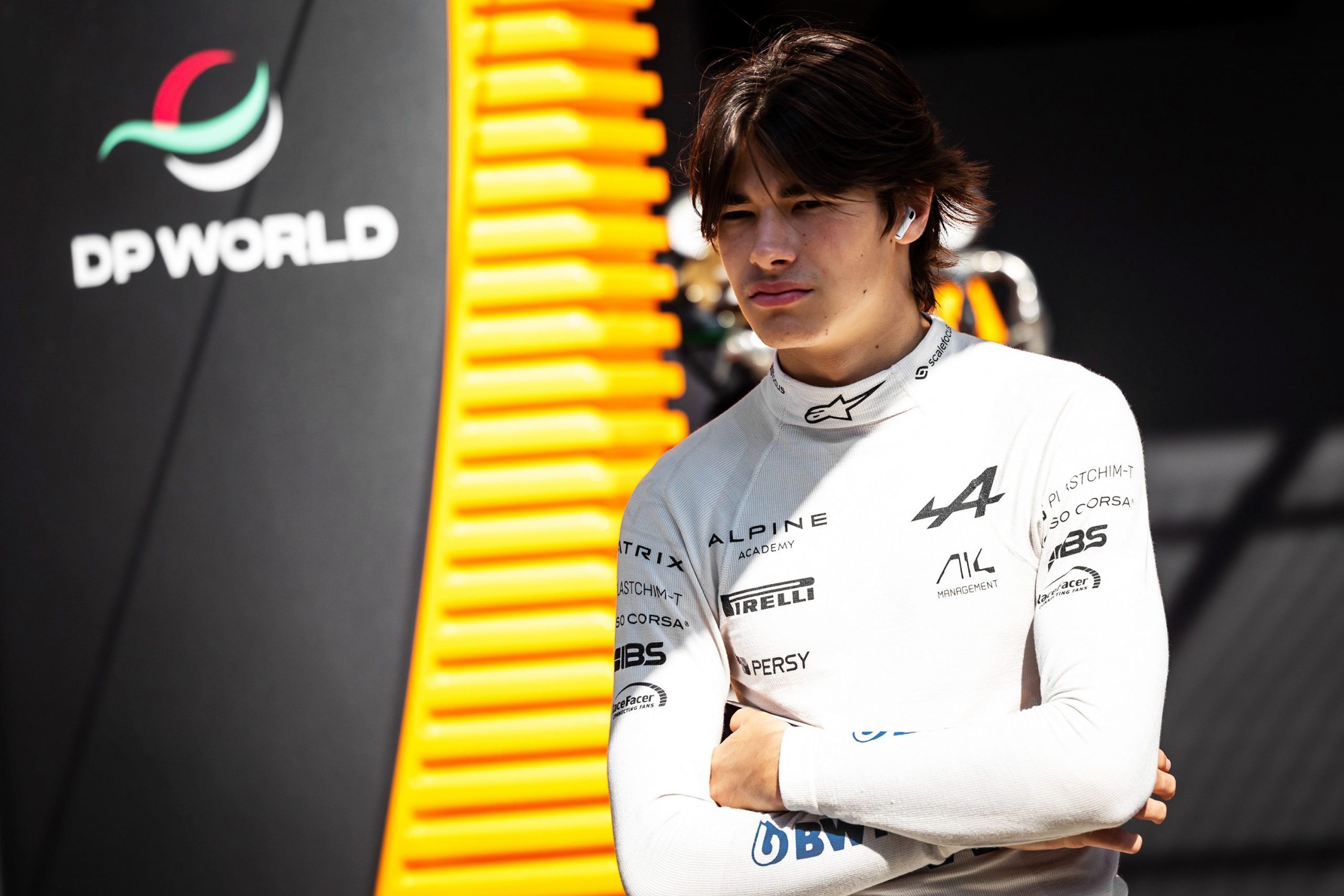
The F3 grid, like most junior single-seater series, is composed of young people in their teens and early twenties. They’re a lot like you and me except that they learn and demonstrate the fundamental principles of good behaviour – respect, honesty, responsibility – in junior single-seater paddocks rather than classrooms and offices. We can question Tsolov all we want for his apparent failure to demonstrate such values in the heat of the moment, but he should be encouraged to learn them now, even if the lessons must come the hard way. The stewards’ verdict does not do so; it tacitly encourages argumentative recklessness rather than respectful mediation of conflict.
And amid the stewards’ flippant attitude towards unsportsmanlike conduct, lest we forget another fact: motorsport is dangerous. Even with vastly improved safety standards in junior single-seaters and elsewhere, injury and tragedy can still happen, as shown most recently by the death of Dilano van ’t Hoff, whom Tsolov succeeded as Spanish F4 champion in 2022, in a Formula Regional race last July.
Those are the darkest days in racing. We who are in the sport weather them because we believe in motorsport’s ability to showcase dazzling skill and bravery, not because we wish to relive them. Regardless of what caused Tsolov’s manoeuvre – a burst of white-hot adolescent anger, a desire to enact justice with a jerk of the steering wheel, a genuine misjudgement with costly consequences – it was deeply dangerous, a fact the F3 stewards failed to acknowledge appropriately. Instead, they endorsed and embodied cowardice.
If they cannot hold their own properly accountable, who will?
Header photo credit: Dutch Photo Agency
Make a one-time donation
Make a monthly donation
Make a yearly donation
Choose an amount
Or enter a custom amount
Your contribution is appreciated.
Your contribution is appreciated.
Your contribution is appreciated.
DonateDonate monthlyDonate yearly Feeder Series