
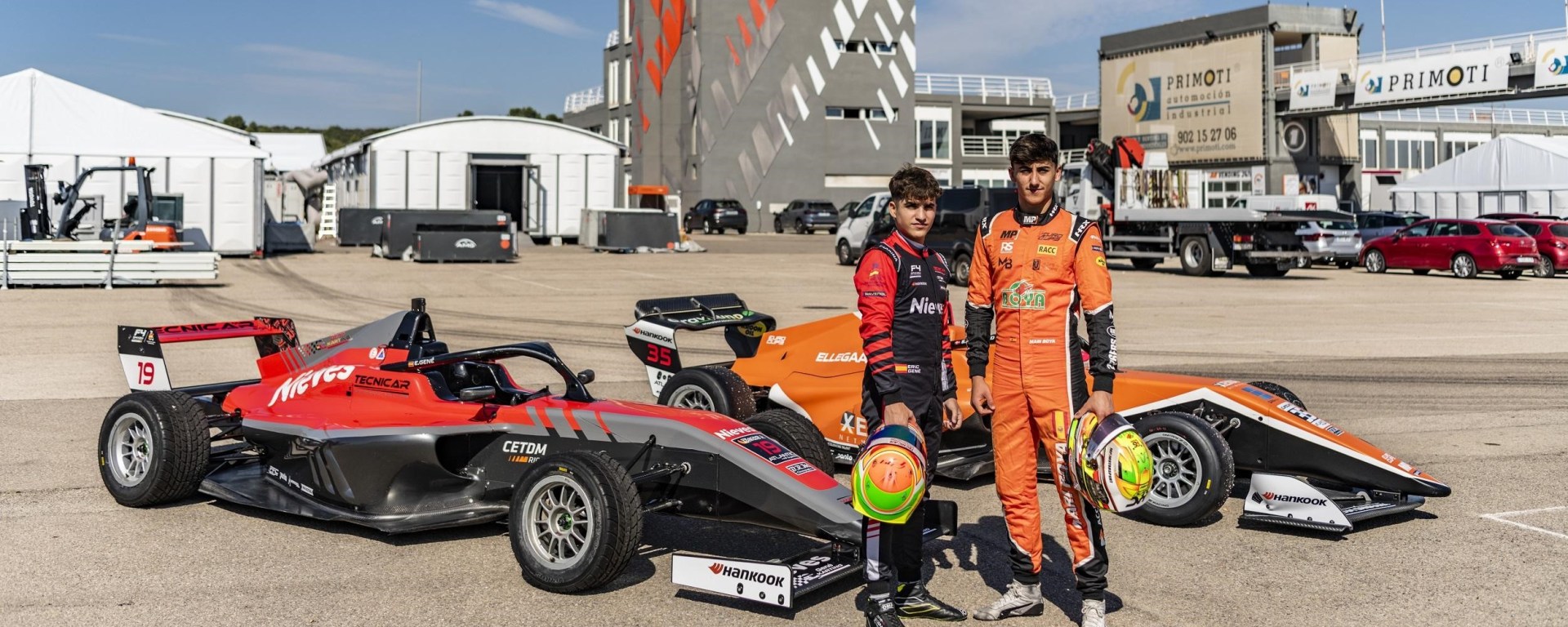
Eurocup-3 is quietly shaking up the Formula Regional market, but exactly how successful has the series been since its inauguration?
By Juan Arroyo
The level between Formula 4 and Formula 3 is a complicated one these days.
Between the Formula Regional European Championship, Euroformula Open and GB3, there are a lot of championships for drivers to consider.
FRECA is the preferred option in Europe, with grids of 30 cars almost every other weekend. It is also the FIA’s preferred choice. But its use of the Tatuus F3 T318, a car known for its heavy handling and sensitivity to dirty air, sparks occasional criticism of the series.
Euroformula Open, despite all the praise hurled towards its Dallara 320 chassis, has not seen a grid larger than 12 cars since 2021. A number of Formula Regional and F3 drivers test Euroformula cars every year, but full or even part-time campaigns almost never come to fruition.
A full Euroformula Open season is said to be even more expensive than the average FRECA seat. For most, the deal simply isn’t worth it.
There is always the option of skipping this tier entirely, but it’s rarely a risk worth taking. Few teenage drivers are equipped to deal with the sudden increase in attention, pressure and competition level.
Many will remember Nikola Tsolov’s Spanish F4 campaign as one of the most dominant in series history and how only a year later, the Bulgarian driver was floating around the lower midfield spots in F3.
Spanish F4 organisers – along with four participating teams – created Eurocup-3 in late 2022 to bridge this gap at a low cost. The series is a new rival to FRECA and Euroformula Open in the FRegional tier, using a lighter, improved version of the Tatuus F3 T318 and adopting a few of GB3’s most successful qualities.
Last year, Eurocup-3 averaged around 15 entries per round and achieved its goal of attracting several F3 drivers. It also convinced Álex Palou enough to enter his new eponymous racing team prior to the season, while French outfit Saintéloc Racing stays on for 2024 and adds multiple cars after running a partial season last year.
While the organisers are yet to define their metrics for success for Eurocup-3, a long-term objective will undoubtedly be to have an established path to F3 from Spain. This would lead to additional entries in Spanish F4 and the subsequent growth of Eurocup-3 through the lower series’ graduates.
There is already evidence of this plan working as the series enters its second season.
However, the fact that the series’ drivers receive no Super Licence points is a pertinent issue for its short and medium-term success. The series has not received full FIA certification, meaning no Super Licence points can be allocated as of yet. This is a major hurdle to clear if it realistically wants to attract F3 drivers or major talent from Spanish F4.
In many ways, Eurocup-3’s birth is a reflection of Spain’s ongoing commitment to growing its racing scene.
It took four teams with long-standing ties to Spanish motorsport to come up with the idea for the series: MP Motorsport, Drivex, GRS Team and Campos Racing.
MP and Drivex have competed in every Spanish F4 season since its inauguration in 2016. GRS (or Global Racing Services) joined in 2018. Campos Racing, Spain’s largest junior series team – and one of Europe’s most emblematic – began fielding cars in the series in 2021.
Their goal was clear from the start: to create a low-cost alternative to the European championships that could push F4 graduates into F3.
The formal announcement of the series came in late 2022, at the Spanish F4 finale in Barcelona. It came with the promise of a Tatuus F3 T318 made for overtaking and an eight-round season featuring four Spanish circuits and four international circuits.
Eurocup-3 was received by some as a Spanish version of England’s GB3 Championship, and in some ways, it is. Both series have visits scheduled to international circuits, support from to a lower series and plans to move up drivers within a national ladder.
Series organisers have made little effort to dispel this notion. Interestingly, even though GB3 is oriented mostly towards attracting British drivers and teams, Eurocup-3 organisers still consider it just as much part of the Formula Regional ecosystem.
“We created the championship with the competition from FRECA, EFO, et cetera, but FRECA still has over 30 cars. It is a very similar grid compared to what they had last year. EFO has 10 cars, which is more than on some of last year’s rounds, and GB3 is still having a strong grid,” Spanish F4 and Eurocup-3 coordinator Álvaro Martínez de Tejada told Feeder Series in May 2023. Martínez de Tejada left his role in January 2024.
“We just covered a space of the market. We are not competitors. We are completing each other because each championship has its positive points and its not-so-positive points.”

Palou, an IndyCar champion and Spanish national, was attracted enough by the prospect of the championship. Together with his former management company, Monaco Increase Management, and his father, Ramón Palou, he created the Palou Motorsport outfit ahead of Eurocup-3’s inaugural season.
The opening round of that season attracted fifteen drivers, including F3 driver Mari Boya. A last-minute addition to the Spa-Francorchamps entry list, Boya announced he would compete in the rest of the season, barring clashes with his F3 commitments.
Martínez de Tejada said attracting F3 drivers for dual campaigns had been one of his goals all along. The calendar was specifically designed to minimise clashes, which meant Boya only had to miss one Eurocup-3 round out of eight. F3 driver Nikola Tsolov also made two appearances with GRS.
The number of entries hovered between 15 and 17 cars across the season, a healthy number for a series in its debut year. Eleven drivers in total took part in all eight rounds.
“For an inaugural season, I think it was quite impressive. I wasn’t expecting it to be as good. There were many excellent drivers, it was really good,” José Garfias, who took part in all eight rounds, previously told Feeder Series.
“From what I heard, it’s going to be even better next season. Apparently, there will be a couple of new teams, more cars, etc. It would be great to see a 20–25-car grid. My respect for the Spanish Federation, I think they did great.”
Relative to the organisers’ original goals, Eurocup-3’s debut season was a success.
Every full-time team except MP Motorsport added part-time drivers across the season. Some of them, such as Georgy Zhurasvkiy, will stay on for the full 2024 season. Saintéloc Racing, which also races in Spanish F4, joined from the fifth round onwards and will continue in the series in 2024.
As a bonus for the organisers, Tasanapol Inthraphuvasak, who finished sixth in the series 2023, graduated to F3 this year with PHM Racing – the first driver to make the move up.
Eurocup-3 runs under the FIA’s Formula Regional regulations, using a lighter, modified version of the Tatuus F3 T318. The car features an aero package more akin to the ones produced in Formula 1 since 2022.
The inspiration from those technical regulations is noticeable in the wings and side pods. The front wing endplates are raised higher and curve back at the top. The rear wing’s shape is curved and designed to produce maximum downforce and minimise drag. Just like F1’s new regulations, these changes were made to make overtaking easier during a race.

Pierre-Louis Chovet was called to test the modified Tatuus before the start of last season. Chovet raced in European Formula Regional series in 2020 and 2022, entering 29 races in total.
“It may depend on the tracks, but the car is much lighter and gives much more drag in the straights, so it helps overtaking even without push-to-pass,” Chovet previously told Feeder Series. “What is even more surprising is that despite giving all this drag, there isn’t much dirty air in the technical parts of the track, so we can follow each other.”
According to Tatuus, the Eurocup-3 car is a preview of what the FRECA car may look like post-2025, when the manufacturer plans to introduce the Formula Regional Gen2.
Alpine introduced a push-to-pass system in FRECA ahead of the 2022 season to address concerns about the lack of overtaking on display. Even with that, the regular Tatuus F3 T318 remains difficult to handle in high-speed corners and very sensitive to dirty air, but that may cease to be the case next year when the Gen2 car hits the track.
It’s a pro Eurocup-3 will have to make up elsewhere from next season, when that advantage is possibly nullified.
“It really looks like a little Formula 1 car, especially on the side pods and on the wings. I think all other feeder series will be looking like this in a few years,” Chovet said of the Eurocup-3 car.
To level the playing field, Eurocup-3 allows a maximum of 12 days of testing outside of event weekends. Even those who could pay for extensive private testing in theory earn little benefit.
Maintaining parity has been an evident priority in the series, with all five teams agreeing to run on a fixed price per seat of €450,000 (roughly £384,000).
“[The price] is one of the main assets of the championship because in other ones, there is a huge difference in budgets between bigger and smaller teams. We don’t want to have that in Eurocup-3,” Martinez de Tejada told Feeder Series in November 2022.
For comparison, a seat at a front-running team in FRECA will run a driver around €1,000,000 for a full season, while the cheapest, backmarker seats will cost somewhere in the region of €350,000.
FRECA has not become a hard sell by any means, and the 2024 grid once again appears set for more than 30 drivers. But competitive prices elsewhere are bound to make drivers think twice about where they choose to race.
As reported by Feeder Series last month, British team Arden left the series, electing to focus on GB3 and GB4 this year, while Monolite Racing’s campaign is also reportedly in danger.
Monolite was in advanced talks with Valentin Kluss for a 2024 seat before he opted for Eurocup-3. The German driver even ran with the team at the final FRECA round as a one-off appearance. The Italian outfit has not announced a driver for 2024 in the five months since.

The same money that gets drivers into a backmarker or mid-pack team in other series could make them frontrunners in Eurocup-3, but that is far from a guarantee outside of MP Motorsport and Campos Racing. The rest of the teams have catching up to do if they want to attract drivers outside of Spanish F4.
MP and Campos won every single race between them last season, while drivers from the rest of the teams struggled to grab the occasional podium. Eight of the top ten in the final drivers’ standings raced for these two outfits, evidence of their dominance over the rest.
Palou Motorsport reportedly chose to enter Eurocup-3 over Spanish F4 as it was a new championship and thus the team was more likely to be competitive from the jump. The team took three podiums, but the gap in performance was evident. It is a harsh warning for other European teams considering entering under the same line of thinking.
The fact that this was Palou’s debut season – not just in the series but as a team entirely – has to be taken into account. The same could be said for the likes of Saintéloc and GRS Team, which had not competed in the FRegional tier prior to 2023.
These teams and others have genuine potential to become strong outfits in Eurocup-3. Théophile Naël became Spanish F4 champion with Saintéloc in the team’s sophomore year in F4. GRS achieved multiple podiums thanks to Han Cenyu and Nikola Tsolov’s appearances. Palou Motorsport, in its first year as a team, also made it into the top three multiple times.
It is in their hands to make a seat in the series attractive – at least outside of MP and Campos.
One of Eurocup-3’s core goals is to promote drivers from Spanish F4. Not only does this help its teams see more revenue from drivers that would otherwise head to FRECA, but it also helps the organisers establish a direct path to F3 from their own series.
Spanish F4 runner-up Christian Ho is switching to Eurocup-3 with Campos Racing for the upcoming season, as is Noah Lisle of Australia. Luciano Morano, Theodor Jensen and Georgy Zhuravskiy are mirroring the move but with different teams. Spanish F4 should, and likely will, become Eurocup-3’s direct source for entries.
Outside of Spain, the series could begin to attract some more F3 drivers part-time, drivers who want to spend less after competing in FRECA, and – possibly but less likely – drivers from other F4 series.
If the model so far sounds familiar, remember that GB3 operates almost exactly the same way. They are country-specific FRegional championships meant to boost their own ladder, rather than compete with the continental series. Eurocup-3 will not replace FRECA or Euroformula Open by any means, nor is that its goal.
Instead, it will serve as a boost to Spain’s racing scene and seek to capitalise on Spanish F4’s recent growth, which has seen it nearly double its average grid size since 2018.
It was only last month that GB3 was finally allocated Super Licence points after years of exporting highly capable talent across Europe. How long will it take for Eurocup-3 to do the same?
If GB3 continues to add more drivers from outside GB4 and British F4, the Spain-based series could be on for the same growth given full FIA certification.
Header photo credit: RFEDA
Make a one-time donation
Make a monthly donation
Make a yearly donation
Choose an amount
Or enter a custom amount
Your contribution is appreciated.
Your contribution is appreciated.
Your contribution is appreciated.
DonateDonate monthlyDonate yearly Feeder Series
One thought on “A year in, where does Eurocup-3 stand among its rival series?”