
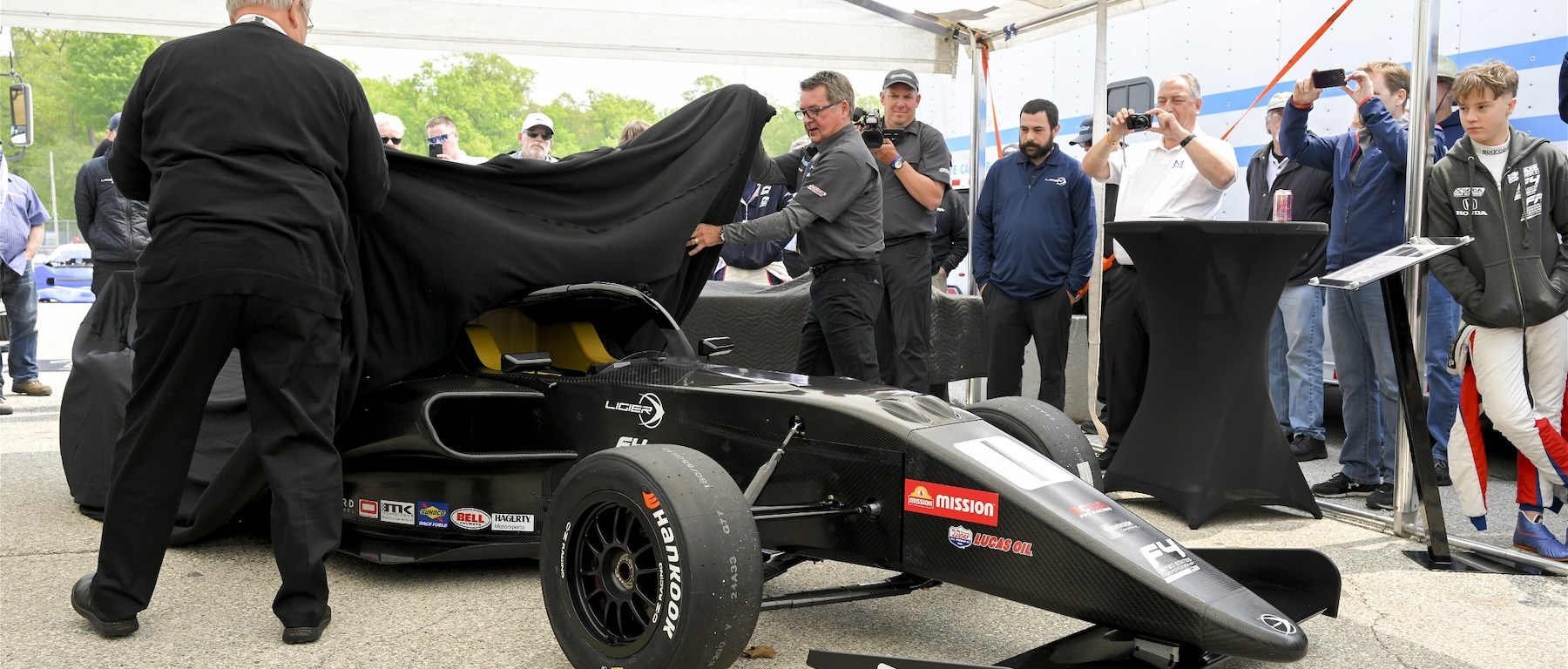
The Formula 4 United States Championship was initially slated to kick off alongside FR Americas and Ligier JS F4 at NOLA Motorsports Park on 11 April, but the start of the championship – and the debut of its new Ligier JS F422 chassis – was quietly rescheduled to 16 May at Road America. This shift, coupled with just eight confirmed drivers thus far, signals a concerning trend for F4 US. Feeder Series analyses what has happened to the once-promising American championship.
By Laura Anequini
A representative from the series told Feeder Series that Ligier delayed the delivery of the new cars for undisclosed reasons. A similar situation unfolded in 2016, the first year of the championship, when the series’ first two rounds had to be delayed because of an insufficient supply of chassis.
Charitably, the five-week delay this year gives teams and drivers a bigger window to secure funding and solidify their plans as well as the championship time to ensure the new cars are appropriately prepared. But the mere presence of a delay suggests deeper infrastructural issues at play.
F4 US: A brief history
F4 US was launched in 2016, the third year of the F4 level, through a collaboration between the Sports Car Club of America (SCCA) and the FIA.
To save costs, the championship placed a focus on domestic suppliers. The car’s engine, the same one that powers the Honda Civic Type R road car, is manufactured in Ohio; the series’ Hankook tyres are distributed from the Hankook America headquartersin Nashville; and the chassis from Ligier Automotive are produced in the North Carolina locale of Denver, a suburb of Charlotte.
In 2020, Parella Motorsports Holdings (PMH) acquired the commercial rights of both F4 US and FR Americas. The company, created by telecommunications executive Tony Parella in 2012, already had a portfolio that included ownership of the Sportscar Vintage Racing Association (SVRA) and the TransAm Series. Following the acquisition, F4 US finished the 2020 season under SCCA Pro Racing and started 2021 under the wings of PMH.
The deal was advertised as a way to expand the championship by increasing the number of competitors, teams and sponsors, and it was thought that Parella’s industry connections and the success of SVRA and TransAm would boost the series’ reputation.
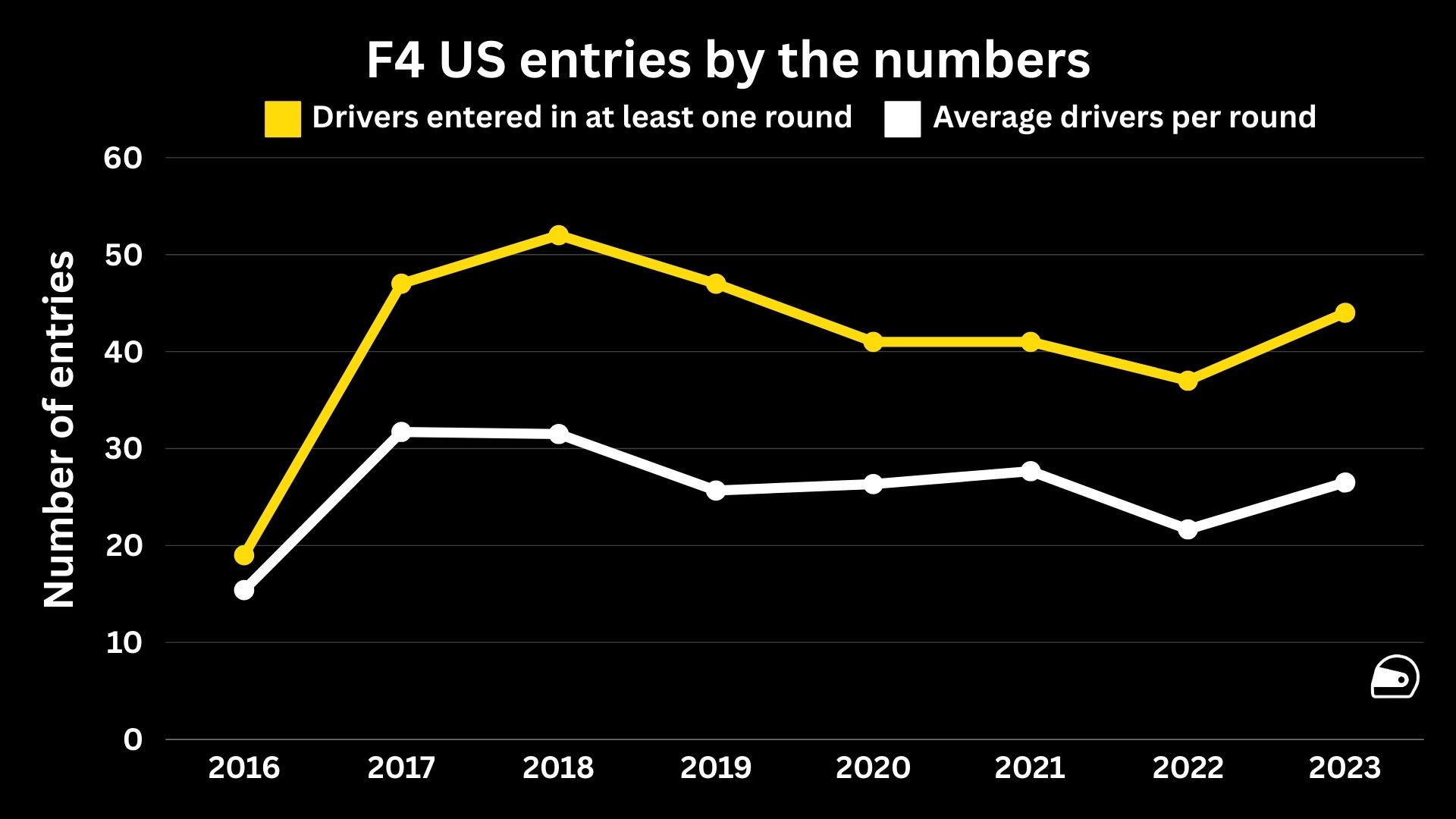
For a while, it seemed everything continued to work well. The number of drivers, for example, was relatively steady throughout the years even while, as Feeder Series understands, series organisers faced financial difficulties behind the scenes.
It was announced in December 2023 that private equity firm Velocity Capital Management had acquired PMH. Velocity had previously invested in companies within the sports, media and entertainment sectors, most notably the X Games action sports competition. Parella, 64, remains CEO.
Although the acquisition seems promising, F4 US still faces two big challenges that threaten to undermine its future: the introduction of the new Ligier chassis and the launch of rival series USF Juniors. The once-promising trajectory of the championship now faces uncertainty.
Competition from within: Ligier JS F4
In May 2022, F4 US announced that from 2024 onwards, the championship would use the Ligier JS F422 car. The new model had the technical features necessary for the championship to continue to be homologated by the FIA, such as the halo and reinforced protective structures on the front, rear and sides of the car. In addition, differently from the Ligier JS F4 previously used, the car’s engine would be provided by Ligier instead of Honda.
The decision to change vehicles has been met with a shocking price increase. The new model, priced at $114,800, is significantly costlier than the old one, valued around $65,000,placing a substantial financial burden on entrants. This escalation in costs has caught many teams and drivers off guard and kept some out of the series entirely.
In response to changes made in F4 US, PMH launched a new championship on the SCCA bill to repurpose the first-generation F4 US cars. Fourteen drivers participated in the first round of the Ligier JS F4 Series, the successor to Formula Development.
The contrast in costs between the Ligier JS F4 Series – priced in the range of $150,000 to $200,000 – and F4 US in 2024 is stark. This year, the season-long operational budget for F4 US is around $250,000, which can be even higher if the driver chooses to run additional testing.

The creation of JS F4 by F4 US’ own organizer poses an existential threat to F4 US since it creates a direct competition for participants. Only eight drivers are set to race in F4 US this season, a far cry from the 20-some entries that populated entry lists in previous years.
A representative from Atlantic Racing, for example, told Feeder Series that the team’s driver, Daniel Quimby, would join F4 US but would participate in JS F4 at first because there were not enough second-generation F4 cars for points to be awarded. Quimby will switch to F4 US beginning with Road America.
Not all drivers appear set to do so.
In February, Florida-based International Motorsport announced that Uruguayan racer Maite Cáceres, who raced in F1 Academy last year, would join the team for an F4 US campaign. But in actuality, she is racing in Ligier JS F4, continuing with a car she used in four rounds of the 2022 F4 US season and concurrently in the Homestead-based Formula Fara series.
Competition from outside: USF Juniors
The challenges experienced by F4 US reflect a broader trend across the Americas. Unlike the European landscape, the American racing scene is not adapted to the more expensive F4 series as some regions lacks the necessary support and regulatory frameworks to sustain F4 racing at the European level. The limited success of European-style F4 series on the continent, such as the short-lived F4 Argentina, reflects the incompatibility between the motorsport industry in the region and the pressures of the industry worldwide.
Series that are independent from the FIA are not beholden to the current standards required for F4 cars, including the safety upgrades. They also permit drivers younger than 15 to compete, as has happened in both JS F4 and Formula Development.
JS F4’s successful launch shows that in the Americas – as in Scandinavia, where the unsanctioned Nordic 4 has replaced Danish F4 – FIA oversight is not indispensable. The difference is fundamentally a trade-off between lower costs and more stringent standards and regulations, and many in the American racing scene are evidently prioritising the former.
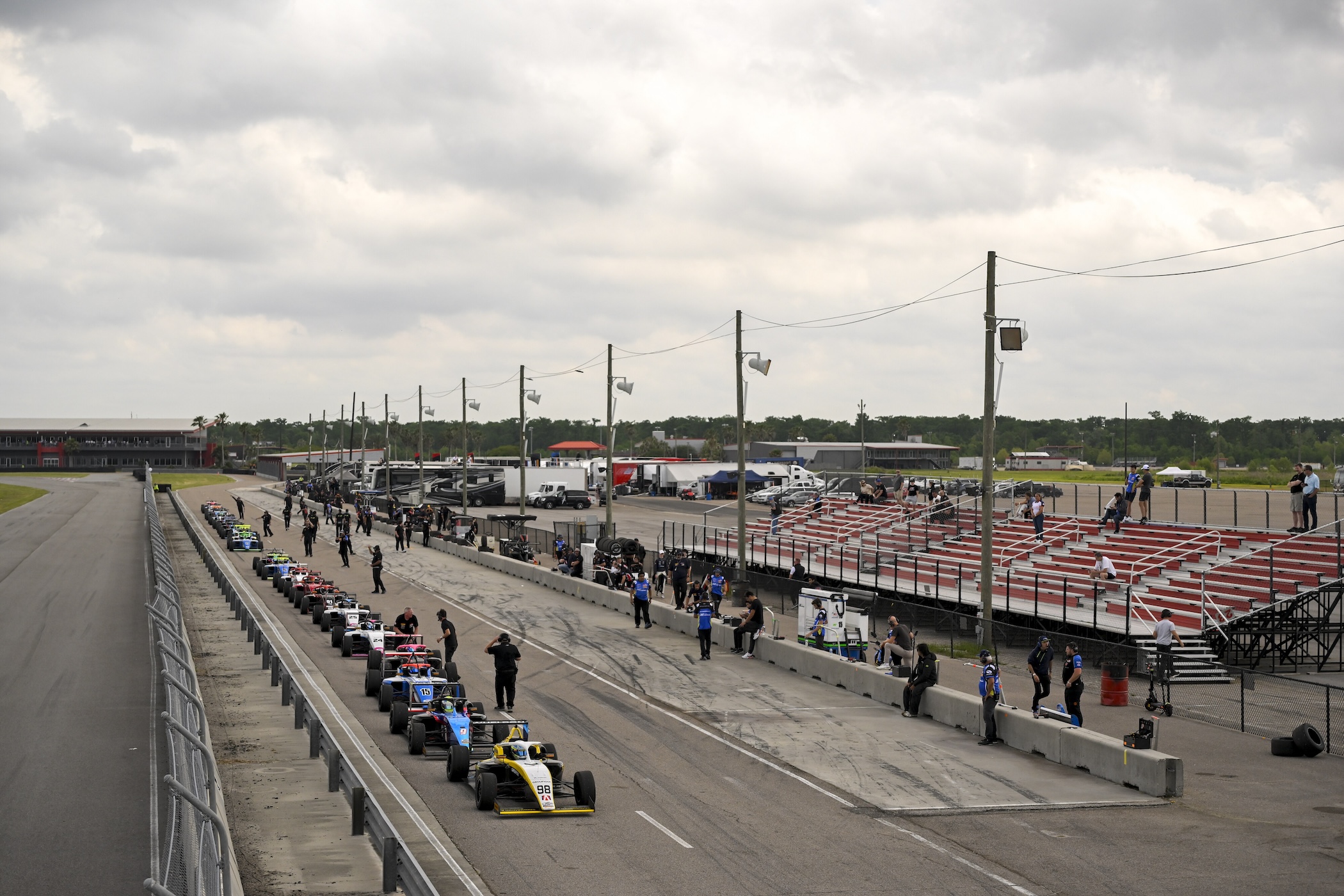
As racing series such as IndyCar grow in popularity, more and more drivers are turning to the Americas. However, rather than trickling down to F4 US, the increased popularity has instead boosted numbers on the so-called Road to Indy.
The creation of USF Juniors in 2022 was the biggest obstacle for F4 US. USF Juniors provides drivers aged 14 and up with a platform to transition from karting to single-seaters. Owners of USF Juniors cars can convert their Tatuus chassis to fit the USF2000 or USF Pro 2000 car with minimal additional expenses, essentially giving them three cars for the price of one.
That reduction in costs is coupled with the fact that USF Juniors also offers a more structured pathway for drivers to the top. USF Juniors offers its champion a scholarship currently valued at $263,700 to advance to USF2000. F4 US, on the other hand, offers a $212,000 scholarship to advance to FR Americas, the highest-level single-seater series on that package. Anyone seeking to progress further in single-seaters must switch to either international competition or the domestic IndyCar ladder.
One of F4 US’ standout features was the on-track opportunities it offered drivers with little or no prior karting or single-seater racing experience. But the downside to such a low barrier to entry was a highly inexperienced grid that produced many incidents during the season, which made it harder to prepare drivers to go further on the racing ladder. Driving standards were a point of contention last year, and the consequences of on-track incidents directly contributed to two drivers’ mid-season withdrawals from the series.
Ligier JS F4’s introduction underscores the urgent need for F4 US to improve its value proposition to remain viable in the junior single-seater landscape. A smaller grid and a safer car may alleviate the concerns surrounding on-track behaviour, but will it be enough to save F4 US from itself? Road America this weekend will be a crucial test for determining the series’ prognosis.
Editor’s note, 13 September 2024, 1:20 CEST: This article was updated to clarify the name of the Sportscar Vintage Racing Association (SVRA).
Header photo credit: Formula 4 United States Championship
Make a one-time donation
Make a monthly donation
Make a yearly donation
Choose an amount
Or enter a custom amount
Your contribution is appreciated.
Your contribution is appreciated.
Your contribution is appreciated.
DonateDonate monthlyDonate yearly Feeder Series
2 thoughts on “The existential threats facing F4 US in its new era”