

Twenty-five years ago, Bruno Junqueira was a finalist for a Formula 1 drive with BMW Williams Racing, but the seat never materialised – not even after he won the F3000 title the next season. The Brazilian driver sat down with Feeder Series to discuss the success he eventually found in American open-wheel racing and what could have been in F1.
By Sean McKean
In the world of modern junior single-seaters, it is not uncommon for drivers to spend three years in F2 – the second-tier series – to prove their worth. Both its 2022 and 2023 champions, Felipe Drugovich and Théo Pourchaire, benefitted from that extra year won the respective titles on their third attempt, but neither has made it to F1. Pourchaire appears less likely to ascend to F1 after his title than he did after his first two seasons.
Such scenarios are not new. Back in 2000, Bruno Junqueira won the International F3000 title after having narrowly missed out on an F1 drive with BMW Williams Racing for the 2000 F1 season. Yet even with a title in hand, he was overlooked for F1 drives and had to turn elsewhere to launch his professional career.
Junqueira, now 47, grew up in Brazil in the 1980s and 1990s, during the country’s golden age for racing talent.
“When I was young, I started racing go-karts. I was ten years old. At the time, we had the luxury to have two really good racing car drivers race in Formula 1, Nelson Piquet and Ayrton Senna, both of them winning. So for sure, they were my inspiration.”
Piquet would win his third title in 1987, while multiple race winner Senna was angling for a pivotal move to McLaren that would bring him three world titles of his own in 1988, 1990 and 1991. Back home, a young Junqueira made his way through the Brazilian karting ranks, stepping up to single-seaters in 1993.
His early single-seater years brought him moderate success. He staged campaigns in Formula Chevrolet Brasil, F3 Brasil and Formula 3 Sudamericana, but wins were hard to come by.
In 1997, he finally took his first single-seater title in his third F3 Sudamericana season with six wins, defeating three-time champion Gabriel Furlán.
With a title under his belt, Junqueira took the next step in 1998 and moved to F3000 with Draco Racing.
“At that time, Formula 3000 was very strong,” he said. “You had like 32 to 34 cars and just 26 qualified for the race, so some people didn’t even qualify for the race and was sent home. So it was a very difficult series.”
Junqueira never failed to qualify for an event, but an 18th-place overall result with three points left a lot to be desired. So he returned in 1999 as a member of the Petrobras Junior Team scheme set up for young Brazilian drivers.
His second season went considerably better. At first there was agony when he retired after just three laps from his first pole at Magny-Cours. Then in the span of four weekends, he took his first podium at Silverstone, failed to qualify at the A1 Ring and won his first race at Hockenheim. These results helped put him fifth in the championship.
Coming close to F1
His improvement in a 12-month timespan garnered the attention of many within the F1 paddock, including Frank Williams, who invited him to a testing shootout against Jenson Button in January 2000 to fill the seat vacated by Alessandro Zanardi. Come the end of the shootout, however, Button was chosen to take over the second Williams seat. That left Junqueira to do another year in F3000 with the Petrobras Junior Team.
He flourished. In a title battle that came down to the very last round, Junqueira took the F3000 title ahead of Nicolas Minassian, becoming the fourth Brazilian driver to win the championship.
Despite winning what was at the time the top support series for F1, Junqueira was not considered for any drives for 2001. With this, his dream of making it to the top flight was over.
What happened?
“I won the championship, so I really, really wanted to race in Formula 1 in a really good team,” Junqueira said. “I couldn’t get a contract for a good team and ended up choosing IndyCars.
“On the other hand, some of the other drivers that finished third, fourth in the championship [Mark Webber and Fernando Alonso], they could’ve waited but ended up racing Formula 1 [with] small teams and did very well. Ended up racing top teams in Formula 1 and winning races and championships in Formula 1. But that’s how it goes, you can’t predict.”
Pivoting to CART
Facing a decision on where to continue his career, Junqueira found an opening in the American open-wheel scene. The 1999 CART champion, Colombia’s Juan Pablo Montoya, left Chip Ganassi Racing to join F1 with BMW Williams Racing in 2001, replacing the outgoing Button. With second driver Jimmy Vasser likewise switching to Patrick Racing, two seats were open at one of the series’ top teams.
Junqueira took one of them, while F3000 rival Minassian took the other. It wasn’t going to be easy.
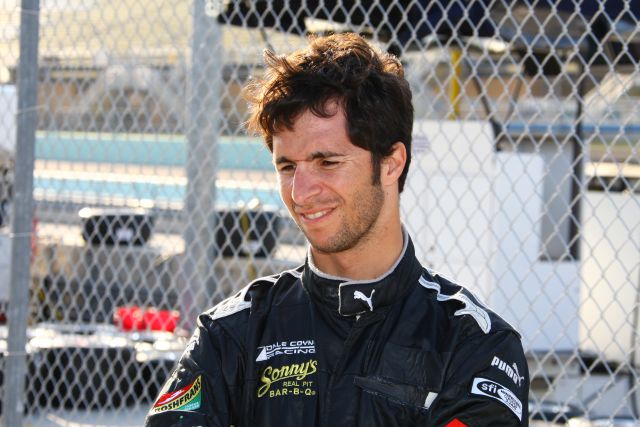
Chip Ganassi Racing nowadays are consistent frontrunners whose drivers have taken 10 of the last 16 IndyCar titles. But by 2001, they were declining in performance, hamstrung by faulty engines and internal conflicts with series organisers. Pressure would be on the Brazilian to perform right away.
“It was a big change for me,” he said. “Number one, I was living in Europe with the European style of racing. Even in Brazil, in South America, you kind of model the rules off European style.
“Then you go to the US, completely different. Rolling starts, yellow flags… refuelling, same fuel, turbo engine with a big kick on the power straight away. There were a lot of difference, racing ovals and a lot of street courses,” he continued.
“It was a tough first year for me in IndyCars, because I joined a very, very good team in Chip Ganassi Racing, but it was me and another rookie as well, a French driver [Minassian] that never raced in US. We were both trying to learn what was very difficult.”
Minassian was let go before season’s end, but Junqueira acclimated well to the new environment. He had taken his first pole in just his third race in Nazareth, then secured his first victory at Road America later in the season.
“I was able to get a pole position in Nazareth at an oval, I was able to win a race in my first year, so at the end of the day it was decent.”
Junqueira also took part in that year’s Indianapolis 500, sanctioned by CART’s rival series, the Indy Racing League. After qualifying 20th, Junqueira kept his nose clean in the race and finished fifth on debut.
“That was a race I always wanted to do since I was young, racing go-karts. So for me to have the chance to race in the Indy 500 was amazing in 2001. Then in 2002, even better when I won pole position and I led so many laps on the race.”
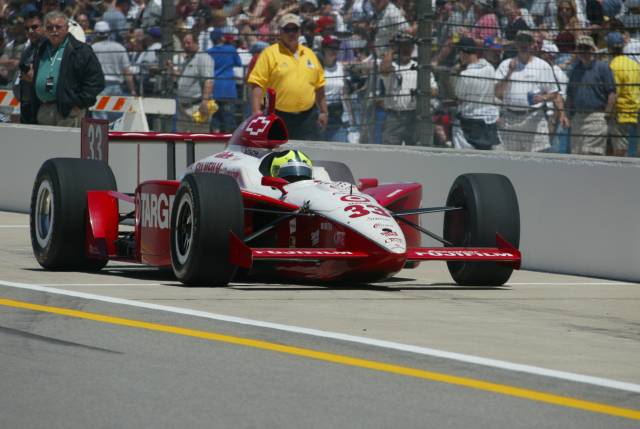
Mechanical issues plagued the Ganassi squad that year. Junqueira stalled exiting pit lane and retired from the race with gearbox trouble. But while Indy 500 success never materialised, his CART career was far more fruitful. He took seven victories and three championship runner-up finishes from 2002 to 2004, the first year under the Champ Car moniker.
He started the 2005 season as well as one could hope by taking a podium in the season-opening Grand Prix of Long Beach and winning the Grand Prix of Monterey. That put him in the championship lead by one point, but before the next round, he knew he had already lost it. A huge crash in the IRL–sanctioned Indianapolis 500 left him with a concussion and two fractured vertebrae and put him out for the rest of the Champ Car season.
He recovered in time for the 2006 season and remained in Champ Car through the merger with the Indy Racing League in 2008. After one season in IndyCar in 2008, he called it quits on his full-time single-seater career.
Reflecting on F3000
F3000 was replaced by GP2 in 2005, which then became F2 in 2017. Most on the current F2 grid were not yet born when Junqueira won the 2000 title.
None of the series Junqueira raced in during the 1990s still exist. There is now just one international Formula 3 series, FIA F3, and open-chassis series are dwindling. But the essence of both F3000 and F2 – having the top junior prospects in one series vying for an F1 drive – remains the same nearly 25 seasons later.
“I mean, I think Formula 3000 and Formula 2 is basically the same category. They just changed the name to GP2 and now F2. That makes much more sense to be called F2, but I think [they’re] the same,” he said.
“You always race the same tracks as Formula 1 on the same weekend, so usually the top drivers from F3 [do well]. In my case, I was South American Formula 3 champion. I joined Formula 3000, I raced against the Italian champion for Formula 3 [Oliver Martini], the Formula 3 European [Nick Heidfeld, German F3], the English champion [Jonny Kane].
“All the top Formula 3 drivers, they merged together and raced in Formula 3000 at the time, or Formula 2 now. Everybody is trying to do their best, to show up for the F1 teams to get a chance to race,” he continued.
“What I love about Formula 3000 – and I feel the same about GP2 – is that it’s the same car, same engine, same tyres, same chassis as everybody, so I think the driver makes the biggest part of the difference, the team and the driver.
“For sure, there are teams with more resources, more knowledge, so you’ll probably do better, but even if you’re in a small team, have a good relationship with mechanics, you’re going to end up doing very well in Formula 2 now. Formula 3 was very different because there were so many different chassis and engines, so there was big discrepancy in performance.”
Even if you’re in a small team, have a good relationship with mechanics, you’re going to end up doing very well in Formula 2 now
Bruno Junqueira
In modern F2, private testing is prohibited, and sanctioned testing takes place only a few times per year. Junqueira recalled that there was also “very little testing” in F3000.
“Especially my first year when I went to Europe, I didn’t know any tracks, everything was new to me. We didn’t have simulations, nothing. There’s no drivers’ coaching, just go to the track and drive.
“Because you race during the Formula 1 weekend, there was very little time. There was a 30-minute practice, and a 30-minute qualifying, and a race, so it was very, very limited.
“And then pre-season testing was maybe two days testing and others throughout the year, so you do six days testing throughout the whole year. [It was] very difficult to learn the car and learn the tracks.”Drivers now have access to hyper-realistic simulations with telemetry and force feedback, but racing simulators were much more basic in the 1990s and early 2000s. So how did he practise European tracks?
“I remember [at] the time, I loved computers and there was a game called GP2 [Grand Prix 2], and [it] was very basic. There was three to four tracks, and I was able to learn little bit of tracks on that game. It was my simulation at the time. You play with the keyboard.”
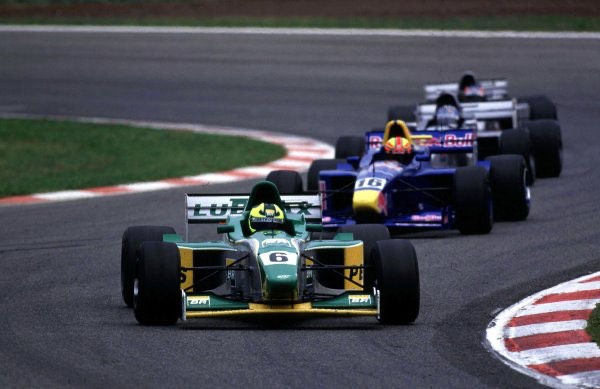
After IndyCar, Junqueira took part in four seasons of the American Le Mans Series, now the IMSA SportsCar Championship, achieving a best overall finish of third in the standings in 2012 and 2015. The latter was his last full season in a race car.
“I raced until 2016 full time, and I think ’17, ’18 some races. In 2019, I raced with the gentlemen in Lamborghini Super Trofeo [North America], won a few races. In 2020, I was going to race again, but then the COVID came.”
Since the pandemic, Junqueira has only competed in one race: the Legends Cup invitational for former IndyCar drivers, held on the 2022 Mexico City Grand Prix support bill. Now the Brazilian is a real estate broker based in Miami, where he has lived since 2002, with Coldwell Banker. And he’s itching to return.
“I was talking to my wife and kids last week. I’m missing so much racing, so maybe next year, I’ll see if I can find another seat again in sports cars.”
Header photo courtesy of Bruno Junqueira
Make a one-time donation
Make a monthly donation
Make a yearly donation
Choose an amount
Or enter a custom amount
Your contribution is appreciated.
Your contribution is appreciated.
Your contribution is appreciated.
DonateDonate monthlyDonate yearly Feeder Series