

Formula 3 organisers trialled a new qualifying format for the series’ season finale at Monza this weekend. But while some felt that splitting the grid into two groups was an improvement over having all 30 cars run at once, others believed still more needed to be done to limit congestion and ensure safe running.
By Michael McClure
Single-seater racing is a sport for the fearless. But even some of the bravest young drivers shudder at the thought of F3 qualifying at the Autodromo Nazionale Monza.
Other circuits have similar challenges. Both the Red Bull Ring and Spa-Francorchamps are notorious for producing traffic jams and generating scores of penalties for impeding. Yet every year, Monza stands alone for the tensions it brings to the 5.793-kilometre surface.
So when F3 rolled out its new qualifying format for Monza featuring two groups of 15 cars each, there were hopes that the chaos seen in previous years would diminish.
The new format quietly appeared on F3’s websites in the lead-up to the event. When asked last weekend about the reasoning for the change – yet to be formally announced at that time – a series representative told Feeder Series that the group qualifying system had been established “to ensure better conditions” during the session, split into two 13-minute halves.
But even with fewer cars on track than in previous years, the outcome was, statistically at least, worse: two crashed cars, 14 penalties for impeding and countless complaints about the session from around the paddock.

The crux of the problem is that Monza, the highest-speed track on the calendar, has four long flat-out sections on which drivers aim to use the slipstream from the car ahead of them to gain extra top-end speed that might not otherwise be attainable.
Two of those sections – the main straight and the passage between the Lesmo 2 and the Ascari chicane – permit the speed-boosting drag reduction system to be used. The other two – from the exit of the Rettifilo chicane through Curva Grande until the Roggia chicane, and from the exit of Ascari to the Parabolica – do not permit use of DRS but lead into prime overtaking spots.
Drivers often jockey for position in trying to gain slipstream. There is a window within which it will have maximum effect; get too close or too far from the car in front, and drivers will either have to slow down to avoid hitting the rear of the other or lose out on the advantage entirely and risk slowing down those behind. Any substantial pace differential within the field, even from one corner to another, can be highly disruptive.
And for once in racing, nobody wants to be first. The lead car gets no slipstream; it is a sacrifice few drivers want to make, especially not when there is a title on the line. It tends to be on the 30-car F3 grid, however, that the consequences of these decisions are most visible and dramatic.
What went down in qualifying?
Under almost any other circumstance, championship leader Leonardo Fornaroli’s commanding pole position by 0.256 seconds, one of the largest margins of the season, would have been more of a story than it was. Yet in the paddock on Friday, the results themselves – and even the championship implications of the two extra points Fornaroli gained from pole – were somewhat of an afterthought.
For much of the first qualifying group, the question was not who would go fastest but whether anyone would set a competitive lap at all.
Jenzer Motorsport’s Max Esterson was alone on track at first, and it was only after about five minutes that most cars had left pit lane. No representative lap times were set in the first eight minutes as drivers formed progressively longer and slower queues – until disaster struck.
As they approached the majority of the cars from Group A between the first and second Lesmo, Kacper Sztuka and Laurens van Hoepen made contact. MP Motorsport rookie Sztuka, who failed to set a time in practice because of a mechanical problem, slowed upon seeing the queue in front but remained on the racing line, leaving Van Hoepen immediately behind with little time to react. Though both cars returned to the pits, the incident brought out the red flag with five minutes and 23 seconds to go.
Sztuka sustained a puncture and damage to his left-rear corner, while Van Hoepen’s front-left suspension and nosecone assembly had broken. Neither driver took part in the remainder of qualifying, and Sztuka received a five-place grid penalty for the next race in which he participates as well as three penalty points on his record for causing the incident. He will start from pit lane in the sprint race, thus voiding the penalty’s effect.

In the remaining minutes, drivers continued to fight over track position, but no further incidents occurred. Most drivers only got two flying laps completed as the session wound to a close, with Trident’s Fornaroli first on a 1:38.287 ahead of title rival Gabriele Minì of Prema and Trident teammate Santiago Ramos.
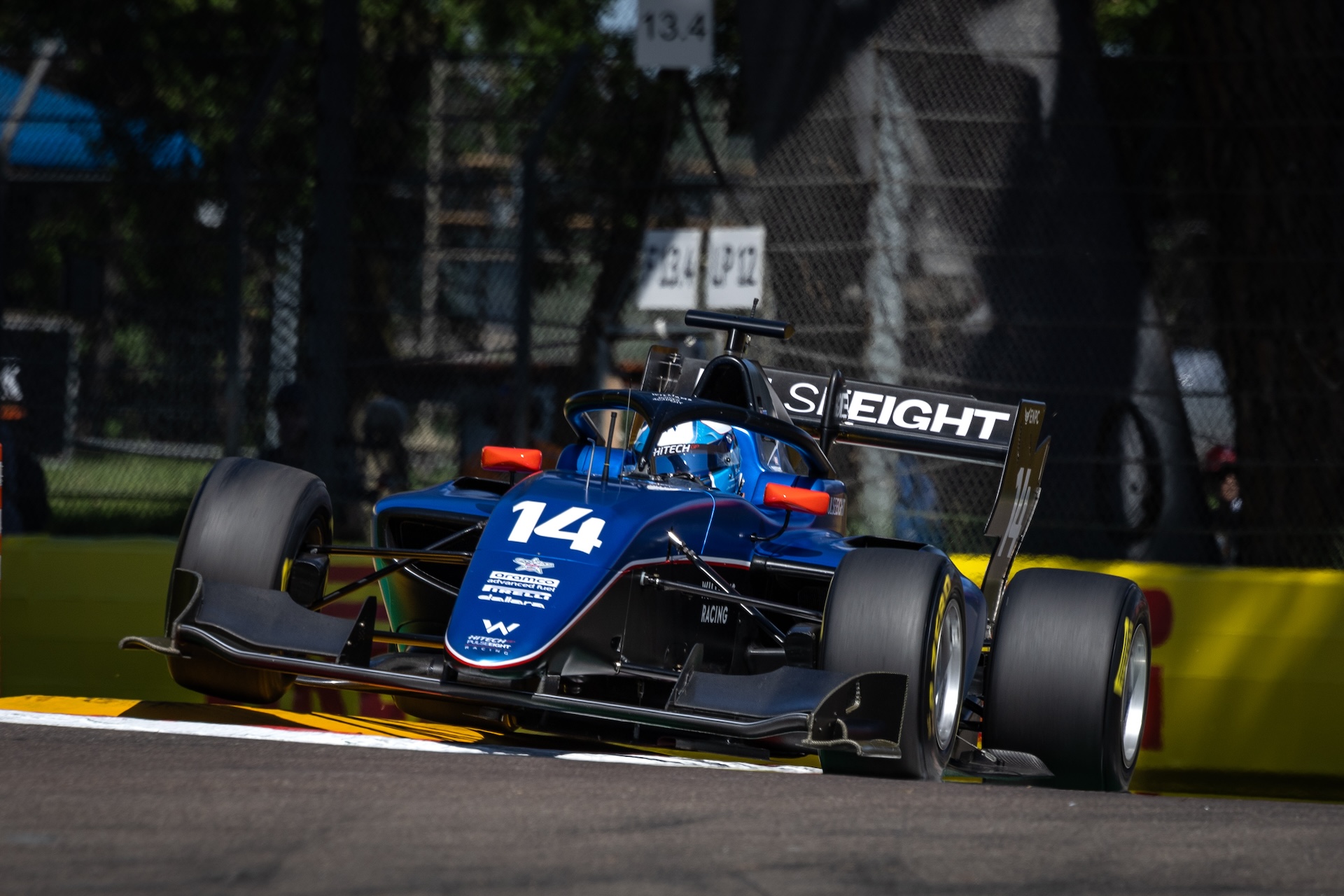
The first driver outside the top six in the session was Hitech’s Luke Browning, who sits third in the standings on 123 points. His time of a 1:39.124 put him nine thousandths behind Tasanapol Inthraphuvasak and one place away from pole position for the sprint race.
“Wrong place, wrong time,” Browning surmised. “The car in front made a couple of mistakes on his best lap and I was the one to collect it, unfortunately.
“One lap I had to back off, and then the other one I was far too close, unfortunately, and had to back off through Parabolica. The third lap, the tyres were gone.”
The delay to group A meant that group B started a few minutes later than planned. The cars ventured out even later.
The first five minutes passed without activity; the sixth saw everyone head for the circuit with such fervour that Callum Voisin and Nikita Bedrin nearly collided upon leaving pit lane.
As cars circulated around the circuit, a major queue formed into the Ascari chicane with three minutes to go. Then things eased up, and drivers gradually unseated each other at the top of the timesheets. MP Motorsport driver Alex Dunne, one of the last in line, jumped to the top of the timesheets, while Trident’s Sami Meguetounif and MP’s Tim Tramnitz, who were also in the back half, went second and third.
Dunne held on to top spot in the group as drivers completed their second flying laps, but his best effort was 0.531 seconds slower than Fornaroli’s. Improvements by Sebastián Montoya, Christian Mansell and Dino Beganovic dropped Tramnitz to sixth in his group – and thus 12th overall, gifting him pole position for Saturday.
Arguably the big shock of the session was that Arvid Lindblad, currently fourth in the championship on 113 points, qualified only 18th overall. That leaves him as the lowest placed of the six F3 drivers still in mathematical contention for the championship title.
Post-qualifying penalties
A total of 19 drivers were summonsed to the stewards after qualifying, with 14 of them handed penalties. That figure is one shy of the 15 drivers penalised after the Monza qualifying session in 2019.
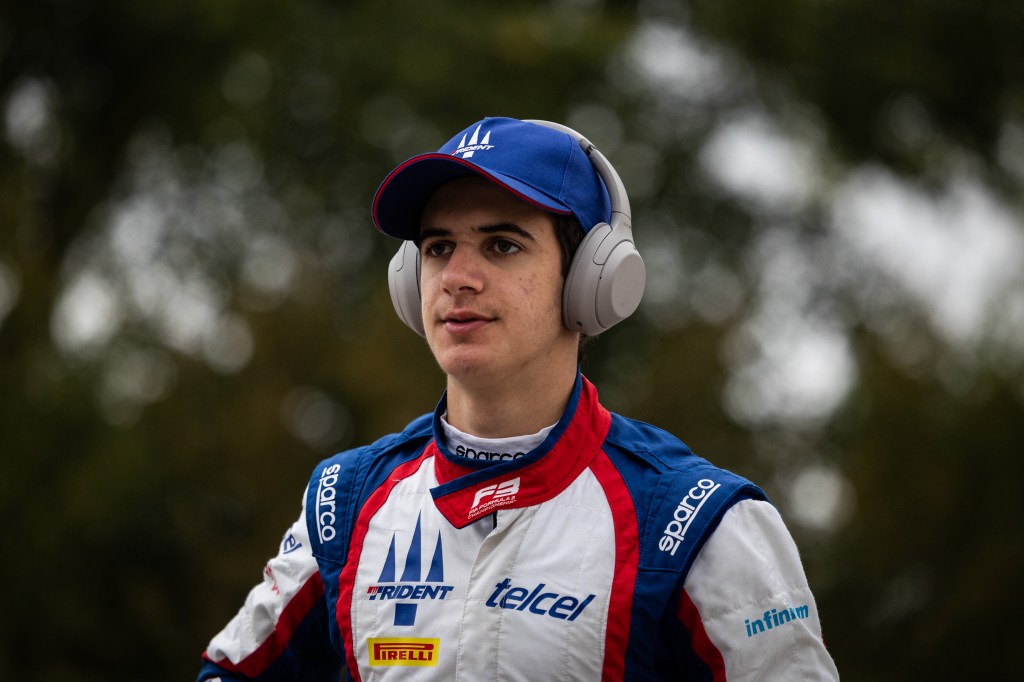
In addition to Sztuka’s five-place grid drop for hitting Van Hoepen, 11 drivers ahead of them were given four-place grid drops for the next races in which they participate for driving unnecessarily slowly between the two Lesmos. They are Fornaroli, Minì, Joshua Dufek, Mari Boya, Tasanapol Inthraphuvasak, Browning, Piotr Wiśnicki, Noel León, Esterson, Noah Strømsted and Tommy Smith.
The only three drivers from Group A not penalised were collision victim Van Hoepen, Ramos in fifth and Cian Shields in 21st.
The text of the penalty reads as follows.
During the session Car 14 [Browning], which was the leader of a group of cars, slowed out of Turn 6 and pulled over to the right side of the track leaving the racing line to the left clear continuing to slow to approximately 10kph. Several following cars behind arrived and chose to fall in behind Car 14 rather than continuing on at normal speed on the racing line. Cars 30 [Piotr Wiśnicki] and 26 [Tasanapol Inthraphuvasak] arrived and because they were unable to join the queue behind Car 14, they overtook and pulled in in front of Car 14 such that the queue was now formed behind Car 30.
The speed of the new lead car in what had become a 10 car queue, Car 30, reduced to just 2kph at one point with all the cars behind nose to tail travelling at a similar speed. Car 8 (Sztuka) later arrived out of Turn 6, and the Driver saw the queue and slowed contemplating an attempt to fall in at the back of the queue and Car 24 (Van Hoepen) collided with the rear of Car 8.
The Driver of Car 14 said that he decided to pull over to the right and slow because he hoped that another car would pass him and he could fall in behind and gain the advantage of a tow on his preparation lap. The other Drivers acknowledged that they decided to join the queue for the same reason. The decisions of all of the Drivers to form, join and maintain a queue of cars travelling at an extraordinarily slow speed resulted in the collision between Cars 24 and 8.
The Stewards acknowledged that there will be occasions during practice and qualifying sessions for cars to slow significantly off-line, potentially to a stop, in order to avoid impeding another car. Such circumstances are examples of driving “necessarily” slowly. In this case, however, it was entirely “unnecessary” for any of the Drivers to have slowed to such an extraordinarily slow speed. It was only done in the hope of gaining a sporting advantage from a tow.
The Stewards also acknowledged that what speed might be considered “unnecessarily” slow may be a matter of judgment and degree according to the particular circumstances. However, to be driving at under 10kph and as low as 2kph on a straight is, on any view, unnecessarily slow and is potentially dangerous to other drivers.
In addition to the Voisin–Bedrin unsafe release incident, on which no further action was taken, Mansell and Nikola Tsolov in 16th were also handed three-place grid penalties for their next races. Entering Parabolica, they impeded, respectively, Beganovic and 28th-placed Sophia Floersch, who is one of Tsolov’s fellow Alpine juniors.
Group qualifying’s history in F3
Group qualifying is not a new concept in F3. At the series’ Monaco round, introduced to the calendar in 2023, the 15 cars are divided into two groups by odd and even car numbers, just as they are in Monza.
That format was first introduced to the F1 support package – then the GP2 and GP3 Series – after a 2011 GP2 qualifying session at Monaco in which a series of accidents wreaked havoc around the 3.340-kilometre street circuit. GP3 used it once in 2012 on its sole visit to Monaco.
In other single-seater series with large grids, group qualifying is the norm. In Formula Regional Europe, which has grid sizes in the mid-30s, drivers are split into two groups by championship position at every circuit they visit, not just those such as Monaco and Monza that pose added complications for drivers. And even at Monza and other slipstream-heavy circuits, there is less congestion than in the corresponding F3 sessions.

A handful of returning F3 drivers have experience at Monza with both the regular and group qualifying formats in F3 as well as with the group qualifying system used in FR Europe. One of those is Montoya, whose experiences at Monza now span two Italian F4 qualifying sessions, one FR Europe session and two F3 sessions.
“The slipstream is a bit more important here, especially with the field being so tight,” Campos’s Montoya explained to Feeder Series in the Campos trailer. “If you look at an F4, Regional qualifying, it can be close, but it’s not as close as F3. Like F3, we’ve had five races this year where from P1 to P25 is one second, and a tenth can be the difference between P15 or P6. So I would say [F3 has more trouble] probably because it’s so close and everyone’s so on the limit.
“But I’d have to say that, especially now since it’s been quite a few years now with the car, a lot of teams have a lot of experience with it, so they want to maximise the speed a lot more. And the teams this year, to be fair, they’re all really close. Obviously there’s some that have a bit more of an edge than others, but overall I think it’s quite close. No one wants to help another person out, and everyone just wants to be the best they can.”
Does the F3 format need more tweaking?
In view of the fact that the top three in the championship were all in the first group, some drivers supported grouping in alternating championship order, as FR Europe does.
Ninth-placed Mari Boya, whose 1:38.872 put him fifth in Group A and 0.054s off the top time in Group B, felt he could have been second overall were it not for a mistake at Parabolica while following Browning.
“This [format] I don’t like,” the Spaniard told Feeder Series after qualifying ninth. “The three biggest title contenders are in the same group. In Monaco we were the quickest; now, we are the quickest by six tenths compared to the other group, so even losing half a second in the last corner, I am less than one tenth from pole in the other group. It’s clearly an advantage of being in the other group.
“For me, the best thing if they want to divide in groups is taking the championship standings and making one, three, five in one and two, four [in the other].”
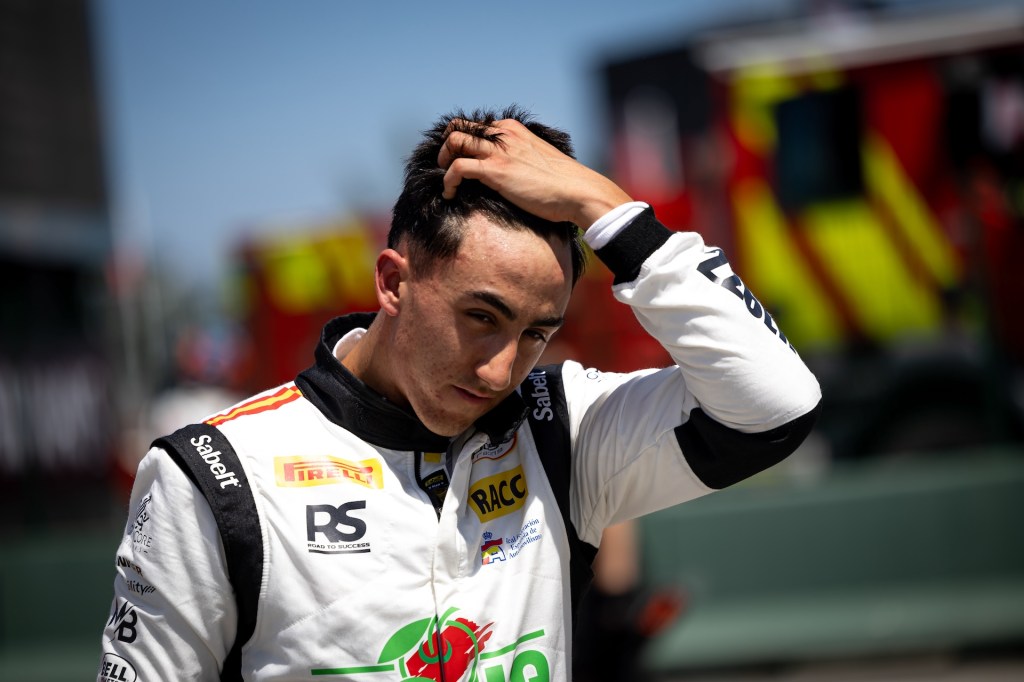
Montoya, who qualified sixth and third in Group B, supported grouping via alternating championship standings but also said about F3’s split format that he “[had] to give credit to the championship for doing that because practice, for example, was a mess”. He finished 14th in practice, which Boya topped.
Browning said that “the pole disparity was massive” between the two groups and that sorting by championship order “makes it a little bit more fair”. He also suggested a minimum time for qualifying out laps, mirroring a system used in F1 races and outlined in article 2 of the weekend’s event notes for the Italian Grand Prix.
Dunne and Minì were more amenable to a minimum lap time than to changing the way groups were allocated, but the Italian driver suggested that such a policy would relocate rather than eradicate the problem.
“Once again, you make a bit of queuing in the box,” he told Feeder Series in the post-qualifying press conference. “It will just stop everyone from going and just go when it’s two minutes to go and maybe someone will not do the lap.”
“We can stay here and talk about this all day, but in the end I think it’s not really something easy to fix.”

MP Motorsport team principal Sander Dorsman ended the session with one driver on the feature race front row, one on sprint race pole and one with a broken car. He told Feeder Series that he felt the change in format failed to address the primary problem: driving behaviour.
“Group A, I think it was a very messy session. I’m not too pleased with some behaviours in the field,” he said, while adding that he was happy the stewards had investigated so many drivers for impeding.
“It all starts a bit when people really almost come to a complete stop, perhaps you can say. I was speaking with Seb [Philippe, team principal] from ART. He also had a good idea to say, ‘Oh, the light turns green, everybody must go immediately and you cannot stop,’ and this and that. Perhaps you need to find [a fix] in things like that. Obviously, to divide it into two groups is a nice idea, but it didn’t really work out.”
Dorsman also suggested a more dramatic workaround: removing Monza from the calendar and replacing it with Zandvoort, the team’s home race and the venue for the penultimate F3 events in 2021 and 2022. But until that happens, the Dutchman believes there are still lessons to learn.
“Let’s hope they fix it a bit and we can have more cleaner qualis in the future,” he said. “Perhaps it’s nice for the people at home. They have a nice popcorn moment. But I think here, it’s not really what we want.”
| Sprint race grid pre-penalties | Sprint race grid post-penalties (+/- position) |
| 1. Tim Tramnitz | Tim Tramnitz (0) |
| 2. Tasanapol Inthraphuvasak | Dino Beganovic (+1) |
| 3. Dino Beganovic | Sebastián Montoya (+4) |
| 4. Mari Boya | Santiago Ramos (+4) |
| 5. Christian Mansell | Sami Meguetounif (+4) |
| 6. Joshua Dufek | Tasanapol Inthraphuvasak (-4) |
| 7. Sebastián Montoya | Alexander Dunne (+4) |
| 8. Santiago Ramos | Mari Boya (-4) |
| 9. Sami Meguetounif | Christian Mansell (-4) |
| 10. Gabriele Minì | Joshua Dufek (-4) |
| 11. Alexander Dunne | Joseph Loake (+3) |
| 12. Leonardo Fornaroli | Arvid Lindblad (+6) |
| 13. Luke Browning | Martinius Stenshorne (+7) |
| 14. Joseph Loake | Gabriele Minì (-4) |
| 15. Piotr Wiśnicki | Cian Shields (+6) |
| 16. Nikola Tsolov | Leonardo Fornaroli (-4) |
| 17. Noel León | Luke Browning (-4) |
| 18. Arvid Lindblad | Callum Voisin (+4) |
| 19. Max Esterson | Nikola Tsolov (-3) |
| 20. Martinius Stenshorne | Piotr Wiśnicki (-5) |
| 21. Cian Shields | Noel León (-4) |
| 22. Callum Voisin | Nikita Bedrin (+2) |
| 23. Noah Strømsted | Max Esterson (+4) |
| 24. Nikita Bedrin | Charlie Wurz (+2) |
| 25. Tommy Smith | Sophia Floersch (+3) |
| 26. Charlie Wurz | Noah Strømsted (-3) |
| 27. Sophia Floersch | Tommy Smith (-2) |
| 28. Matías Zagazeta | Matías Zagazeta (0) |
| 29. Laurens van Hoepen | Laurens van Hoepen (0) |
| 30. Kacper Sztuka | Kacper Sztuka (0) |
Editor’s note, 31 August 2024, 7:18: The drivers from Group A who received penalties were enumerated for clarity.
Header photo credit: Dutch Photo Agency
Make a one-time donation
Make a monthly donation
Make a yearly donation
Choose an amount
Or enter a custom amount
Your contribution is appreciated.
Your contribution is appreciated.
Your contribution is appreciated.
DonateDonate monthlyDonate yearly Feeder Series
5 thoughts on “Report: 14 F3 drivers penalised after Monza qualifying as new format divides opinion”