
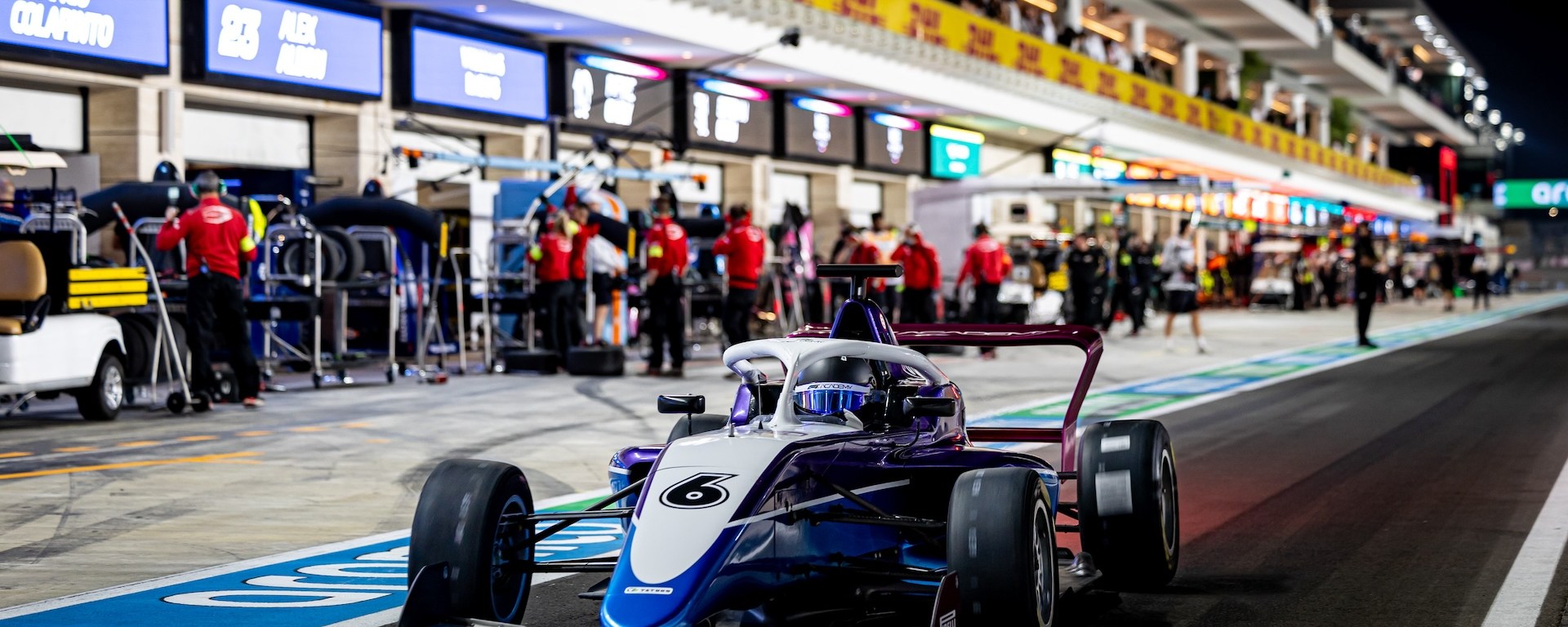
Wild card drivers have been featured in all but one round of the F1 Academy calendar this year. In Qatar, Feeder Series spoke to Alisha Palmowski to get the inside story on how wild card drivers are chosen and what life is like for them on track.
By Calla Kra-Caskey
The introduction of wild card entries to the F1 Academy grid was one of several rule changes made at the beginning of the season. Wild cards have featured at every round save Barcelona. The cars, run by reigning teams’ champions Prema Racing as a result of their teams’ championship victory in 2023, bring the grid up to the 16 cars needed for Super Licence points.
Originally, wild card entries were to be drawn from the host region. The guidelines have since been expanded to allow for F1 Academy hopefuls to enter when finding participants from the host region is not possible.
Getting selected
British driver Palmowski impressed in her first year of single-seaters, finishing as runner-up in GB4. She had always been targeting a 2025 F1 Academy seat, and naturally, her strong performances drew some attention from the paddock.
“Susie Wolff managed to spot me and thought that I’d be a good candidate for a wild card, so we were put in touch with Prema,” Palmowski told Feeder Series.
“I actually found out on my 18th birthday that I’d got this opportunity, which was the best birthday gift ever.”
Palmowski added that she didn’t talk to previous wild cards before joining for Qatar. “I just winged it, to be honest!”
Testing with the team
F1 Academy had a three-day test at the Lusail International Circuit in mid-November. As previous wild cards Reema Juffali and Courtney Crone were ahead of their respective appearances, Palmowski was invited to join the test.
“That gave me a great chance to meet the team, start building relationships, experience and adapt to the new car,” Palmowski said. She cited differences in brakes, aero, and weight between the first-generation GB4 car she’d previously driven and the second-generation F1 Academy car she drove in Qatar.
“This circuit obviously is very different to most of the UK circuits as well,” Palmoski added. Her wild card appearance was her first experience racing internationally.
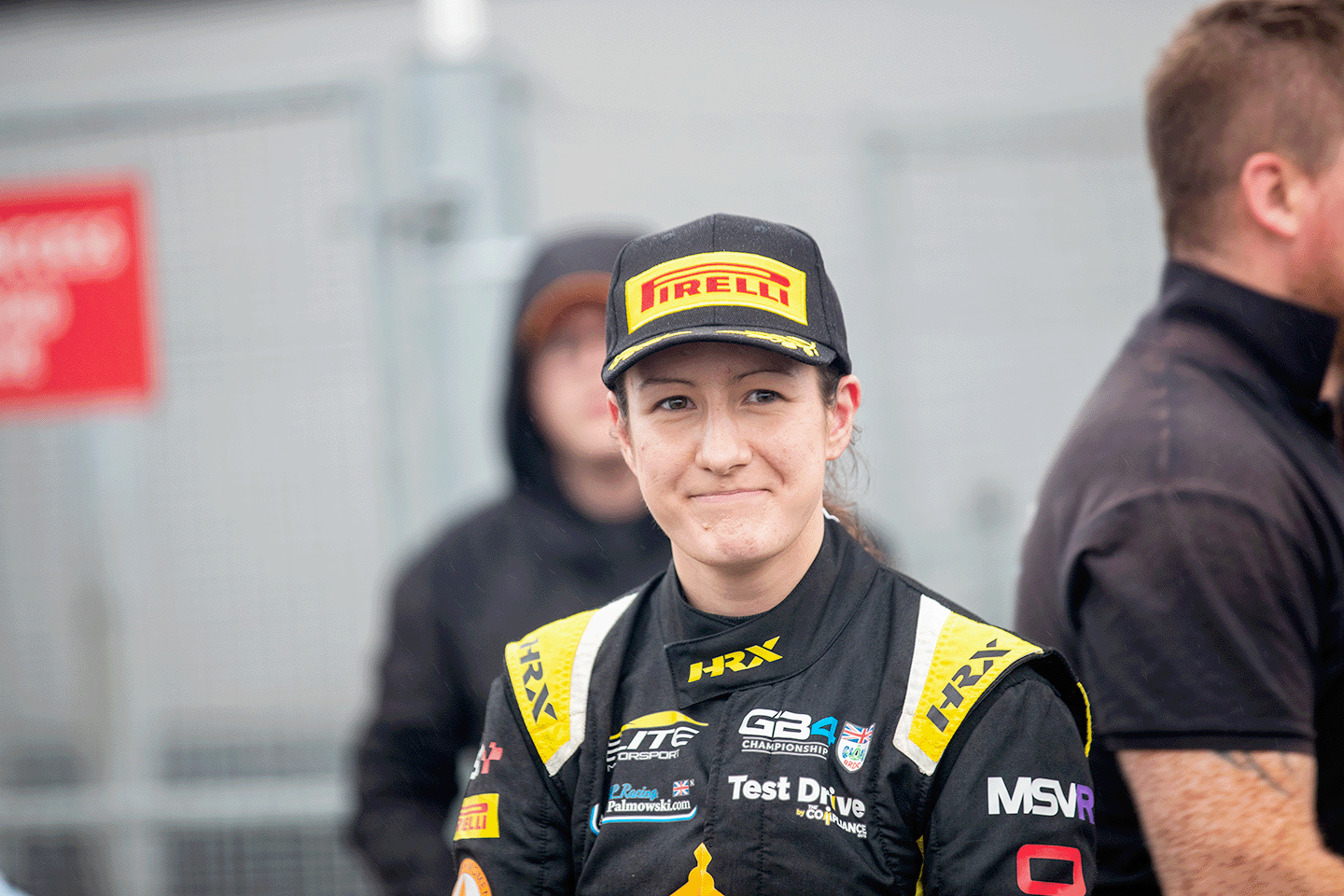
Although Palmowski previously competed against several current Prema drivers, including Freddie Slater in the Ginetta Junior Championship, she had no previous connections to the team. But she said she was smoothly integrated into the fold, mentioning teammate Maya Weug as being particularly welcoming.
“She’s been absolutely fantastic. She’s really sort of taken me under her wing and really helped me out a lot,” Palmowski explained. “We have quite a similar driving style actually, and quite similar personalities as well. So she’s just really helped me out in terms of speeding up that progression.”
Arriving for the weekend
F1 Academy weekends are structured similarly to F1 weekends: Thursday for media, Friday for practice, and competitive sessions on Saturday and Sunday. In most other series, F4-level drivers don’t have any media duties, so the dedicated media day was a new experience for Palmowski.
“That was an awesome experience. It was my first time in the F1 support paddock, so just walking in, seeing all the people, the atmosphere – there’s a great vibe, loads of fans. It’s just absolutely incredible. It’s a dream come true because I’m such a big Formula 1 fan,” Palmowski said.
“In terms of being a wild card, there’s been a lot more media duties than I’ve ever had before. … It’s a little bit of a whirlwind to be honest.”
She also had to adjust to a different practice schedule. While in GB4, drivers normally spend all of both Thursday and Friday testing, F1 Academy has to accommodate the schedules of F1 and its other support series. That means F1 Academy is often driving at the very beginning and very end of the schedule, with plenty of down time in between.
Palmowski said these scheduling gaps affected how she drove on track.
“The grip changes so much from session to session,” she said. “It’s like you’re in a different car on a different track, it really does vary that much with the different categories going out on track. So the adaptability needed from session to session obviously is what’s making the difference to the top [F1 Academy] drivers.”
Racing alongside F1
Palmowski had a strong showing throughout the weekend. During the two practice sessions, she finished seventh and third. Her best qualifying lap was good for sixth on the starting grid, while her second best lap put her fourth on the grid for race two.
In the first race, she made up one position to finish fifth. With 10 points in the bag and a great starting position for the second race, she looked poised to become F1 Academy’s highest-scoring wild card, surpassing Nina Gademan’s 13 points in Zandvoort. But before she could make an attempt, the race was cancelled because an accident in the preceding Porsche Carrera Cup Middle East race required extensive barrier repairs at Turn 16.

Palmowski found the extra rubber laid down by the F1 cars helpful.
“We went around two seconds quicker once F1 cars have been out,” she said. “It’s grip like I’ve never experienced before in the UK, but it’s easier, I guess, to go to an increased step in grip than decreased grip, so definitely [having experience racing in the UK] has helped.”
She also enjoyed her first ever night race.
“It’s funny, I didn’t even change my visor,” she said. “I just left the same visor that I have on in the sun because with the lights it’s so bright. With the TV screens, it’s almost like being in daylight.”
Preparing for the future
Although Palmowski’s plans for next year have yet to be confirmed, she emphasised that an F1 Academy seat had always been a target for her. GB4 organisers MotorSport Vision already granted her a €30,000 scholarship towards a 2025 F1 Academy seat as GB4’s top female finisher this year.
Three previous wild card drivers – Crone, Gademan and Ella Lloyd – have already been confirmed for the 2025 grid.
“It’s not been perfect, but I’m sure if I was to get another opportunity to do another race weekend, then we could do a much better job,” Palmowski concluded. We’ll likely see her do so next year.
Interview by Michael McClure
Header photo credit: Dutch Photo Agency
Make a one-time donation
Make a monthly donation
Make a yearly donation
Choose an amount
Or enter a custom amount
Your contribution is appreciated.
Your contribution is appreciated.
Your contribution is appreciated.
DonateDonate monthlyDonate yearly Feeder Series