
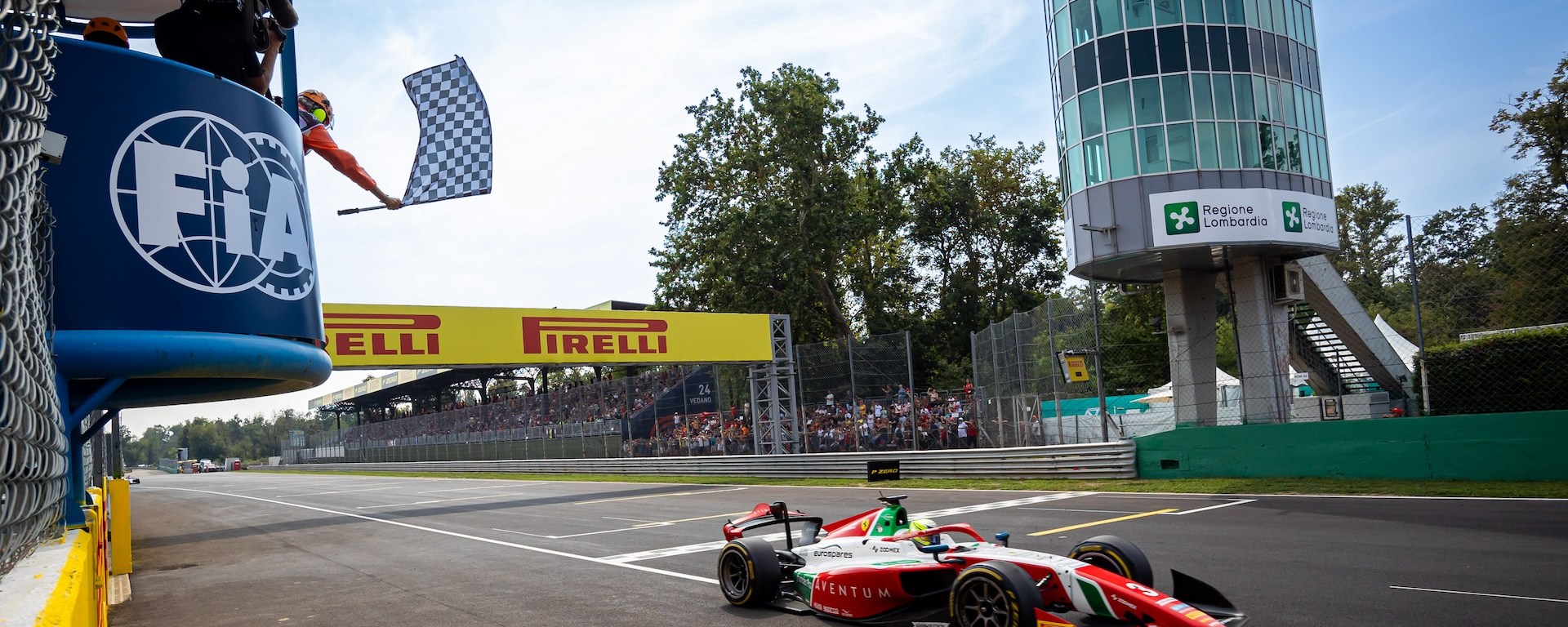
Next year, Formula 1 will see six drivers competing in their first full season in the series, including four stepping up from F2’s 2024 grid. F2 chief executive officer Bruno Michel addressed their performances this season.
By Calla Kra-Caskey
The first F2 driver confirmed for a 2025 F1 promotion was Ollie Bearman, who in July was announced to be filling one of Haas’ seats in 2025. That was followed by Mercedes’ announcing of Andrea Kimi Antonelli in August, Sauber’s hiring of then–McLaren junior Gabriel Bortoleto in November and Isack Hadjar’s promotion to the second RB seat last week.
Despite moving up from F2 together, all four drivers had vastly different experiences in the top junior single-seater championship.
F2, like other single-seater championships, is a spec series in name. In practice, differences in machinery and car set-ups can heavily affect drivers’ performances.
Rarely has this been more visible than this season after a new car shook up the F2 field. Perennial championship contenders Prema finished fifth after failing to score a podium in the first six rounds, while Campos jumped from ninth in the 2023 teams’ championship to second in 2024.
Although Ferrari junior Bearman was expected to be a serious contender for the title, he missed four races and finished the season a surprising 12th. At the front, rookie Gabriel Bortoleto duked it out for the title with Isack Hadjar, who had finished 14th in his first year of F2. Antonelli finished his rookie F2 season sixth.
In a press conference following the Abu Dhabi title decider earlier this month, Feeder Series asked Michel how representative these results were and what impact the car and engine may have had on them.
Michel expressed his excitement at the prospect of having the top two drivers in the 2024 championship graduate to F1, the first time this has happened since George Russell and Lando Norris made the jump together after the 2018 F2 season.
“I’m really happy Bortoleto is confirmed. We don’t know yet about Hadjar, but I hope it will happen,” he said at the time, one week before Hadjar was announced to be taking the RB seat.

He added that “it’s very difficult to give a specific judgement on each of the drivers because they’re all in different situations.”
Sixth-placed Antonelli and 12th-placed Bearman, Michel said, “are drivers from F1 academy teams and have been followed very, very precisely and very carefully by those teams over the last years.”
As a reserve driver for both Ferrari and Haas in 2024, Bearman was originally slated to participate in six FP1 sessions throughout the season with Haas. He ended up participating in four sessions for Haas and one for Ferrari.
Bearman’s 12th-place championship finish is the lowest for a full-time driver heading to F1 the following year in F2 history, but the 19-year-old didn’t have to rely on his junior series accomplishments to prove himself. In Jeddah, he drove for Ferrari in place of Carlos Sainz, qualifying 11th and finishing seventh. With that result, Bearman became the youngest driver in F1 history to score points on debut as well as the youngest Ferrari debutant.
“Ferrari has been putting its trust in Ollie,” Michel said. “Ollie had Jeddah as proof that he was ready for Formula 1.”
Bearman’s reserve duties were once again required in Baku, this time for Haas, following Kevin Magnussen’s one-race ban. With his 10th-place finish there, he became the first driver in F1 history to score points for two different teams in his first two races.
In Brazil, he again stepped in for Magnussen, who was ill.
Michel said that in Bearman’s case, being occupied with discussions around his future plans in F1 may have prevented him from being “completely concentrated” on F2 and thus harmed his results. The specific races Bearman missed may also have affected his place in the F2 standings.
“You know, he’s won races,” Michel said. “The race that he missed in Jeddah he was on pole position for us, so [he] probably would’ve done a good job as well. So I would say [his F2 championship position] is something that is not an issue for me.”

Last October, Mercedes made waves when they announced Antonelli would skip F3 and proceed directly from FRegional Europe to F2. His fast-tracked progression continued in April, when the then-17-year-old Antonelli, who wasn’t yet old enough for the Super Licence required to participate in an F1 weekend, began an extensive programme of testing previous F1 cars.
He had to adapt to bigger machinery and heightened attention both on and off track.
“Kimi didn’t do Formula 3, so that also makes a massive difference,” Michel said. “Not having this kind of preparation in terms of, number one, the car – because he was coming from Formula Regional directly – and, number two, the weekend with Formula 1, the systems that we are using, the track time that he has and stuff like this also made his life more difficult. There’s no doubt about that.”
By contrast, both Bortoleto and Hadjar had a more stable year in F2.
“Gabriel came from Formula 3, Isack was in [his] second year of Formula 2, so for them I would say it made their life easier, let’s put it that way.
“I don’t want after that to try and see who’s better between those four drivers because at the end of the day, I think they all deserve their place in Formula 1, even if they’re not finishing P1 but they’re finishing P12 in the [F2] championship.”
Header photo credit: Dutch Photo Agency
Make a one-time donation
Make a monthly donation
Make a yearly donation
Choose an amount
Or enter a custom amount
Your contribution is appreciated.
Your contribution is appreciated.
Your contribution is appreciated.
DonateDonate monthlyDonate yearly Feeder Series