
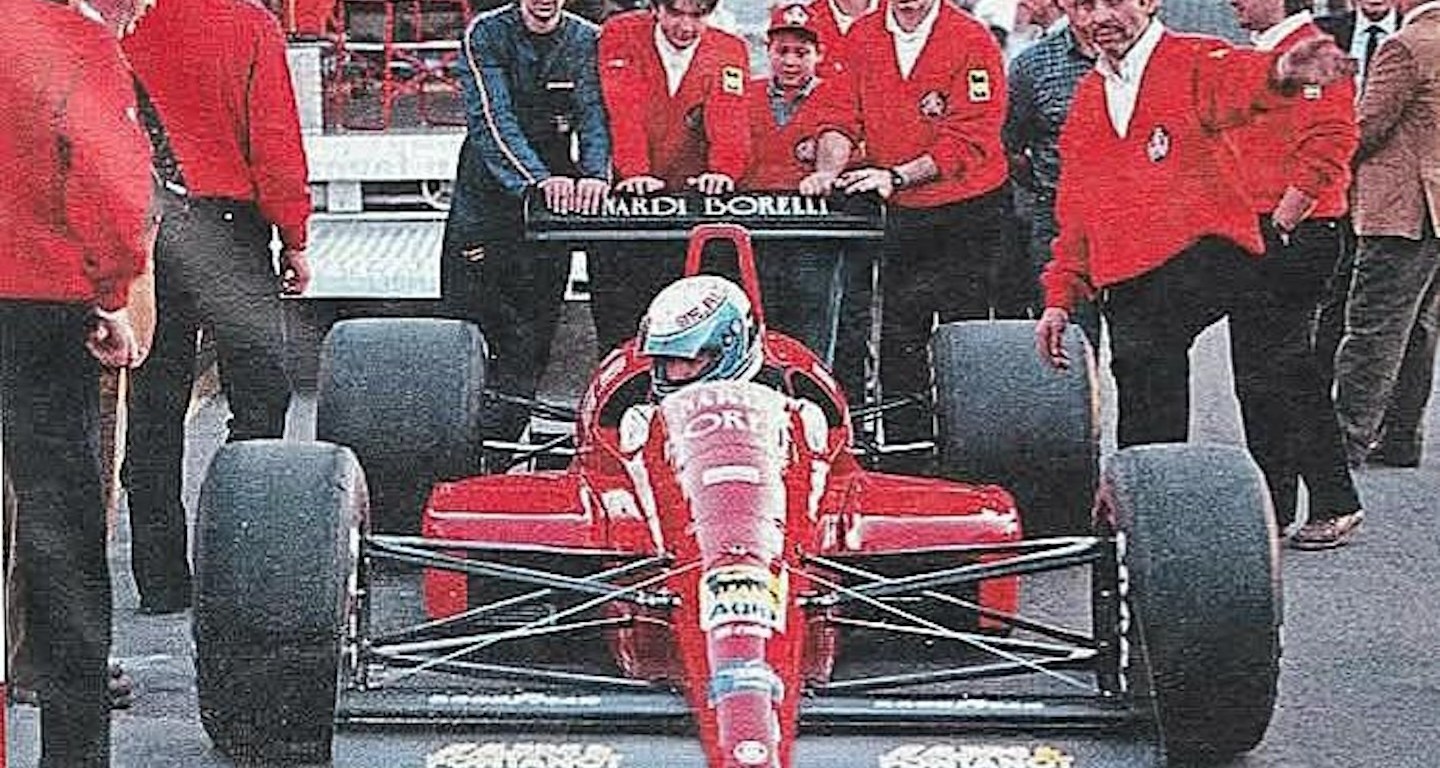
In the modern day, Formula One test drivers, many of them active junior single-seater racers, tend to sit on the sidelines and wait for the rare opportunity to take to the big stage. What were their lives like 35 years ago? Feeder Series spoke to former F1 test driver Franco Scapini about his time in junior and professional racing and his thoughts on the junior ladder in the present day.
By Sean McKean
While F1 test drivers wait for race seats in their teams to open up, they keep busy. For example, 2022 F2 champion Felipe Drugovich, Aston Martin’s third driver since early 2023, has driven the team’s cars in a handful of free practice sessions, pre- and post-season testing, and Pirelli tyre tests as he waits for his grand prix debut.
Access to testing hasn’t always been so easy, however. All it takes is a look back to the 1990s to see how turbulent the role could be. Scapini, a former Life F1 Team test driver, dealt with a failing Formula 1 outfit and the denial of his competition licence.
His experience lacked many of the simulator and testing opportunities of a test driver in 2025, But the role, Scapini says, hasn’t fundamentally changed.
“The position serving the driver career is the same,” Scapini told Feeder Series. “You stay there and you wait for the possibility or the chance to drive the car in the official race. I don’t see a big difference between the two eras.”
The racing landscape was vastly different in 1978, when Scapini, then 16, got his start in karting. Like many drivers now, the Italian inherited his love for motorsport from his father, who owned a Ferrari service workshop for several decades.
“I only started because of my father and the workshop,” Scapini said.
“We worked on historic cars where we restored and repaired [them]. I started to stay with my father at the workshop since I was a child, and my passion took from there. And then I worked with him at the workshop after school and during holidays, and my passion went up and up. I think the moment was when I asked him to permit me to drive go-karts.”
After three years in karting, Scapini began racing single-seaters in 1981 in Italy’s entry-level Formula Fiat Abarth series. He explained to Feeder Series that with help from the Italian Karting Federation, he was supplied with a 2000cc single-seater, akin to F4 cars of the modern day, to fuel his dream of reaching F1.
“At that time, Formula Fiat was the first step after go-karts. I started to drive in racing cars in Formula Fiat because I acquired a new car from the Italian Karting Federation, and so they gave me a car to start my career in auto racing,” he said.
“The cars were all the same – same chassis, same engine. It was 2000ccs with 140 horsepower. It was a quite difficult championship because there were almost 40 cars each race.”
The landscape of racing in general looked much different in the early 1980s, including safety technology. In early May of that year, the young Italian faced this reality head-on at the start of a Formula Fiat race at Imola.
“It was the fifth race of the championship. It was the race the day before the Formula One Grand Prix in Imola,” Scapini told Feeder Series. “We ran there for a [sprint] race. And just after the start, we had this big crash. I don’t remember anything about the accident because it happened shortly after the button. I just woke up the day later in the hospital.
“We could say that the cars at that time were not so [safe], you know. But anyway, we knew what we had to do. We had to drive.”
In 1981, Scapini also partook in that year’s European F3 season finale in Mugello before taking on a full-time drive in his home nation’s F3 championship in 1982. He competed in Italian F3 for five seasons, finishing a best of fourth overall in 1984, and raced with small, family-run privateer outfits.

“There was lots of professional teams, but at that time, if you have the money to buy a car and you have two friends with you, you were able to go to the race. It’s not like today,” he said.
Nowadays, he explained, “It is necessary to have two cars, a team, a licence for the team, a licence for the drivers. At that time, licenses permitted you to drive and own the team. You have to put the fuel in the car, put the tyres on the car and go. … Of course, those who had more money had better material and better races, but that was the story.”
In the midst of his F3 campaigns, the Italian participated in the second season of the International F3000 Championship – an ancestor of the modern F2 – in 1986. In his handful of starts from 1986 to 1989, he raced for Corbari Italia, Lola Racing, Roger Cowman Racing and BVM.
“Stepping to Formula One, the position is the same, but the type of the race [is] completely different,” he said about International F3000. “For example, today, the cars are all the same. There are 20 to 22 drivers on the grid with the same engine, same tyres, same chassis.
“In my time in F3000, there was three or four factory teams plus the same number of satellite team[s] that were connected to the factory. Then there were all the other private teams, so together, there were 20 cars. We ran not less than 34 to 36 cars. We had a pre-qualifying session to qualify the car, then there was qualifying.”
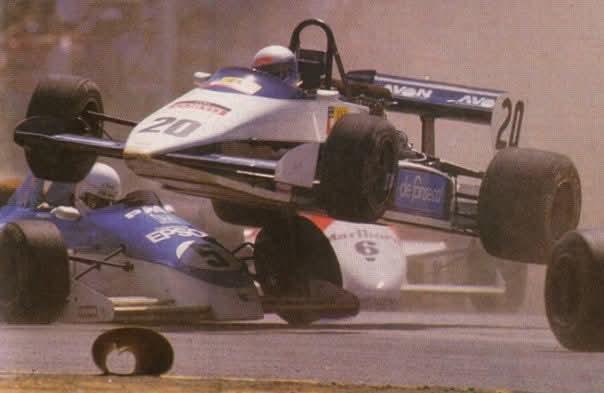
In F2’s most recent season in 2024, all 11 teams and 18 drivers won at least one race during the season. In Scapini’s day, the biggest challenge for smaller F3000 teams was whether they’d qualify to race at all.
“At that time, we had 34, 36 drivers, and just 26 were able to start the race at long tracks, at short tracks 22,” he said. “At every race, 10, 12 drivers go home, so you can imagine which kind of difficulties we had at that time.
“Even if you consider the differences between the car – maybe you drove a good car but with a private team and you have to compete against a factory car – the difference is bigger.”
Racing professionally
Scapini dipped his toes into the professional side of racing during this time too, racing with Mussato Action Car’s Lancia LC2 prototype in the C1 class of the World Sportscar Championship – a precursor to the World Endurance Championship – in 1989. This included his first entry in the prestigious 24 Hours of Le Mans that year, but the team failed to qualify.
In 1990, Scapini was signed by the Life F1 Team as their official test driver. As part of his contractual duties, however, he was unable to secure a race drive elsewhere.
What was life like as Life’s test driver? Scapini thinks the role today is roughly the same as it was in the 1990s – even though testing now is much more regulated.
“Tests, one thing that have not changed in motorsport – especially in Formula One,” he said.
“Testing is money. If you don’t have enough money, you don’t have any chance of a seat in Formula 1, so sometimes you have to spend time as a reserve driver [or] test driver. At that time, we had the possibility to spend more time on the race track driving the real car. Now they spend a lot of time on simulator. The big difference [at] the moment is this.”
It wasn’t long before his tenure with Life F1 Team concluded. The team failed to pre-qualify for the first 14 grands prix of the season and closed their doors before season’s end.
With no official drive for 1991, Scapini took the gamble to go across the pond to the United States and race in the CART World Series for one race with Euromotorsport. This came off the back of a one-off start in the American Racing Series – the precursor to Indy NXT – in 1988 that proved crucial a few years later.
“I took part in an ARS race in Miami because I was a really good friend of Gianni Marelli,” Scapini said. “Marelli was a really important engineer for Alfa Romeo and Ferrari. Then I worked with him in Le Mans with a Lancia LC2 and Life F1 too. He [Marelli] was also really good friends with Mario Andretti, so I had the possibility to speak to Mario, to Marelli, to try to find a solution to drive in IndyCar.” Marelli passed away in October 2024.
Scapini made his first start in Surfers Paradise, that year’s season opener. Despite battling clutch issues throughout the event, he managed to finish 11th, but he never made another start. Why not?

“I took part in the rookie orientation for the Indy 500. I had a good result even there [in Surfers Paradise], but they [Euromotorsport] wanted $400,000 to take part in Indy.”
“If I remember at that time, for one season in IndyCar, it was around $1,700,000. At all of Indianapolis, if I wanted to race, it takes a lot of effort for the team plus the risk [of a crash/failure],” he said.
“If you have a contract for a normal team, you’re okay, for a year, that’s it. But if you sign a contract race by race with a team that is one crash away from survival, this is the situation. It’s easy to understand.”
Following his brief time in CART, Scapini dabbled in GT racing sporadically, picking up two victories total across Italian and Spanish GT3 championships. He last raced a Ferrari F355 for his own team in 2000 in the 24 Hours of Daytona.
Reflecting on his time in racing
In the years since, the junior single-seater ladder has changed dramatically. Gone are the many regional F3 championships available in Scapini’s day, with only the FIA Formula 3 Championship formally bearing the moniker now.
“Today the selection is made in go-karts, where many drivers are there and there are many categories there.
“But karting is very expensive today, even more expensive than an entry-level category in cars. For this reason, therefore the selection is made according to the economic possibility that the pilot provides, especially if a family is paying the people,” he said.
“Even in the academies, everybody speaks about academy help, but no, it’s not like that. If you’re good in karting and they want to take you but you can’t furnish or support the programme, they decide or you pay. Then, of course, if you have support, you go up and up. If you can’t pay in an academy, you have no chance to go up.”
Scapini added that having more personnel at each team has driven up costs for participants.
“If you consider a team, a team is a private business, they need money. They put the team as a big part of this money from a sponsor, but they need more support from your side. For example, if they take you the first year you drive in a new category, for sure you will make some damages, more expenses. They must be covered. Plus, all the teams that have good engineers, for example, the engineers want money to develop the project,” he said.
“Motorsport is more difficult since it seems to be bigger. There’s only 20 drivers [in F1] so that’s why it’s very difficult to join,” he concluded.
Scapini is no longer involved in motorsport professionally. He lives a quiet life at home with his family and his new job as a pilot in the aviation industry and has his sights set on a land-speed record attempt later this summer. He also served as a team manager for the DAC Racing F1 powerboat team, taking eight world championships and two water-speed records.
“So I have a profession of flying, I’ve been involved in aeronautics for four years. I fly often too. It’s been my interest with my free time, which I do spend as much as I can with my son and my daughter,” he said.
“We share a lot of fun interests together. I also go to the track sometimes to prepare and restore historic cars. Life is this.”
Header photo credit: Life F1 Engines via Franco Scapini
Make a one-time donation
Make a monthly donation
Make a yearly donation
Choose an amount
Or enter a custom amount
Your contribution is appreciated.
Your contribution is appreciated.
Your contribution is appreciated.
DonateDonate monthlyDonate yearly Feeder Series