

Forty-five years ago, Eddie Jordan laid the foundations for what would become not only one of the most iconic teams on the single-seater motorsport landscape but also the place that burnished some of its household names. As we mourn his passing yesterday, Feeder Series recounts the Irishman’s career in motorsport and the early years of the team that became Jordan Grand Prix in Formula 1.
By Marco Albertini
Eddie Jordan passed away on 20 March 2025 at the age of 76 after a battle with bladder and prostate cancer. A charismatic and enthusiastic team owner, Jordan left a permanent mark on the single-seater world with his unique way of managing a team and his efforts to help underfunded drivers show their full potential at his team.
Chief among those was Michael Schumacher, whose F1 career Jordan kickstarted when Mercedes loaned the eventual seven-time F1 champion to his eponymous racing team to replace an imprisoned Bertrand Gachot. Twelve other drivers owe their first F1 races to Jordan, while countless more in the motorsport industry benefitted from the team he set up.
Jordan Grand Prix scored four wins in their 15-year tenure at the pinnacle of single-seater racing in F1 from 1991 to 2005 before being bought by Midland midway through 2005 and rebranded for 2006. The team has since changed identities multiple times as investors came and went, and they currently compete as the Aston Martin F1 Team. Through it all, Jordan’s legacy loomed large over the team, long known as scrappy midfielders Force India.
Dublin-born Jordan was unequivocally a racer throughout his life, but in his twenties he was more known for his exploits behind the wheel too. Having taken many jobs in his early years, Jordan took on karting at the age of 22 and immediately found success by winning the Irish Kart Championship one year later, in 1971.
Stepping up to single-seaters three years later in 1974, he quickly moved up the ranks but had to sit out for most of 1976 after breaking his left leg in an accident at Mallory Park. On his return to racing the next year, Jordan moved to Irish Formula Atlantic. He won the title in 1978 and finished 11th and 10th in British F3 over the next two years, also making an appearance in the season-ending 1979 Formula Two race at Donington Park.
By that point, however, Jordan had begun his pivot into team management. In 1980, his last full-time year as a driver, he founded the eponymous Eddie Jordan Racing junior single-seater squad, which graduated to F1 as Jordan Grand Prix in 1991.
Jordan had an eye for talent from the beginning, and in 1981, he ran, among others, 1999 British Touring Car Championship runner-up David Leslie and two-time Formula Ford champion David Sears, later Super Nova Racing’s team principal, in British F3. Leslie scored a pole at Thruxton and concluded the season fifth in the points.
Following a positive 1982 season in which James Weaver scored four pole positions and finished fifth in the points, Jordan signed Martin Brundle for the 1983 season, which would be the team’s breakthrough year. Brundle and Ayrton Senna staged a titanic battle for the title as Jordan established themselves as a frontrunning team.
Brundle ended the season nine points behind Senna after taking six wins, and both graduated to F1 in 1984. That year, future Osella F1 driver Allen Berg was likewise runner-up in the championship despite not winning a race throughout the season.
Maintaining their presence in British F3 until the end of the 1989 season, the team secured their only Formula Three title in 1987, when Johnny Herbert won five races and finished on the podium a further five times to edge out Gachot – of later F1 notoriety – by 15 points.
In their early years, Eddie Jordan Racing also competed in the European Formula 3 Championship, in which they quickly found success. After Weaver took three wins and a fourth-place finish in the points in 1982, Irishman Tommy Byrne scored two wins and another fourth in points in 1983, while Brundle went two for two on one-off entries.
Jordan also expanded their Formula Three operations to France, racing in the French F3 championship in 1985 and 1986. The team most notably ran Dominique Delestre, later the Apomatox F3000 team founder, but never achieved much success in their two years in the series.
While finding success in Formula Three, Jordan’s team also started racing in the European F3000 Championship, the predecessor to FIA Formula 2, in the series’ first season in 1985. They ran a single car on a limited six-race schedule for Thierry Tassin, who had already scored one of his four 24 Hours of Spa 24 wins by then. Despite retiring from the first three races, Tassin already showcased the team’s promise in their handful of races, scoring their first points at the fourth time of asking in Austria with sixth place and taking their first fastest lap one race before at Dijon.
Jordan ran two cars in 1986 for a panoply of drivers, with their main pairing of Russell Spence and Fritz Glatz alternated with such drivers as Jan Lammers, Kenny Acheson, Tommy Byrne and Ross Cheever. None of the nine drivers, however, scored a point that year driving for the British-based team, with their season-best result coming in the hands of Santin with eighth at Pergusa.
For 1987, Jordan scaled back their F3000 programme to a single car for James Hunt’s protégé, Tomas Kaiser. The season proved difficult, and the Swede scored a best result of ninth at Vallelunga. After failing to qualify for the second time that season at Pergusa, Kaiser departed for BS Automotive, leaving Jordan with solely a Formula Three programme to run for the rest of the season.
In 1988, Jordan fielded two cars and found more success as Johnny Herbert won the opening race of the season at Jerez and finished third at Monza. His season was cut short, however, following a vicious crash at the seventh round of the season at Brands Hatch, where he broke both of his legs.
At the same race where Herbert had his season-ending crash, Martin Donnelly, making his series debut, scored his maiden win in F3000 for Jordan. He won again at the final race at Dijon to finish an impressive third in points despite running less than half of the races.
Donnelly stayed with the Irish team for 1989 and won at Brands Hatch en route to eighth in the standings. More notable, however, was the achievement of his teammate and future Ferrari F1 driver Jean Alesi, who won three races and the F3000 title with a race to spare.
In 1990, Jordan ran three cars and four drivers, all of whom eventually became F1 drivers. From among Heinz-Harald Frentzen, Emanuele Naspetti, Vincenzo Sospiri and Eddie Irvine, the Northern Irishman shone the brightest, winning at Hockenheim and scoring four more podiums to end the season third in points.
Jordan entered F1 in 1991 under the Jordan Grand Prix name, and the financial strains from that period spelled the end of their F3000 operations. For their final year in junior formulae in 1991, the team ran Damon Hill and Vincenzo Sospiri, who scored one podium each – Sospiri with second at Hockenheim, Hill with third at the season finale at Nogaro.
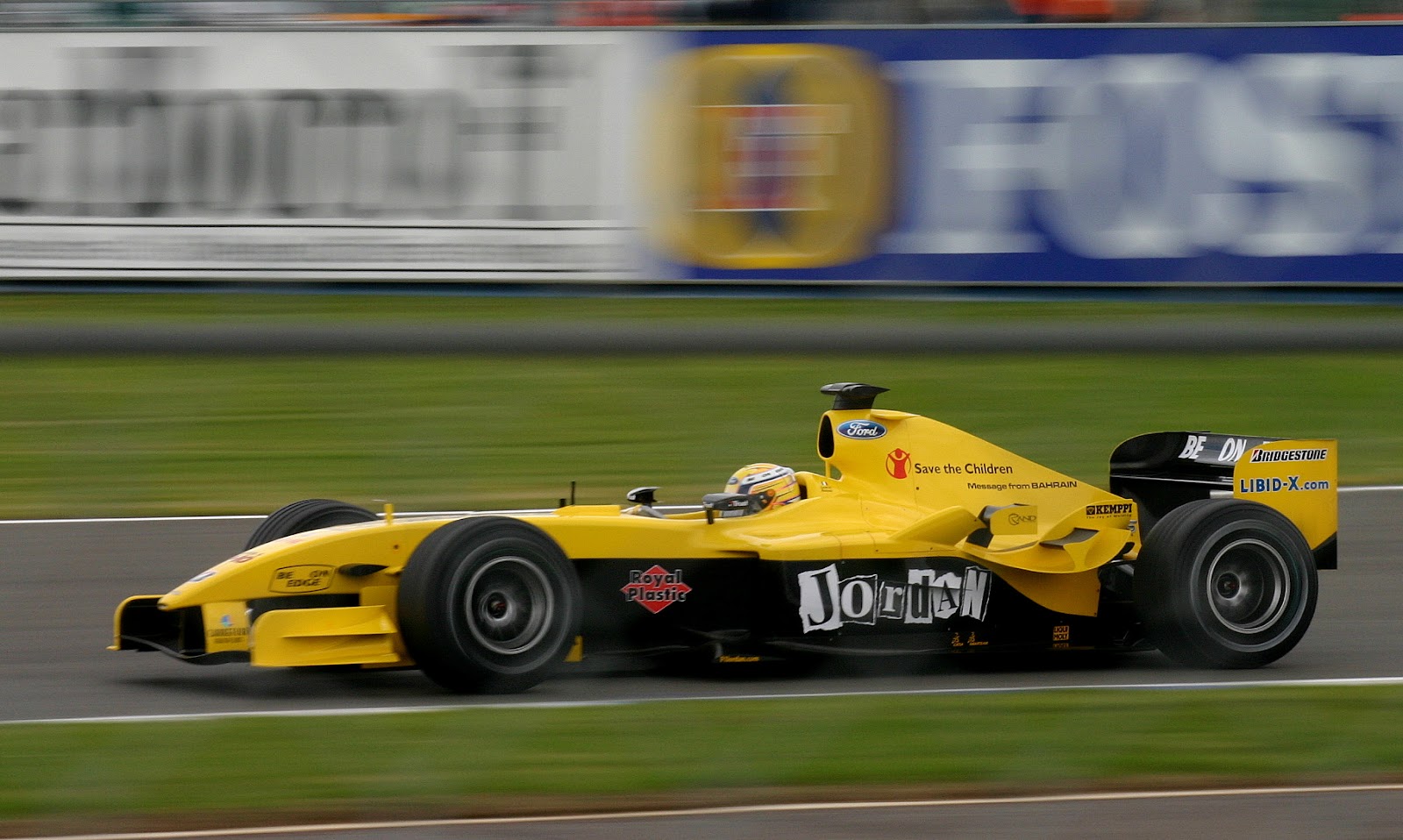
In F1, Jordan reunited with several drivers he had previously run in his British F3 and F3000 operations. Hill and Frentzen gave the Irish-licenced team their first three wins in F1 in 1998 and 1999, while Naspetti, Irvine and Brundle all raced in F1 with the team as well.
Jordan pivoted to motorsport media and consulting after Midland acquired the Jordan F1 team. Jordan served as a pundit on BBC’s F1 coverage in the UK from 2009 to 2015 – teaming up with Brundle for his first three years – and Channel 4’s coverage from 2016 to 2022. He acted as Adrian Newey’s agent and manager in 2024 as the legendary aerodynamicist negotiated a contract to leave Red Bull Racing and join Aston Martin.
“What a character. What a rock star. What a racer,” Brundle wrote in a tribute on X yesterday. “So many drivers owe you so much.”
“We are all going to miss your infectious humour and passion. Thank you for giving talent a chance,” Herbert wrote on Instagram. “We will all remember you for this.”
In addition to countless former colleagues and fans, Jordan leaves behind wife Marie and four children.
We at Feeder Series mourn the passing of Eddie Jordan and send our sincere condolences to his family, friends and former colleagues.
Header photo credit: Nick Goodrum
Make a one-time donation
Make a monthly donation
Make a yearly donation
Choose an amount
Or enter a custom amount
Your contribution is appreciated.
Your contribution is appreciated.
Your contribution is appreciated.
DonateDonate monthlyDonate yearly Feeder Series