

William Alatalo stood out in the junior series for his candid, outspoken, humourous personality online and his impressive results on track despite budget constraints. What might fans have missed from a cursory overview of his junior career, and where has he gone since leaving Formula 3 at the end of 2022? Feeder Series spoke to him to find out.
By Marco Albertini
If you kept up with feeder series three years ago, you would likely have seen the name William Alatalo on your Twitter feed. Known for his comedic personality off the track, Alatalo was serious business on it – even attracting the attention of F1 teams despite having one of the slimmest budgets among drivers on the support bill.
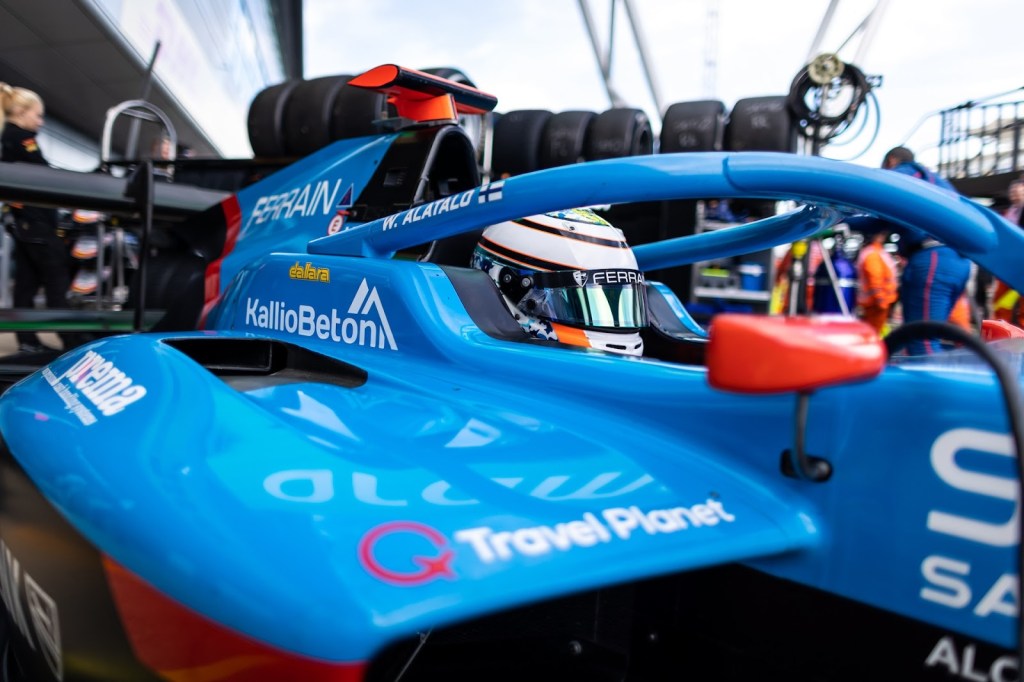
Alatalo competed in just one season of F3, finishing 18th on 24 points. He scored all but two of Jenzer Motorsport’s points that season, with strong drives at Spa and Monza being the highlights of a season on which he looks back with frustration.
Three years on, the 23-year-old Finn with Ethiopian roots has switched to sports cars and now competes in the Italian GT Sprint Championship for BMW Italia Ceccato Racing, the reigning teams’ champions. With two overall podiums, Alatalo and teammate Leonardo Caglioni currently sit third overall in the sprint standings and first in the Pro-Am class standings heading into the third round at Imola in September.
He makes it look easy on track, but initially getting comfortable with the car in 2023 after six years in single-seaters proved challenging.
“It was hard,” Alatalo told Feeder Series in the Italian GT paddock at Mugello. “Especially in 2023 when I did one test with the GT3 and then immediately a race weekend. But I think after those five days of driving, it felt natural. It’s just more weight and you have so much more time. It feels weird.
“Sometimes you feel easier when you go from slow car to fast car, but when you go from fast to slow, everything is too slow. Everything is in slow motion, almost, even though it should be easier. And it is actually easier, but you just have that weird feeling of, ‘Wow, you have so much time’. You don’t know what to do, but then you get used to it after a few days, so it was fine in the end.”
His first full season the following year in Italian GT, which has both a sprint and an endurance championship, was difficult. Racing with the Aston Martin–backed Lazarus Corse team, Alatalo and teammate Mattia Di Giusto scored in five of eight races in the sprint championship. His endurance series campaign alongside three-time MotoGP champion Jorge Lorenzo and former F2 racer Mahaveer Raghunathan yielded zero points.
Still, the fact that Alatalo ended up thriving in circuit racing alongside such storied names already defied chance.
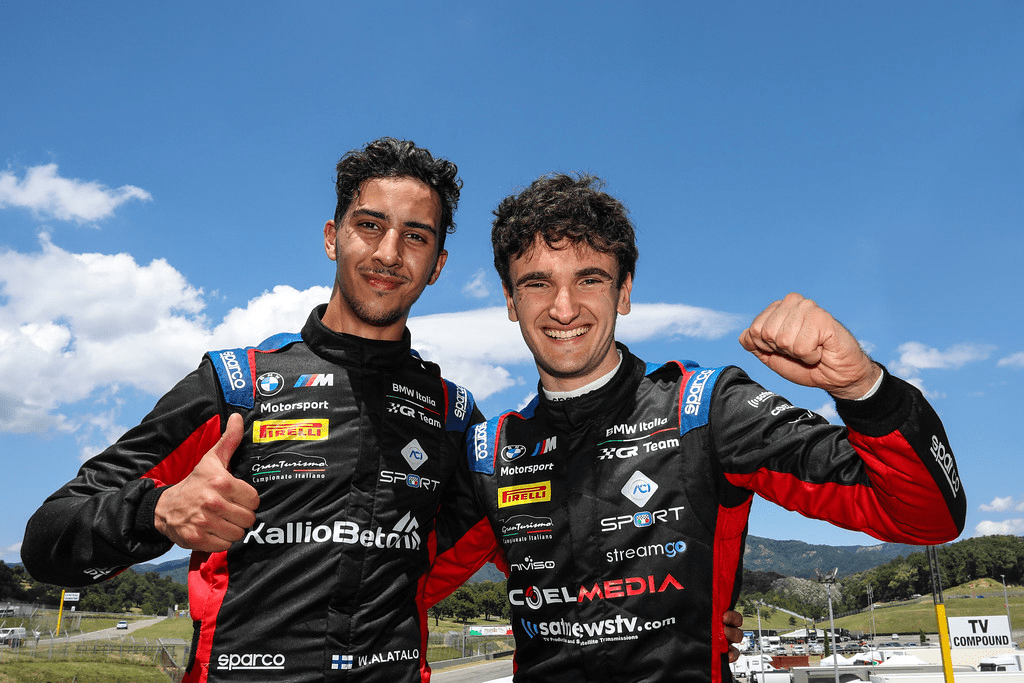
Alatalo hails from the small town of Ilmajoki in the western part of Finland, where the resources that frequently kickstart professional racing careers aren’t exactly in abundance. His peers who did pursue motorsport tended to go for rallying, which has a much stronger foothold in the cold, snowy landscapes of rural Finland. He chose a different path.
“Rally was never really my passion,” he said. “I like driving rally – I’ve tried it also in the snow, in the dirt – but you don’t have that wheel-to-wheel racing, and that’s what I like most about being a racing driver, going against other drivers. In rally, you are just chasing the lap time.”
Alatalo took up karting after receiving one on his seventh birthday and quickly began racking up accolades in his native Finland, winning two national championships in 2014 and 2016. He also competed in European karting, albeit without any top-10 finishes.
“Europe was always not easy for me,” Alatalo admitted. “I never raced in a top team, and my personal attitude in karting was not on the level as others. Everybody else was driving every day [in] karting. I was going to race weekends without practice, also for budget reasons. It’s not because I didn’t want to, it’s that I didn’t have the money to do testing.
“I still have good memories, but it was very hard in Europe for me to be even in the top ten. I think more tests would have been better for me, but I didn’t drive enough in karting when I was young. In Finland, I did some testing because it was cheaper just from [the] back of my father’s van.”
In 2017, the same year he made his last appearances in karting, Alatalo made his single-seater debut in the Formula STCC Nordic series for Kart in Club Driving Academy. Racing an entry-level, 1.6-litre Formula Renault chassis, Alatalo was fifth in points in the three-round series with one win at Anderstorp to his name.
Even with limited testing, the transition to single-seaters ’wasn’t hard’, Alatalo said. But while looking back at his season, he notes that shifting gears was more challenging in the Signatech-built Formula Renault chassis than in the F4 cars he raced in subsequent years.
“You had to use the clutch even on the downshift and upshift or throttle blip, so it was a bit more difficult than in Formula 4,” Alatalo said. “You have paddle shifts [in F4], so it was a bit difficult in the beginning to have that, but in the end, I think I got used to it pretty quickly.“
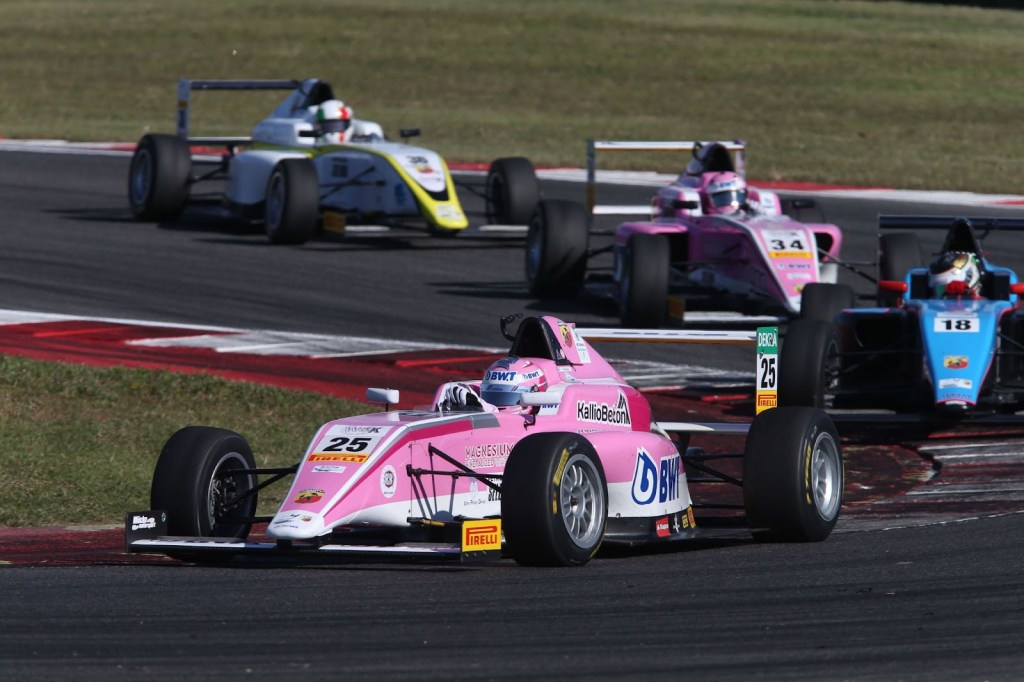
Having learned the basics, Alatalo got his first taste of the newer F4 machinery in two rounds of F4 UAE at Yas Marina in the winter of 2018.
Racing for Mücke Motorsport, Alatalo took two third-place finishes in the first round before taking two consecutive wins in his final outing later that February.
“The tyres, the chassis, engine was different, but it was not a massive step for me even if it was more simple with the gear changes and everything,” Alatalo said.
“The biggest step was just the tracks. I’ve been driving two-, three-kilometer tracks in Finland, then you go to Abu Dhabi and you drive the full-length track and the speeds on the corners and on the straight and everywhere was completely different.
“As the first race weekend I was not too bad. I had two wins there, so it was not a bad start as a Formula 4 career start and I was actually very optimistic after that to go drive in Italy. Obviously, the level is completely different. You have some racing drivers in the UAE, you have 10 to 15 drivers, but in Italy the level is obviously much harder.”
Alatalo stayed with Mücke Motorsport for his debut Italian F4 season in 2018 and scored one win in race two at Monza, helping him finish eighth in points.
“Being on the podium there was something we were not really expecting that weekend, but the speed was fantastic,” Alatalo said. “P8 as my first F4 year in Italian F4 was a good result.
“I don’t think I drove nearly the same amount as the others. They drove German F4, they drove more tests in Italy than me… but I was happy driving with the team. Sometimes I felt like the budget in the team and the focus was not 100%, but it was still a good team [for] my first year in F4.”
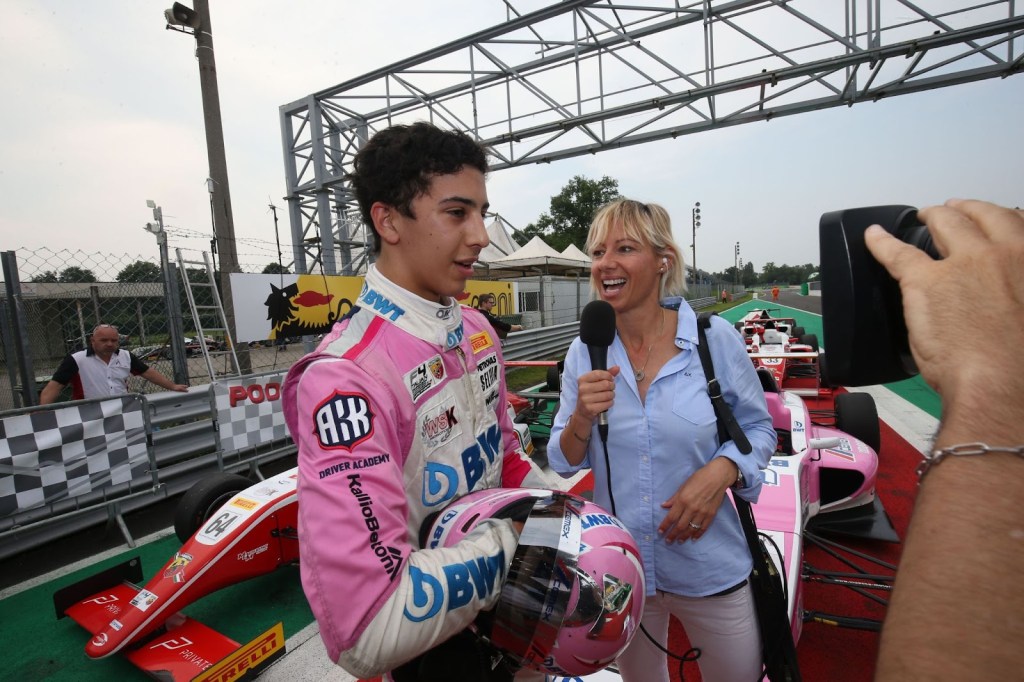
Alatalo stayed with Mücke Motorsport for another season of Italian F4 but didn’t score a podium throughout the season. He only took a best result of fourth four times and ended the year ninth in points.
He was more successful in his one-off appearance in ADAC F4 at the Red Bull Ring, finishing third and second in the first two races before capping off the weekend with a fifth-place finish.
“I went to drive one race because I was actually planning to do more tests in Italy, but the team didn’t go to those, so they said, ‘Do you want to drive one race in ADAC?’, and we said, ‘Yeah, that’s fine’,” Alatalo explained.
“I was expecting good results, but I think that weekend I was the most points gained or the second most points as a driver, so it was a very good weekend. But unfortunately [it] was not my main series.
“[In] Italian F4 I reached P4, but never the podium. I think my driving was really not there. I hit the wall at some point, in a metaphorical way. … Like a mouse running on the running track in the wheel, you run and run and run but you go nowhere, and that’s how I felt.
“I think at some point, we went to the wrong direction in trying to fix the car [when I] maybe should have just done more simple things and focus just on the driving.”
Another podium came at the end of 2019, when Alatalo represented Finland in the first edition of the FIA Motorsport Games in the F4 Cup at Vallelunga, a circuit he knew from Italian F4. He qualified 10th, progressed to fifth in the qualifying race and eventually finished third in the main event.
From within the cockpit, however, the event wasn’t so straightforward.
All drivers raced KC Motorgroup’s newly built KC-MG 01 car in the event, centrally run by Hitech GP. The car featured a hybrid system and the halo protection device, which was not otherwise used in F4 competition until late 2021. At 635 kg, it was also 65 kg heavier than the Tatuus F4 T-014 Alatalo drove in Italian F4.
“I didn’t actually like the car at all, to be honest. The first problem was my size. I didn’t really fit in the car and my feet were too wide, so every time I pushed the brake, it hit the steering rack, so I couldn’t push the brake properly,” Alatalo said. “My feet size is like 43, 44, so it’s not massive, but still I had that problem, and other drivers with size 41 didn’t have the problem, so that was very annoying to me. I couldn’t really apply proper hard brakes without having that issue.
“Even so, there were strange rules in the championship. At first you couldn’t change the car set-up at all. Then some drivers or engineer-driver combination changed it, and then we’re like,
‘Okay, so you can change,’ and they say, ‘Yeah, you can’.
“[It was a] weird race weekend in general. I didn’t like the car, didn’t like driving there, and still was P3 in the main race and was happy to get the bronze medal. The car also was very new, was very heavy – much heavier than normal F4 – so you had to drive it also a bit differently.”

Alatalo then stepped up to Formula Renault Eurocup in 2020. Teaming up with David Vidales at JD Motorsport, the Finn stood on the podium in both races at the second round at Imola as his teammate won both. Neither driver reached those heights, again, however. After taking four top-five finishes in the first five races, Alatalo never finished higher than seventh and ended the year eighth in points, two spots behind Vidales.
In its last two years in 2019 and 2020, Formula Renault Eurocup adopted the Tatuus F3 T-318 chassis currently used in the FRegional Europe series, with which it merged at the end of the year. Compared to the Tatuus F4 T-014 Alatalo drove in Italian F4, the Formula Renault Eurocup chassis was 95 kg heavier, 110 hp more powerful, and several seconds per lap faster.
“You could definitely feel the difference in the grip and the power,” Alatalo said. “But [I’m] not a big fan again with the car because it’s heavier, and with Hankook tyres that year, you felt like driving a road car. It’s heavy. Taking it to an extreme, it’s a little bit faster than a normal Toyota, but it still felt very slow in the slow corners, whereas in the fast corners, actually you feel good because of the aero.
“I think the start of the year was quite good. I had many technical problems that year and on those races where I could have been in the top five, which was a bit unfortunate. But then when we didn’t have technical problems, we had very good weekends, like Imola, even in Monza the speed was fine. And then some weekends I was in P nowhere, really.
“I didn’t feel like I drove very badly and I also didn’t feel like the car was really off, and then we were a second off and it was a strange feeling sometimes. I just fought my way through [and] tried my best.”
Alatalo stayed in the series after the merger, joining Arden Motorsport alongside current F3 driver Nicola Marinangeli and endurance racing standout Alex Quinn.
In his sophomore campaign in FR machinery, Alatalo again started the season well with seven points finishes in the first eight races, including his lone podium at Paul Ricard. Though he managed to finish every race, Alatalo dropped off in scoring and finished 11th with 91 points, two places and 13 points behind teammate Quinn.
“[It] was very weird that I scored a podium [at Paul Ricard] because the … front anti-roll bar was not connected, so it was horrible to drive.
“That’s why I was so slow. Everybody thought I did well because I was P3, but actually the speed was s**t because normally it’s much different. In the other race weekends, sometimes a bit better, sometimes a bit worse.
“It was me versus Alex Quinn. He’s a really good driver. Some weekends he was a bit faster, some weekends I was a bit faster, but I think after a few race weekends, or after Paul Ricard, we never again really gained the speed back. It’s tough when you don’t really know why you are half a second away. Is it the driving? Is it the car? Is it the mix of both? I always knew that I could drive a bit better, but I didn’t know how to find that half a second.”
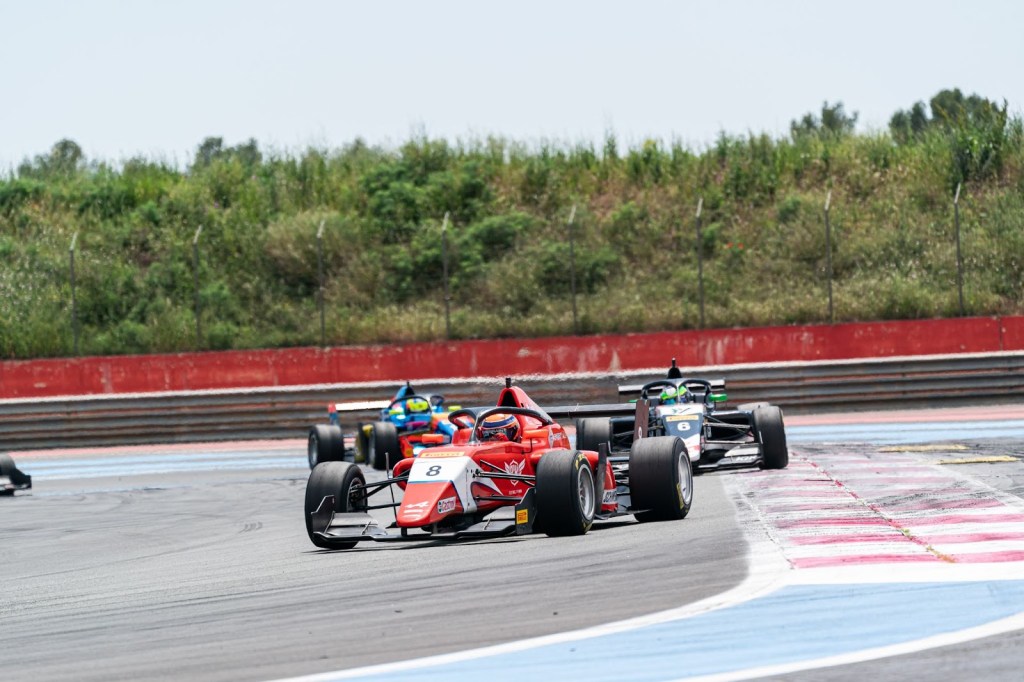
In the winter of 2022, Alatalo signed with Jenzer Motorsport to step up to F3 for the following year. In his only season in the championship, Alatalo took a best result of sixth in the sprint race at Spa-Francorchamps and ended the year 18th in points.
Alatalo said he wishes he had done more than just two days of testing prior to the season in GP3 machinery.
“It felt really hard at the end-of-2021 tests,” Alatalo said. “At Jerez and Valencia, I didn’t get well with the car, but then I go to Bahrain [at the] beginning of the year and suddenly it feels easy, good to drive after half a month of no driving.
“My second push lap ever in Bahrain was like one of my fastest laps during all the three days of testing, so it was very strange. After that, it felt fine to drive. It was not a big step anymore from regional to F3.”
Despite outperforming the machinery he had, Alatalo was and is unhappy about some of his strongest performances, feeling as though he would’ve been closer to the top 10 if he hadn’t made certain mistakes.
“I know that [Jenzer] are not a top team, but I know it’s a good team. It’s a team I trust and they worked super hard,” said Alatalo, who is still friends with the Jenzer mechanics to this day. “I know they really tried their best, also so did I.
“I think speed-wise I was sometimes very good, but I f***ed up twice in qualifying. I remember two qualifyings just with track limits, when there’s 10, 20 centimeters over the white line and that’s it. In Monza in the last race, the track limits played a part. Otherwise, [I] would have been P3.
“[At the] Hungaroring, some tyre guys went to change the tyre. I didn’t. Otherwise I could have been again on the podium, or at least top five somewhere, but it’s obviously easy to say afterwards. But it felt like many times, it’s just not pure speed but my own small mistakes, or strategy-wise, I f***ed up myself. And those still hold me in my nightmares.
“So it’s not a nice topic for me, but otherwise I think sometimes I drove really well and still was P15, P13, and sometimes I didn’t drive well and actually I was well in the points.
“I was a rookie driver again in F3. My teammates were not and I was in the end ahead of them, but that year I think I could have been easily close to the top 10 just on those few races where I didn’t, wouldn’t have made a mistake. I would have scored much higher points, but again, easy to say afterwards.”
At the end of the season, Alatalo participated in an evaluation test for the Williams Racing Driver Academy, which had expanded significantly in the previous year. He performed well on the simulator, but an agreement couldn’t be reached because of budget-related issues, Feeder Series understands.
Those same issues threatened to derail his single-seater career entirely, though they were not the only factor in his departure from single-seaters. Alatalo was also close to a deal to race in the European Le Mans Series’ LMP2 class for 2023, but budget limitations and mandatory military service forced him to remain in Finland for most of that year.
All this meant that Alatalo had to wait until June 2023 for his next outing in racing, when he joined AKM Motorsport for a one-off appearance in Italian GT’s sprint championship. He was ranked 14th and 15th in the two races he ran at Monza with teammate Lorenzo Ferrari.
While he awaited a return to competition, Alatalo tested various types of cars, ranging from old GP3 machinery to prototypes. While he ultimately found a path forward in motorsport, the uncertainty made him re-evaluate his future.
“I drove tests with GT, GT2, and LMP2,” Alatalo said. “I did testing even with formulas, actually. I did test for Jenzer, GP3 testing for like four days. I didn’t drive a lot, but I did some testing. I just didn’t really know what’s the next step for me. Is it LMP? Is it GT? Is it what championship?
“If I would have two million in my bank account, I wouldn’t need to think that much, but unfortunately I don’t have two million, not even one. So that was a problem. And then it was a year where I just tried to understand what I do in life.
“Where I want to go is in GT. And then, at the end of 2023, I decided I want to drive GT3 and even in the Italian championship. It’s good to start my career here. Hopefully I don’t end my career here. I’m still driving here, but hopefully I’ll get to bigger races also.”
Header image credit: Dutch Photo Agency
Make a one-time donation
Make a monthly donation
Make a yearly donation
Choose an amount
Or enter a custom amount
Your contribution is appreciated.
Your contribution is appreciated.
Your contribution is appreciated.
DonateDonate monthlyDonate yearly Feeder Series
One thought on “The untold story of William Alatalo, F3’s outspoken underdog ”