
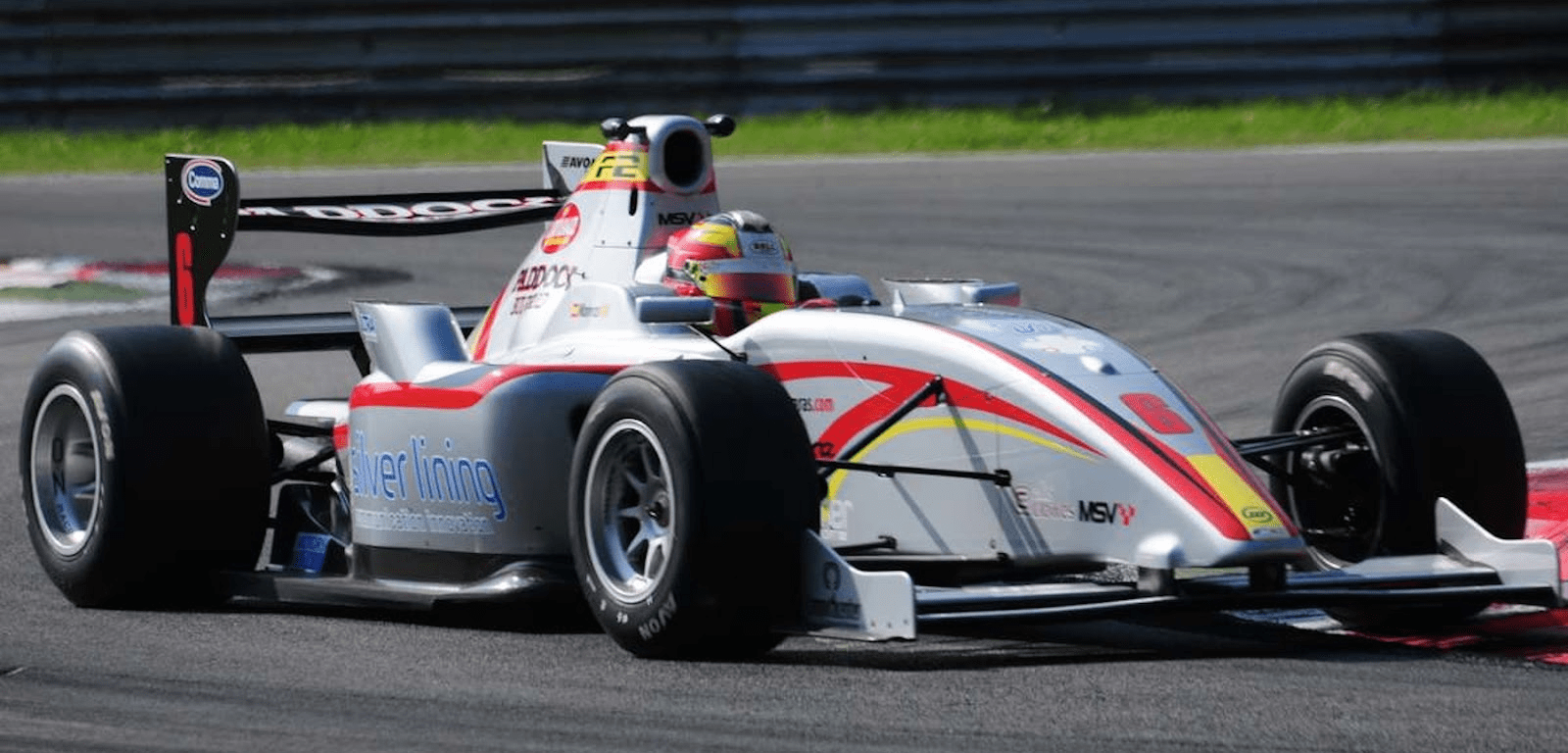
In the late 2000s, Miki Monrás was one of Spain’s brightest prospects on the junior single-seater ladder, trading blows with the likes of Daniel Ricciardo, Valtteri Bottas and António Félix da Costa in Formula Renault and GP3. But while his rivals pushed on towards F1 or careers in GTs, the Spaniard’s single-seater journey came to an abrupt halt in 2011. Feeder Series caught up with Monrás to reflect on the times he rubbed shoulders with greatness, the challenges of racing in the post–financial crisis era, and life beyond motorsport.
By Anabelle Bremner
Back in the noughties, the path from karting to Formula 1 looked nothing like it does today. There was no standardised Formula 4, no carefully managed ladder – just a patchwork of championships that rewarded those brave enough, and wealthy enough, to dive straight in. Eurocup Formula Renault 2.0 was as deep as it got: 40-car grids stacked with future stars, the proving ground where Pierre Gasly, Nyck de Vries and Lando Norris would come to cut their teeth.
But before all of them, it was Monrás in the thick of it. He made his single-seater debut in late 2007, the result of years spent chasing speed. His first taste of racing, in fact, came on two wheels – on a motocross bike, inspired by his father, who had raced professionally in Spain and Europe. At the age of eight, Monrás joined a motocross camp, and it wasn’t long before karting came calling.
“After the first race, I really enjoyed it,” he recalls. “I remember it was Christmastime and I asked for a motocross scooter and for a go-kart. So I finally got the go-kart, and that’s the way I started. Then I started racing in Catalonia, and I just moved through Spain and Europe and all the world championships until formula.”
Single-seater racing, however, would prove a unique beast. Shortly before turning 16, Monrás moved straight from karting into Formula Renault 2.0, in which the competition was fierce.
“Normally at that age you’d go before to a category not straight to 2.0,” he said. “My first year I was racing with Bottas, I was racing with Ricciardo, I was racing with [Andrea] Caldarelli – really good drivers.… I was racing against people that were already racing for two years in single-seaters. That was a big difference.”
His first Eurocup campaign, in 2008, proved a challenging one. He was scoreless for his first five rounds with the Hitech Junior Team (no relation to the current Hitech) before a switch to SG Formula brought him six points in the final two rounds. Valtteri Bottas, then of Motopark Academy, went on to claim that year’s title after a close fight involving Ricciardo, Caldarelli and Roberto Merhi.
The next year brought Monrás a decidedly better season and three podiums with SG Formula, owned by Mercedes Junior Team advisor Stéphane Guerin. He wound up fifth overall in a season dominated by a fierce three-way fight between Félix da Costa, Jean-Éric Vergne and Albert Costa – the last of whom ultimately took the title.
Racing against so much talent at such a young age left Monrás with plenty of perspective on what might have been.
“Ricciardo was my teammate. Jean-Éric Vergne was my teammate. I raced with Da Costa, Bottas, with Magnussen, so many people that have been racing each other and winning races,” he said. “[I] think if I changed something at that point, maybe I would be in Formula 1, but who knows. Maybe yes, maybe no.
“But at that time, it was really difficult times because it was 2010, ’11, ’12, where there was also a big crisis in the world, especially in Europe. It was really difficult for Spanish drivers to get the sponsors and the money to race.”
The financial squeeze triggered by the 2008 global financial crisis left Monrás and many of his peers in a precarious position. Several teams, such as SG Formula, shut their doors in the wake of the crisis amidst an already shifting landscape in junior racing.
“It’s been changing a lot from that time until now. When I was racing Eurocup 2.0, one time we were like 48 drivers, I remember. 2008 at Spa. It was a massive level and so many drivers wanted to go in,” he said. “Eurocup was really high level, I would say maybe [comparable] to Formula 4 about the car and the lap times.
“Motorsport has changed a lot in the last few years. It’s more expensive. At that time, Eurocup was also expensive, but I think Formula 4 is around €700,000 more or less, maybe more now. It’s quite expensive. Back then, I think Eurocup was around €300,000 or €250,000, so there was a massive difference. A lot more people could race at that time.”
After two and a half years competing in various Formula Renault series, Monrás stepped up to GP3 in 2010. The inaugural season, won by eventual F1 driver Esteban Gutiérrez, came with another steep learning curve. Monrás managed two podiums and a 10th-place finish in the standings, but the step up exposed the limits of what talent alone could achieve in a field packed with hungry, well-backed drivers.
“When I raced GP3, that was the first year of the championship, so it was a new championship for all of the teams. I also raced with Arden, which was a new team in the category, so it made it a bit difficult,” he said. “During testing, I remember I was flying in GP3, and then suddenly in some races there was such a huge difference with some other cars and drivers. It was difficult sometimes. … I think this is always present in motorsport in all categories. You will find some kind of differences within cars and teams. It just will always be there.”
Challenging as it was, that season had its highs for Monrás. A recovery drive in Spa’s characteristic rain remains a fond memory for the Spaniard.
“I had a really bad qualifying because there were some yellow flags,” he explained. “Because there were 30 cars, it was easy to find yellow flags if you’re waiting for the last minutes in qualifying. I finished [ninth in] race one, and in race two it started raining really heavily after five laps. I went from P10 to P3, nearly fighting for the win in the last lap against Rossi and Tambay. That was a really good race.”
After a season in GP3, Monrás moved up a rung on the ladder to Formula Two. At the time, the feeder series landscape was fragmented. GP2 and Formula Renault 3.5 offered established paths to Formula 1, while the MotorSport Vision’s FIA Formula Two Championship, which first ran in 2009, aimed to do the same with a more affordable package.
“Formula Two at that point was very competitive, economically speaking,” Monrás said. “It was a lot cheaper to race in Formula Two than race in GP2 at that moment or 3.5 because it was like all one team. All the cars were one team with different engineers, and that made it low cost for the time.
“A lot of drivers went to it because of that. They were racing in the best tracks, same as World Series and similar to GP2, and the car was competitive. Maybe not as competitive as GP2 or 3.5 because it was a bit slower, but it was really competitive and really fast, on the straight especially.”
“In that time, what they were saying was it was very equal. You had one engineer for three cars, you were sharing data with these three cars, and it was all under the same team. You can always find differences in motorsport. Maybe not a difference to make one car win and one car P15, but you can still always find two-tenths difference in similar cars, and two tenths, sometimes it’s a lot of time,” he said.
“The cars were on the same team, but each engineer was doing the set-up for his driver. The set-up I was using and maybe the set-up Bortolotti was using, he had won the championship maybe from our different set-ups. Every race, you changed engineers. Every weekend, you were rotating engineers so at the end of the season, everybody worked with everyone.”
By 2012, the funding had dried up. Monrás was left sponsorless and unable to compete in Formula Two. He sampled GT racing in the Blancpain Endurance Series and tested with both Audi Sport and Atech GP, but no program materialised. From there, Monrás transitioned into driver coaching and team management – mostly with the AV Formula team owned by his manager, Adrian Vallés – and eventually “moved on” from motorsport around 2017.
“I was working also with McLaren Automotive, but it was not motorsport. It was automotive, developing road cars, really competitive cars. After that I decided to stop because I wanted to follow a new career professionally, and I moved onto real estate which I have always been [involved with] because of my family, so that’s why I decided to move over,” he said. “I now work in a real estate company which I own with some partners, and that’s my day-to-day nowadays.”
After years climbing the ladder in lockstep with some of the sport’s future stars, Monrás has found a new rhythm – one that’s decidedly less fast, but no less his own. Yet his career remains a reminder of the talent that defined an era: a Spaniard who went wheel to wheel with the likes of Ricciardo, Bottas, and Vergne, racing in some of the deepest junior grids of the 2000s and 2010s. In the story of that generation, Monrás may no longer be on track, but he’s never far from the memory of it all.
Interview by Sean McKean
Header photo credit: Pietro Zoccola
Make a one-time donation
Make a monthly donation
Make a yearly donation
Choose an amount
Or enter a custom amount
Your contribution is appreciated.
Your contribution is appreciated.
Your contribution is appreciated.
DonateDonate monthlyDonate yearly Feeder Series