
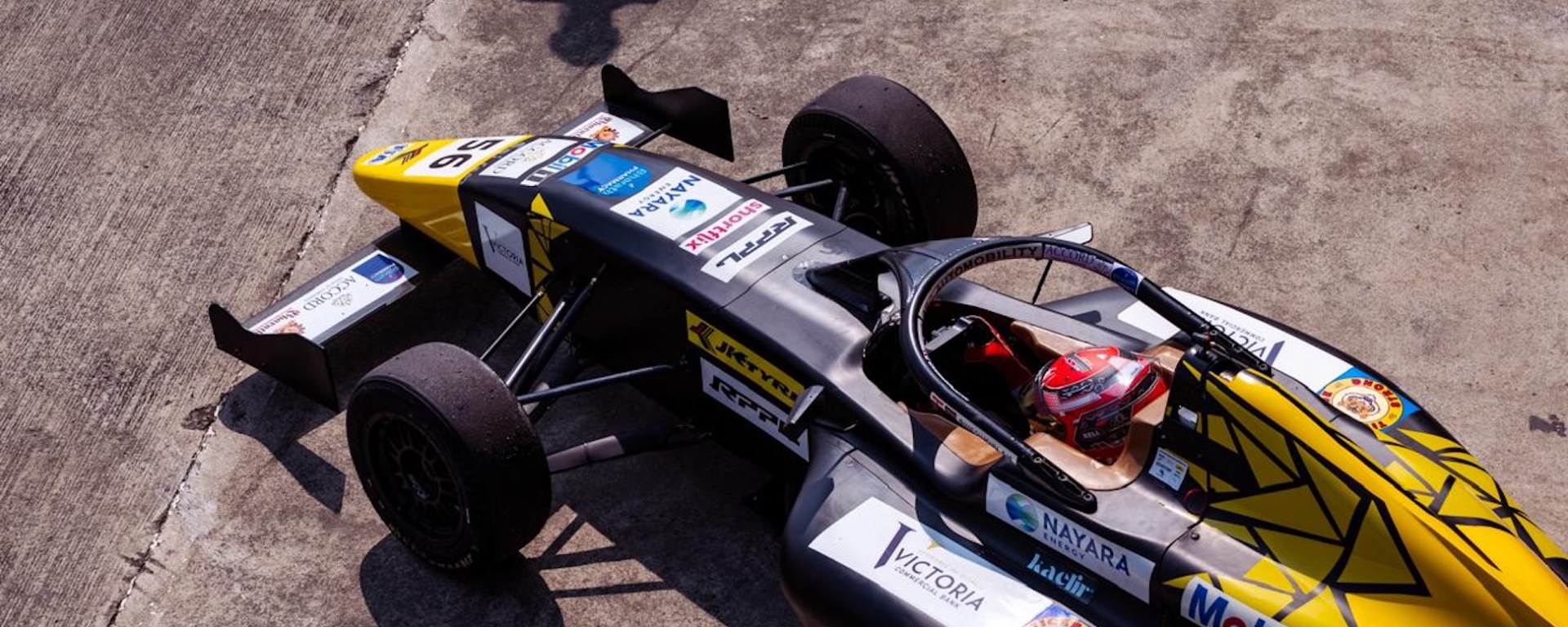
Shane Chandaria sealed his name into the single-seater history books last year as the first Kenyan to win an FIA-sanctioned single-seater championship after a sublime debut campaign in Indian F4. The reigning champion spoke with Feeder Series about his journey to the top step and what will come next.
By Grayson Wallace
Beginning a motorsport career in Kenya, a country that has traditionally produced more rally and motorcycle racers, is less than conventional.
Shane Chandaria, however, took it as a challenge. After moving his way up the karting ranks in East Africa and England, he stormed into the world of single-seaters at age 15 by winning the Indian F4 championship as a rookie, taking three wins and eight podiums across the season.
“I don’t think it really hit me until I got out of the car and saw my parents and my family there cheering me on. Then I realised that we’d come and we’d done it in our first season, which was really empowering,” he told Feeder Series.
Chandaria and his family had come a long way from his early days in club karting at the Great Rift Valley Circuit, located about 50 kilometres north-west of Nairobi. There were ‘about five’ karters in total in the country, Chandaria said, and he naturally found success as he moved up the ranks in the Kenya National Karting Championship. Chandaria aspired to more, however, and set his sights on the United Kingdom, where he competed in the British Kart Championship. In his first year in the Junior Rotax category in 2024, he finished 37th. He rejoined the following year for the first three of six rounds – which ultimately placed him 40th in the standings.
He had stepped away from karting to pivot to single-seaters, beginning with the Formula Global Shootout Programme (FGSP), which took place at Circuit du Var in France in June 2025. The programme, launched in 2024, intended to bring international racing drivers into Indian F4, offering a fully funded seat for the championship to the shootout winner.
Last year’s programme shootout, which had a total of 11 racers, took place across three days. Drivers were evaluated based on overall performance in the assessments. Day one included interviews, fitness evaluations, sim racing and reaction time tests, whilst the activities on days two and three took place on track.
“I didn’t really know what to expect, but it was well run,” Chandaria said about the programme. “It was just tricky because we only got four sessions and you had to make the most of it by learning the track and making the improvement as soon as the coaches told you to. If you needed to change something, like braking later into Turn 1, you had to do it from the first lap of the next session to be able to be on the pace.”
Most of the other FGSP competitors were also new to the world of single-seaters, creating an equal playing field for the prize.
“It was really small margins in the practice sessions and even in the shootouts on the last day,” Chandaria said. “It was really competitive.”
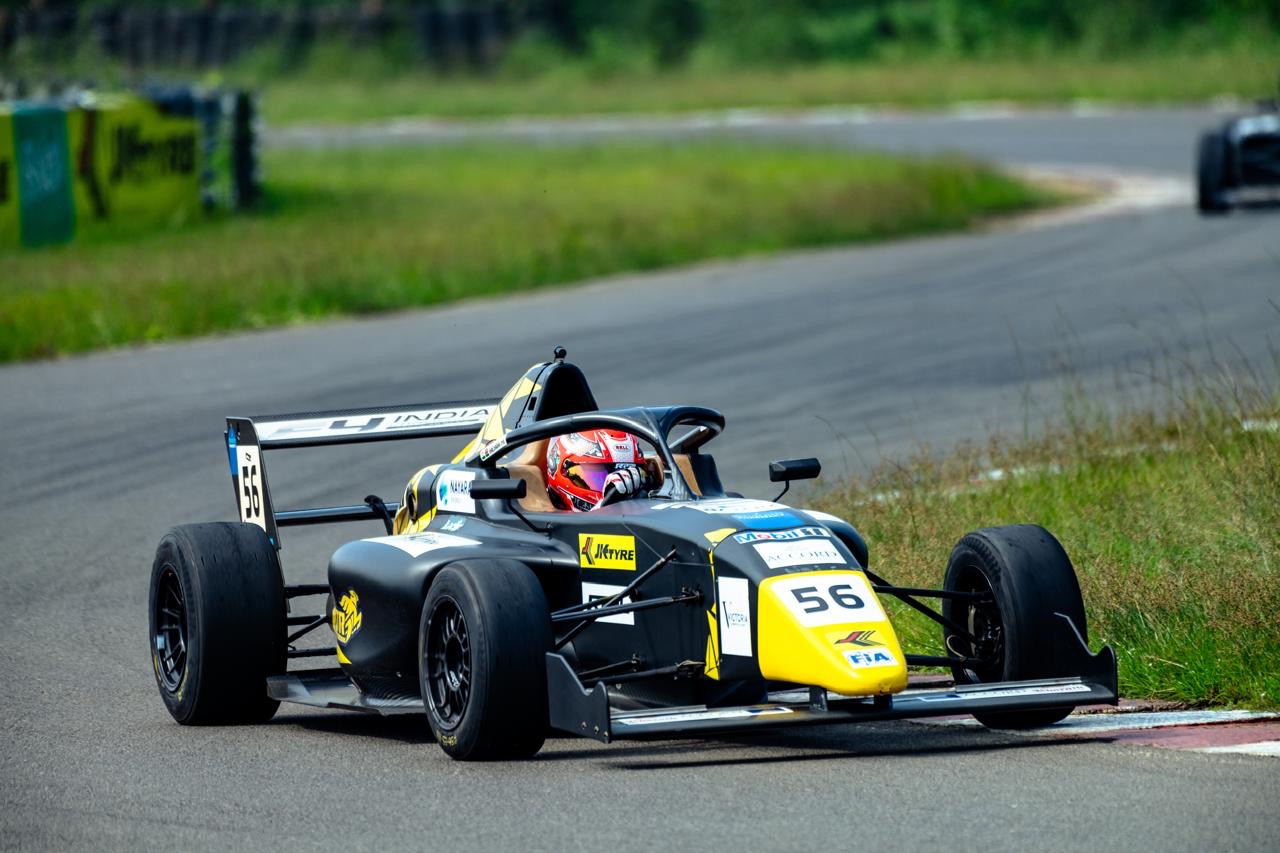
Chandaria placed third in the contest, which was won by Sachel Rotgé, then 19. Chandaria, then 15, continued into the Indian F4 season with the Chennai Turbo Riders squad, who previously fielded 2023 champion Cooper Webster. Making the jump from karting in the UK to F4 in India was ‘a big step up’ for the Kenyan.
“There are a lot more fans and people that come in to watch, and you’re racing at bigger tracks,” he said. “Everything’s just at a bigger scale. If you crash, it costs a lot more, and if you win, people take it more seriously than if you win a kart race.”
Chandaria achieved second- and fifth-place finishes in his first out of five rounds in the championship at Kari Motor Speedway. A retirement and a seventh-place finish in the first two races at the Madras International Circuit held him back, but he picked up the pace again in race three and took his maiden victory at Madras from pole.
“Looking back at it, I did make mistakes. In the first two rounds, I got a grid penalty [for opening-lap contact in race two at Kari], which definitely hindered my racing a bit. I think in round three, I just made a lot of mistakes that were kind of rookie errors, but when I went to rounds four and five, I improved a lot. I learnt from my mistakes quite quickly.”
Though he won two races in the first three rounds, the Kenyan only claimed two other podiums, giving other competitors such as Rotgé and Ishaan Madesh – who had two and three wins respectively – time to catch up to him.
By the third visit to Kari in round four, Chandaria had mastered his race craft effectively enough to be in genuine contention every race. He came out of the weekend with a podium finish in third on Saturday, as well as a fifth place in the second race and yet another win in the third race on Sunday.
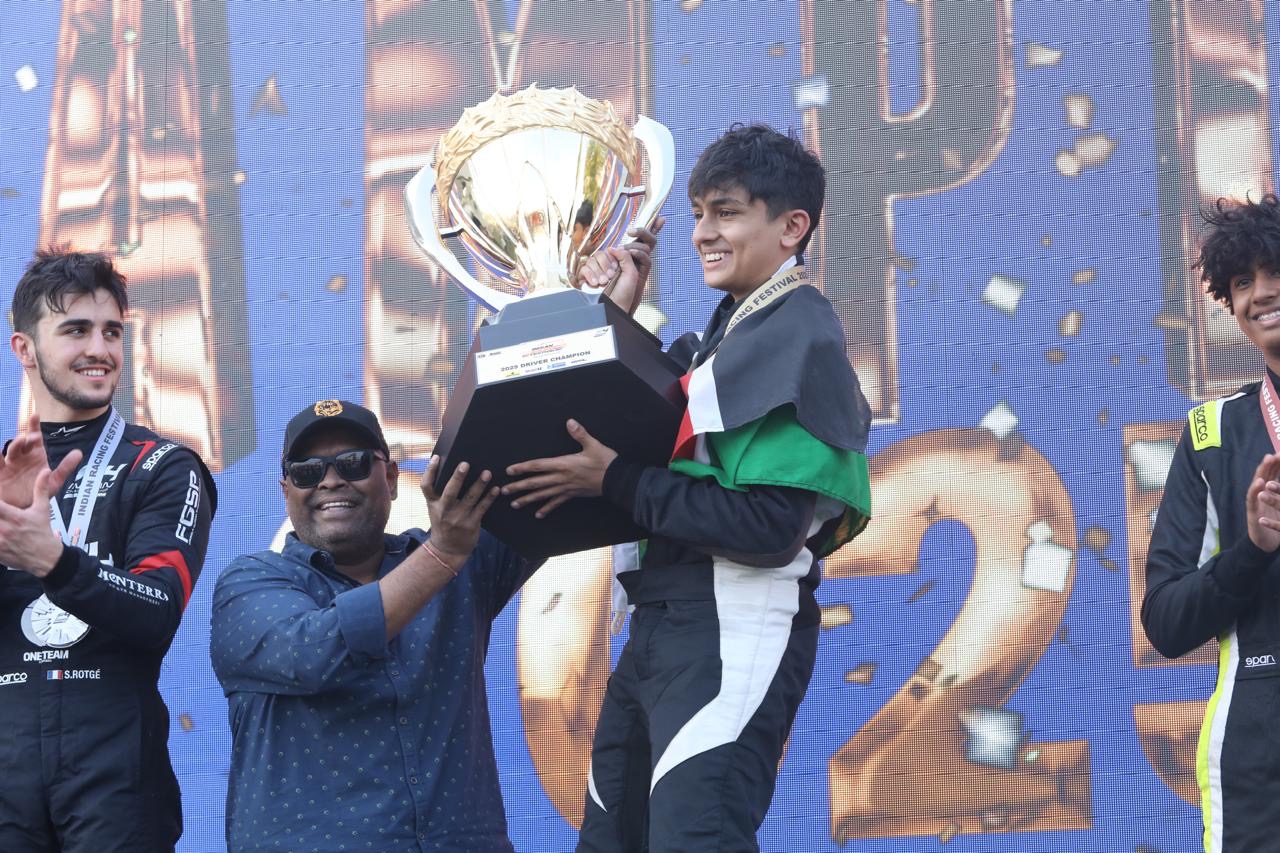
Returning to Madras in the final round, Chandaria had two podium finishes – enough to achieve his dreams of earning his first single-seater championship. The battle between him and runner-up Rotgé continued to the penultimate race. Chandaria finished with 186 points, 18 more than the Frenchman, and took a total of three wins across the 15 races in the season.
“When I came across the last corner and across the line and realised I was champion, it was a great feeling,” Chandaria said. “It felt like a lot of pressure was off me. It was also a big confidence boost. It proved to me that all the hard work and everything was worth it.”
The 16-year-old will be proceeding to the French F4 championship as part of iM4’s driver development programme in 2026. Like Indian F4 with FGSP, French F4 partners with the Feed Racing scholarship programme to offer a driver free entry. The series, which has no teams, is instead centrally run by the Fédération Française du Sport Automobile (FFSA), allowing it to be low-cost, similar to Indian F4.
Header photo courtesy of Shane Chandaria
Make a one-time donation
Your contribution is appreciated.
DonateMake a monthly donation
Your contribution is appreciated.
Donate monthlyMake a yearly donation
Your contribution is appreciated.
Donate yearly Feeder Series