
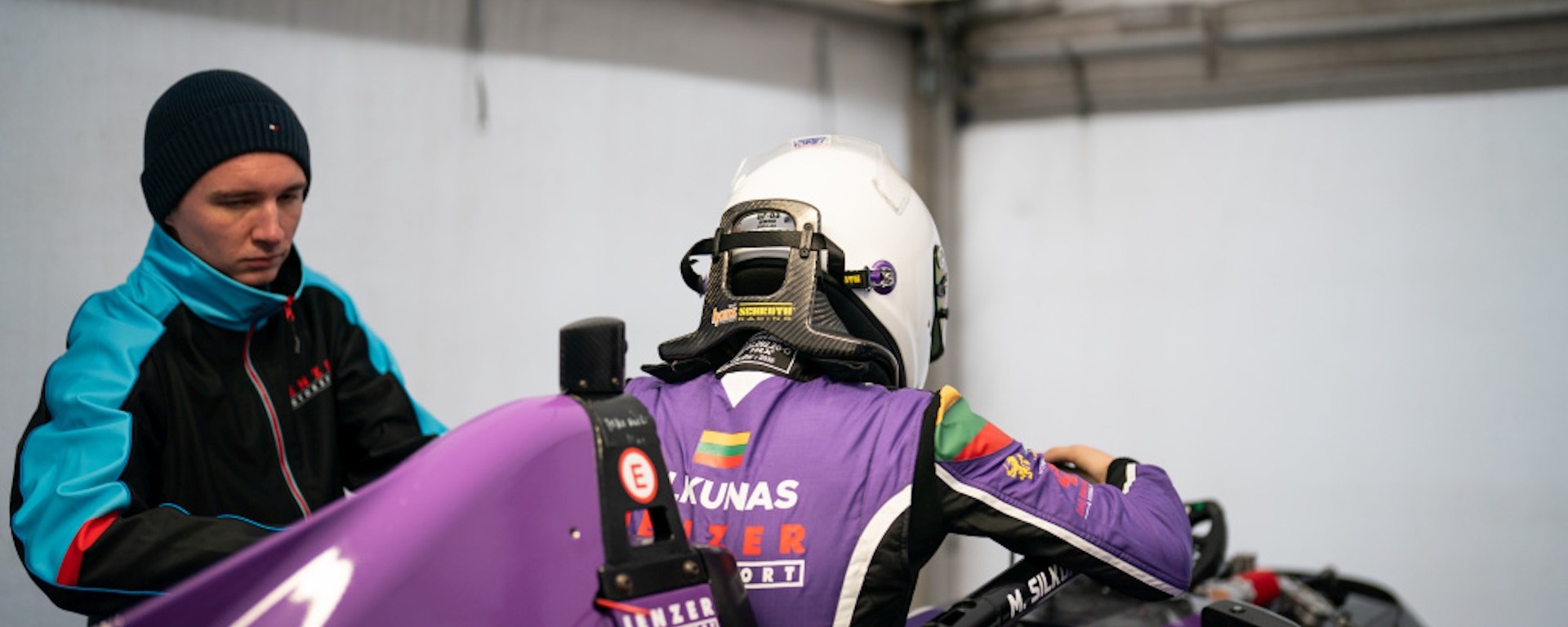
Two Lithuanian drivers will line up on the Formula 4 Central European Zone grid this season, while a Lithuanian racing team is quietly preparing for a potential F4 programme of its own. After a long period on the margins of the junior single-seater ladder, Lithuania is building momentum for a new generation of drivers hoping to forge a path to the highest levels of international racing. Feeder Series investigates the developments already underway.
By Maciej Jackiewicz
Tomas Rudokas’ karting career, as a whole, looks quite like those of many other single-seater hopefuls. He began karting at the age of seven, won his national championship and eventually moved to various European kart championships, scoring points but never managing to win a major event or take home a title.
As he turned 15 in 2024 and became eligible for most single-seater series, he had a choice: stay local in Lithuania or look elsewhere for more competition. Without the backing of multimillionaire parents or an F1 junior programme, the latter would be difficult, and the Vilnius native naturally gravitated to the former.
Unlike many of his peers, however, he had no nearby F4 series to enter. Instead, the Vilnius native gained experience in GT racing, competing in the BGT Pro class of the Baltic Touring Car Championship and finishing second overall. He also appeared in the season finale of the Porsche Sprint Challenge Central Europe at Brno in Czechia, securing a podium finish in the first of the three races.
His opportunity in F4 emerged only a few weeks later. The Austrian FormelAustria Race Academy team, which has a partnership with F4 CEZ team Renauer Motorsport, signed Rudokas for the 2026 season, with additional preparation coming through outings in the Formula Winter Series. Fellow Lithuanian Markas Šilkūnas is running a similar programme with Jenzer Motorsport, making those two championships the first F4 series in recorded history to have featured two Lithuanian competitors in the same season.
With a population of just under three million people, Lithuania is beginning to make its presence felt in junior single-seater racing. This is already visible with two drivers taking on F4 and further competitors winning races in karts. As the championship based the closest to Lithuania, F4 CEZ has attracted the current crop of drivers, but more developments are underway to offer a more seamless path to single-seater glory than the atypical pathway Rudokas had to follow.
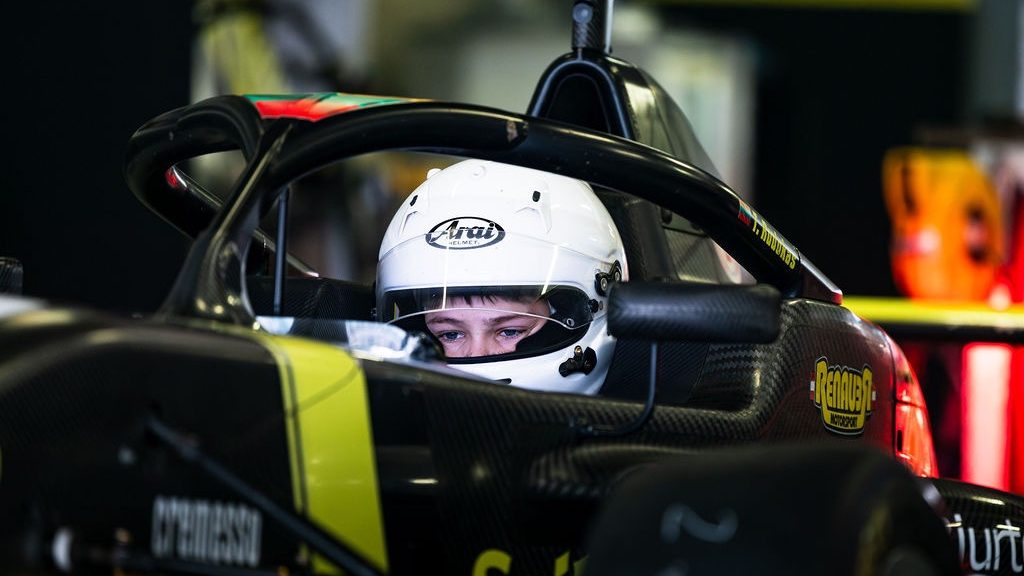
Šilkūnas is one who has followed the more traditional path from karts directly into single-seaters, albeit only doing so aged 17. In 2025, the Kaunas native, born on New Year’s Day 2009, competed full-time in the Champions of the Future Academy Program’s OK-N class, becoming champion of the series with a 149-point gap over Red Bull junior Chiara Bättig.
“ I was really happy because I didn’t expect that we can win quite a big championship,” Šilkūnas said about his 2025 COTFA campaign. “And then when we came after the first round, we understood that we have the pace to win the championship, so that’s what I did in the end.”
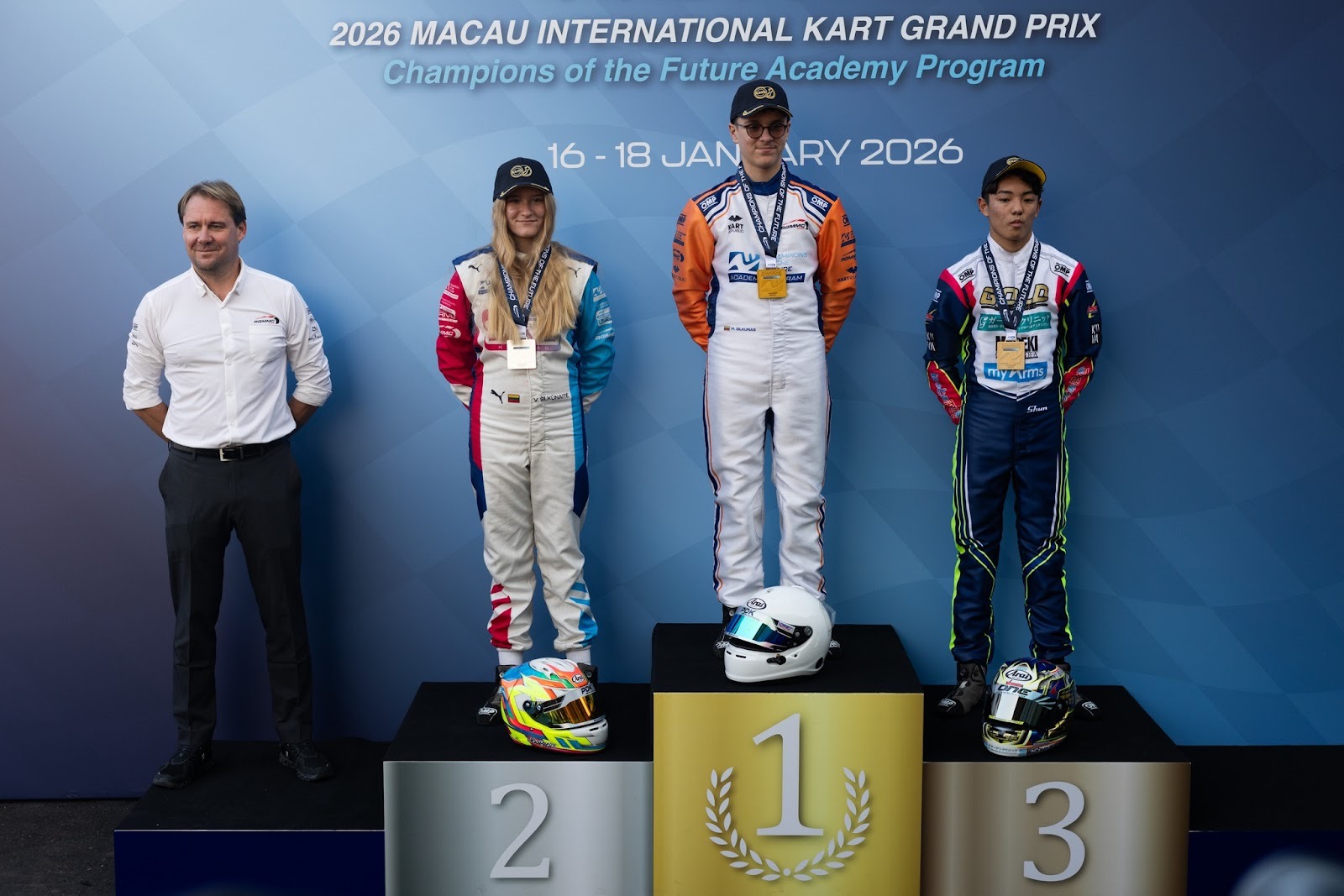
Šilkūnas came out on top once more in a COTFA showcase round at Macau in January 2026.
Just a few days later, the 17-year-old hit the track for the first round of FWS at Estoril, where he hoped to translate his karting talent to car racing prowess. After five rounds, Šilkūnas’ best result was 12th place, scored four times. But it was never about headline results for him.
“Our goals for this winter series was to prepare for [F4 CEZ] and we thought that it would be good if we would finish somewhere in the middle, more or less,” Šilkūnas said “So that’s where we were finishing, but [we] had much more pace than that – just got unlucky a few times.”
The Šilkūnas family has no known motorsport background, but they are becoming increasingly known within Lithuanian junior racing circles. Markas’ younger sister, Vanesa Šilkūnaitė, is showing great pace in the karting world. The 15-year-old got her first karting title in 2019 by winning the Micro 60 class in the Lithuanian Karting Championship before regularly competing at the most famous European tracks.
The first breakthrough of her career came in 2023, when she won the FIA Girls on Track – Rising Stars program in the Junior class alongside Senior winner Alba Larsen, currently a Ferrari junior. Two years later, she was chosen for the F1 Academy Discover Your Drive initiative, with her main campaign being split across the OK-NJ and OK-N classes of COTFA.
“ It means a lot to me because I’m from a small country like Lithuania,” Šilkūnaitė said about being part of F1 Academy Discover Your Drive. “It pushed me even harder to try my best, and it shows that I can compete with the boys and it’s not just for the boys, this sport.”
For this year, she was retained by the F1 Academy Discover Your Drive program. Her first win of the year came at the COTFA event in Macau, where she won one of the races to finish second overall, just one point behind her brother, with whom she shared the track in the latter half of 2025.
“ It’s really difficult because you don’t want to destroy his race as well, but you always compete like crazy, you try to push each other as much as you can and forward, to overtake and to be better than him,” Šilkūnaitė said about her brother.
“No papaya rules,” Šilkūnas joked.
For this season, Šilkūnaitė will stay in karting but has set her sights on testing F4 machinery across the season to prepare for a potential 2027 campaign.
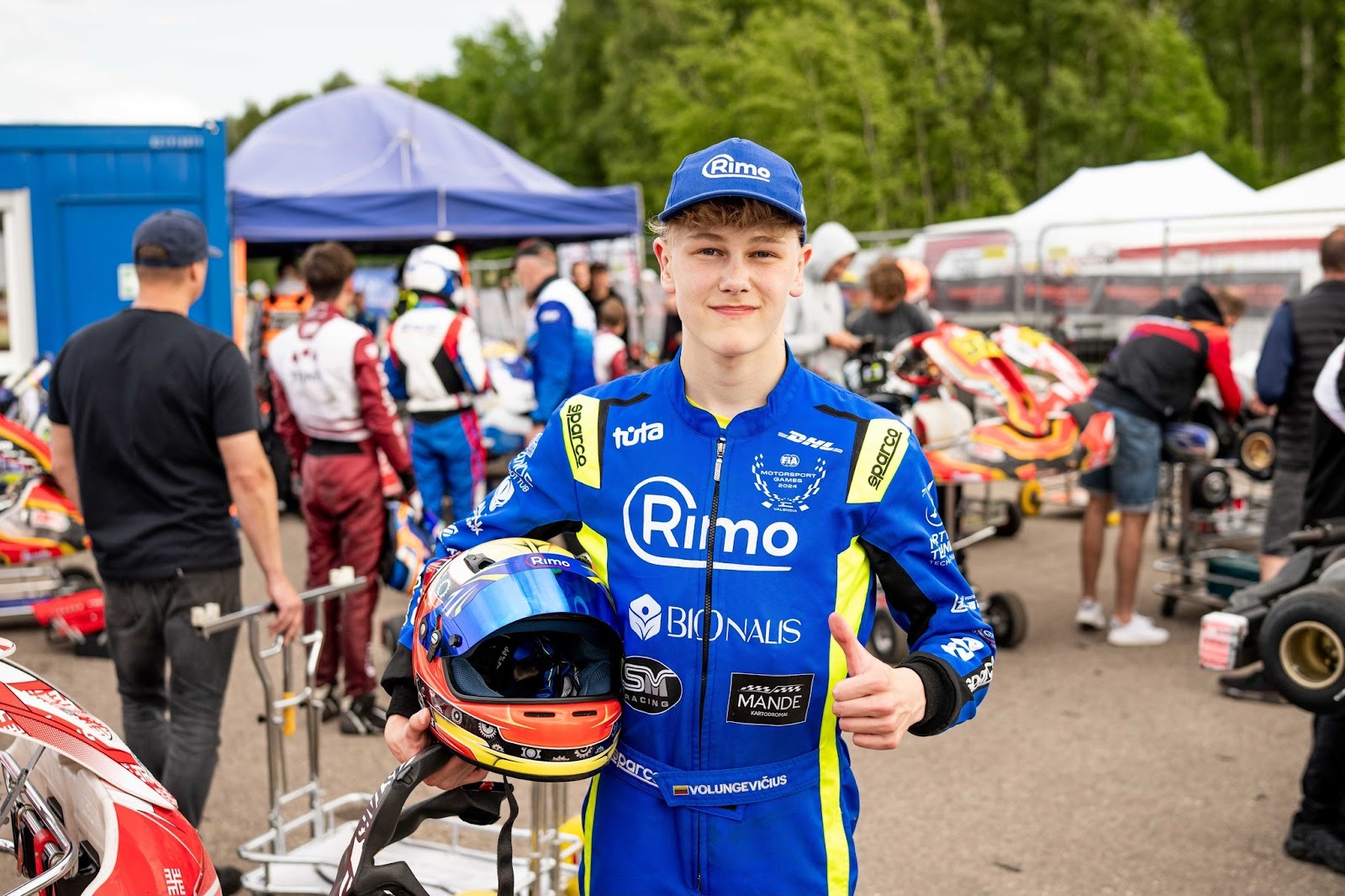
The emergence of Rudokas and Šilkūnas in F4 represents a landmark moment for Lithuania, but they are not the only drivers to have done so recently. Last February, Linas Volungevičius took his first steps in single-seater machinery when he tested at Circuit Ricardo Tormo with Juta Racing. Volungevičius was then one of 12 drivers chosen for Indian F4’s 2025 Formula Global Shootout Program in June, but he fell short of earning a fully paid seat in Indian F4 after the shootout at the Circuit du Var in France.
“The selection in France was a very important experience, as it was a chance to get closer to single-seaters and one of the first opportunities to win a scholarship for an FIA-certified Formula 4 championship. The first days of testing went really well and I also showed strong performance in the simulator and in media activities,” Volungevičius wrote to Feeder Series. “For me, it was an invaluable experience – working with the AGS F1 team was a big step and what I gained there will stay with me for life.”
The main issue for Volungevičius was budget. He was originally set to compete in FWS and F4 CEZ in 2025, but a lack of money kept either opportunity from coming to fruition. He therefore stayed in karting for 2025, with his most notable result being fourth position in the senior class of the brand-new FIA Karting Arrive and Drive World Cup.
“In Malaysia, I finished fourth in a very strong international field, in my class out of 52 drivers. It felt like a podium was within reach – I was setting fastest laps and closing in on the leaders, but I missed out on the shootout by just one position, as the race was stopped due to a tropical rainstorm and red flags were shown,” the Lithuanian driver said.
Despite those strong karting results, Volungevičius did not find a place on a single-seater grid for 2026. The main hurdle for him remains budget.
“Formula 4 is still my goal, but at the moment it remains a dream, even though real opportunities exist – I receive quite a few offers from teams and programs to compete in Formula 4 or other car racing championships. In reality, I don’t even need to promote myself, but there are no free seats,” the 16-year-old added. “Since funding remains the biggest challenge in Lithuania, this year I also plan to participate in junior selection programmes on my own initiative, where, if successful, it is possible to earn a scholarship through performance.”
In FWS and F4 CEZ, Volungevičius was supposed to race with Juta Racing, a prominent Lithuanian team in the world of European GT racing. In 2025, they competed in the 24 Hours of the Nürburgring and scored three GT3 Am class podiums in the 24H Series.
Juta purchased a Tatuus T-421 car at the very end of 2024 with the ambition of competing in the 2025 seasons of FWS and F4 CEZ, but the plan did not work out as Volungevičius could not collect enough budget.
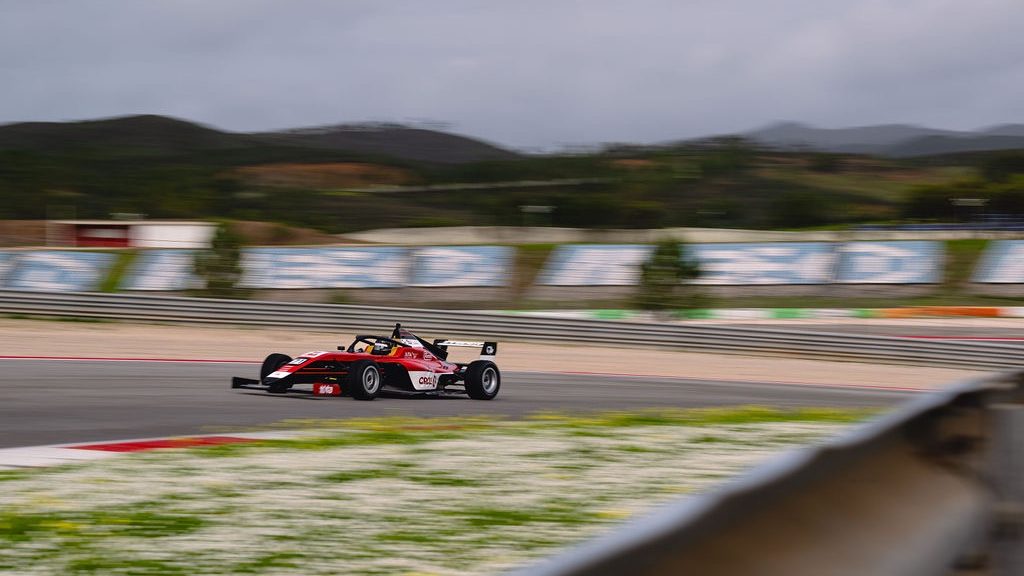
Still, they have tested their Tatuus across the Iberian Peninsula as recently as February this year, when the Kaunas-based outfit appeared at Algarve International Circuit in Portimão. For now, the team is focused on providing testing opportunities rather than race seats as they focus on other commitments.
“Our goal with F4 was a testing programme for our local tracks,” said Juta Racing’s team manager Jonas Gelžinis, a racing driver in his own right. “We have one renovated track from our workshop, another circuit will be built by the end of this year. So it’s mostly orientated for kids immediately after karting, so they have a chance to test at local tracks, to feel the formula [F4], and then we satellite them to other teams if they want to race full season somewhere.”
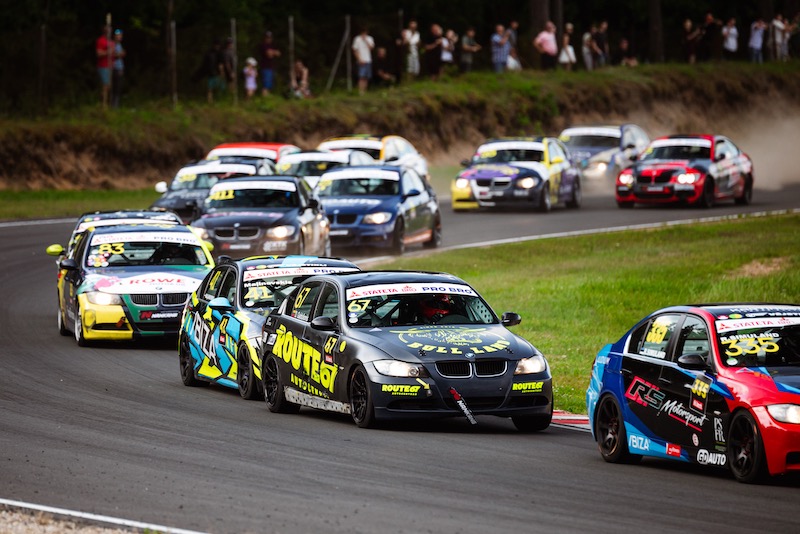
Juta Racing could be called the backbone of an active Lithuanian circuit racing scene, though the highlight takes place on one of the most unusual circuits still in use today. The Aurum 1006 km race is held on a temporary circuit located at the intersection of two highways, A11 and A13, near the coastal town of Palanga. The main partner of Juta Racing, UAB Juta, is the official tyre supplier for the race.
Since its first edition in 2000, a large and diverse grid featuring GT3 cars, GT4 cars, cup cars, touring cars and even road-spec Ladas and Volkswagens have tackled the 2.682 km track every year. The event features mostly Lithuanian competitors but has attracted such names as sports car racer Peter Dumbreck, who won the 2008 race, and Estonian brothers Ralf Aron – a three-time winner – and Paul Aron. Apart from being a great racing spectacle, the Aurum 1006 km is a perfect way for ordinary people to witness motorsport up close.
“It’s really, really popular because the track is by the sea and everyone comes there to not only watch the race but to feel the energy and the hype. So it’s a big race, but last few years the number of participants are going down and down,” Šilkūnas reflected.
The Palanga event is not the only racing competition happening within Lithuania. Year after year, the Baltic Touring Car Championship (BaTCC), which features a mix of GT and touring car machinery and drivers with backgrounds as diverse as Rudokas’, visits Lithuania’s only purpose-built circuit, Nemuno Žiedas. Located in Kačerginė, a small town near Kaunas, Nemuno Žiedas is considered highly dangerous, with limited gravel traps and Armco barriers.
This situation might change in the near future. In May 2025, it was announced that a brand-new venue would be constructed in Lithuania. The 3.3 km Lithuanian Motorsport Park circuit in the Jonava district, around 40 km away from Kaunas, will be built with the plan to earn an FIA Grade 3 license, which would allow it to host regional F4 championships. The project is being spearheaded by Jonas Karklys, a Lithuanian technology entrepreneur and racing driver who has spent the past few years competing in the ADAC GT Masters series.
“We are currently finalising various project details, ranging from interior design and asphalt selection to engineering networks,” Karklys wrote to Feeder Series. “With most of the planning and design work complete, we are now in the home stretch. We are awaiting final evaluations from local authorities regarding our compliance with set criteria and expect to break ground this summer. The new track is scheduled to open in the spring or summer of next year.”
The venue is also set to include a karting track to foster the growth of future Lithuanian racing stars. Completion of the complex would fulfil Juta Racing’s main goal of enabling young drivers from the Baltic region to test F4 machinery in Lithuania.
“It’s a good way to make the racing more popular in the country, because it’s all things included there. Karting, single-seaters track, rally as well. It’s going to be a big part of making more people come, watch and see the racing more closely,” Kaunas native Šilkūnaitė said.
Taken together, these developments point to something larger than isolated efforts. For years, Lithuanian representation on the international junior single-seater ladder was sporadic at best. Now, multiple young drivers are stepping into F4 machinery, a domestic team has invested in its own car, and a new FIA-homologated circuit is under construction.
The pathway to the top echelons of motorsport is demanding, and it often requires looking beyond Lithuania’s borders. Yet it is no longer an abstract dream. It is a route that – in some ways – has already been travelled stateside.
In 2001, Henry and Daiva Malukas, who immigrated to the Chicago area from Lithuania in the early 1990s, gave birth to their fourth child, David Malukas. The first-generation American grew up to pursue auto racing, though he donned his ancestral homeland’s flag on his overalls throughout his junior single-seater career.
Malukas contested only one season in Europe – the 2017 edition of ADAC F4 season, which was also the only campaign in which Malukas raced under a Lithuanian flag. He then switched to the American single-seater ladder for 2018 and finished fourth in the Pro Mazda Championship before moving up to Indy Lights for 2019 with BN Racing. In his debut year in the second tier, he scored two podiums and ended the campaign in sixth, though the bigger story was that his parents’ HMD Motorsports entity had taken over leadership of the BN Racing outfit in August of that year.
In 2020, he was scheduled to compete in Indy Lights again with HMD, but with the season being cancelled because of the COVID-19 pandemic, the American-Lithuanian driver switched to FR Americas, in which he finished as the runner-up. Returning to Indy Lights for 2021, Malukas again came second following a season-long duel with current IndyCar points leader Kyle Kirkwood.
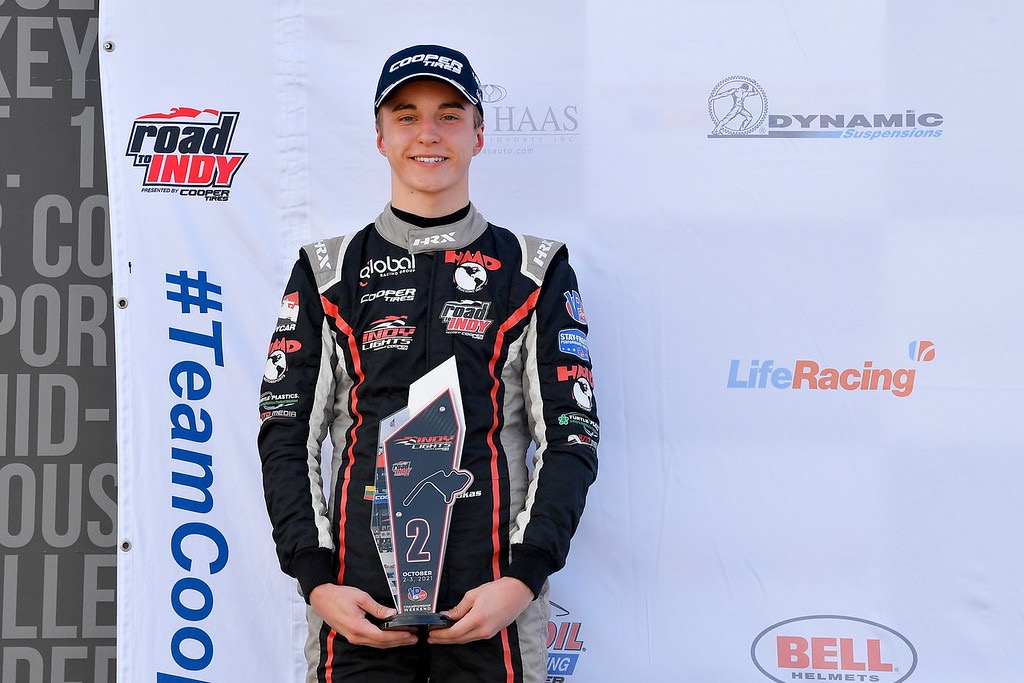
The next year, he advanced to IndyCar with Dale Coyne Racing. Across his next four years in the series, mostly with smaller teams, he stood on the podium three times. For the 2026 campaign, Malukas joined one of IndyCar’s main powerhouses, Team Penske. He sits fourth in the standings with a podium and pole position at Phoenix.
It will take years before any Lithuanian driver nears the heights of what Malukas has achieved. For now, Rudokas, Šilkūnas, Šilkūnaitė and Volungevičius are simply looking to maintain their homeland’s motorsport momentum.
Rudokas already scored his first single-seater points during a chaotic season opener at Estoril, finishing in eighth, but an accident in the last race of the second round at Portimão left him with a broken thumb, abruptly cutting short his campaign. He and Šilkūnas return to the track this weekend for F4 CEZ’s season opener at the Red Bull Ring, which features a record grid exceeding 40 cars. Success, even at a team as dominant as Jenzer, is by no means guaranteed.
Having two drivers in this series, however, can already be considered a major step forward for Lithuanian motorsport. While budget will still be an issue for some drivers, the construction of a brand-new circuit in the country will give the youngest talents a more accessible training ground for progressing up the racing ladder. And one day, it may just help produce the first Lithuanian driver in F1.
Additional reporting by Finjo Muschlien
Header photo credit: Jenzer Motorsport
Make a one-time donation
Make a monthly donation
Make a yearly donation
Choose an amount
Or enter a custom amount
Your contribution is appreciated.
Your contribution is appreciated.
Your contribution is appreciated.
DonateDonate monthlyDonate yearly Feeder Series