
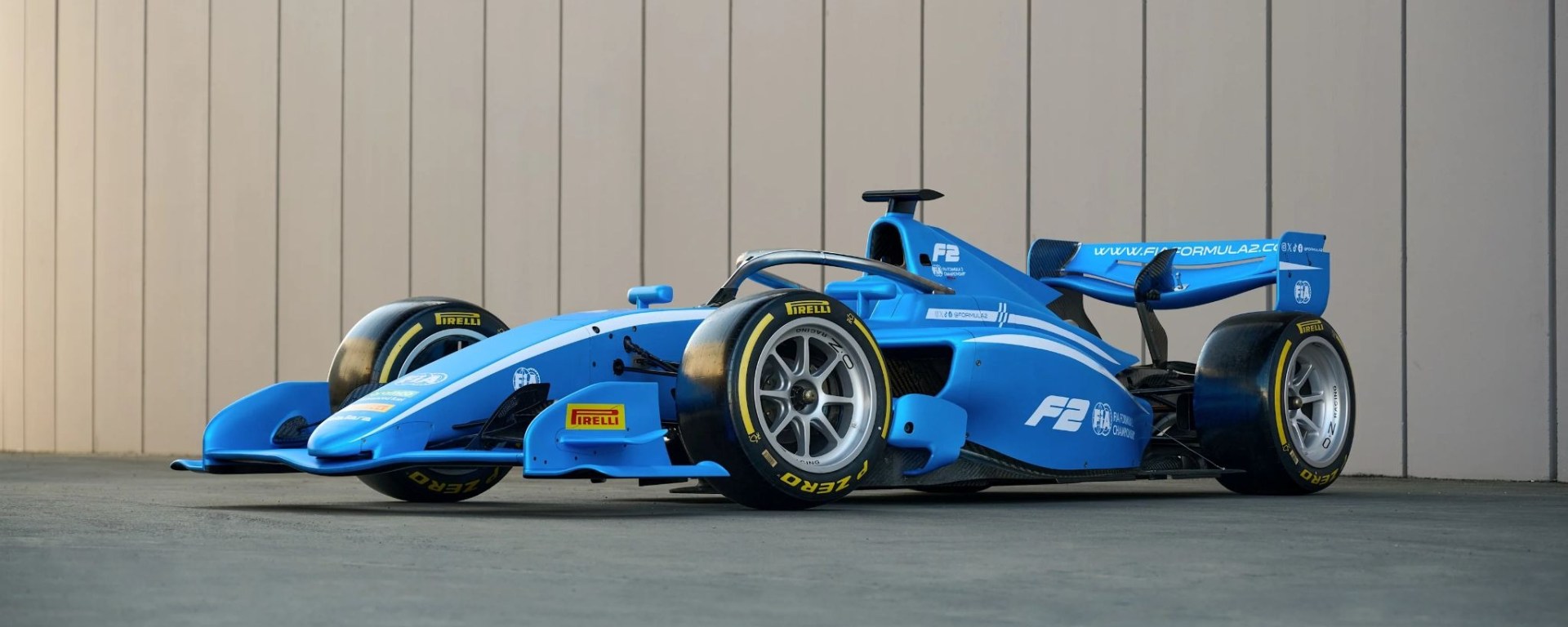
The FIA Formula 2 Championship unveiled the updated version of its Dallara-manufactured car to be used in the championship from 2027 to 2029, incorporating elements of F1’s new-for-2026 aerodynamic philosophy while retaining the existing chassis. Feeder Series has all the information you need to get you up to speed.
By Cliona Sheerin
F2 will revamp the Dallara F2 2024 with a new aerodynamic package featuring reconfigured front and rear wings, mirroring the designs prescribed by F1’s 2026 regulations. The changes will be incorporated into the existing chassis, unveiled 31 August 2023 and brought to the track in 2024, for cost-saving purposes.
The car will also feature a significant increase of 25 points of downforce and three points of drag, facilitating closer racing and allowing cars to follow one another more easily.
F2 will not opt for F1’s new system of active aerodynamics, retaining the drag-reduction system for the coming seasons. DRS has been a feature of the second tier of single-seater racing since its introduction for the 2015 season of GP2.
One of the key additions to the car for next season is an all-new onboard starter, which will aid drivers in getting the car running again after incidents or stalls. A newly designed gearbox with an externally adjustable non-hydraulic ramp differential will be implemented by long-term provider Hewland to integrate the starter.
In terms of braking performance, steering effort and cockpit ergonomics, the car package remains functionally identical to its 2026 configuration. The series will also retain the 3.4-litre turbocharged Mecachrome engine, used since 2018; 100 per cent sustainable fuel mixture by Aramco, introduced in 2025; and Pirelli tyre supply arrangement.
F2 currently runs in three-year cycles, with the new design marking the starting point of an era that will run until the end of 2029.
Speaking at a press conference immediately after the car presentation at the Autodromo Nazionale Monza, F2 CEO Bruno Michel spoke about the importance of bringing the car in line with F1’s regulations to best prepare drivers for the step up to the pinnacle of single-seater racing.
“The goal, the mission of Formula 2 has always been to prepare drivers for Formula 1 and to make sure that when they get into Formula 1, they are ready. The car plays a very important role in this preparation,” he said.
“What we are always trying to do – because we are making a new car generally every three years or a complete new or an upgrade of the existing car – we’re trying to get as close as possible of what Formula 1 is at this very stage to make sure that the drivers are going to be ready when they jump into Formula 1. And that goes not only with the car but also with the tyres because we’re using the same supplies, the same partner, as Formula 1. With many other subjects of the car, we’re trying to make sure the drivers are getting as ready as possible.”
FIA single-seater director Nikolas Tombazis highlighted the new aerodynamics and starter motor as standout features of the design.
“This car is actually a significant upgrade of the previous car,” he said. “There’s a lot of similarities that brings a lot of commonality for cost reasons to retain the financial sustainability of the sport, which is always a priority.
“With that said, there are some very significant changes on the aerodynamics. As Bruno said, there has been a desire to align much more with the Formula 1 philosophy, so all the aerodynamics are new, and I think that will guarantee even better ability to follow closely other cars – not that this is a problem in Formula 2 in general.
“There’s also the starter motor which has been added that is again another important feature in order to avoid, from a sporting point of view, stalled cars around the track and interrupting races or the flow of races because of that. The car does have more downforce, about 25 points of downforce and more drag, three points. So it’s fundamentally a much more efficient car aerodynamically as well as having better characteristics for following other cars and being more similar to Formula 1 and hence a better proving ground for the drivers learning, going up the ladder to get into Formula 1.”
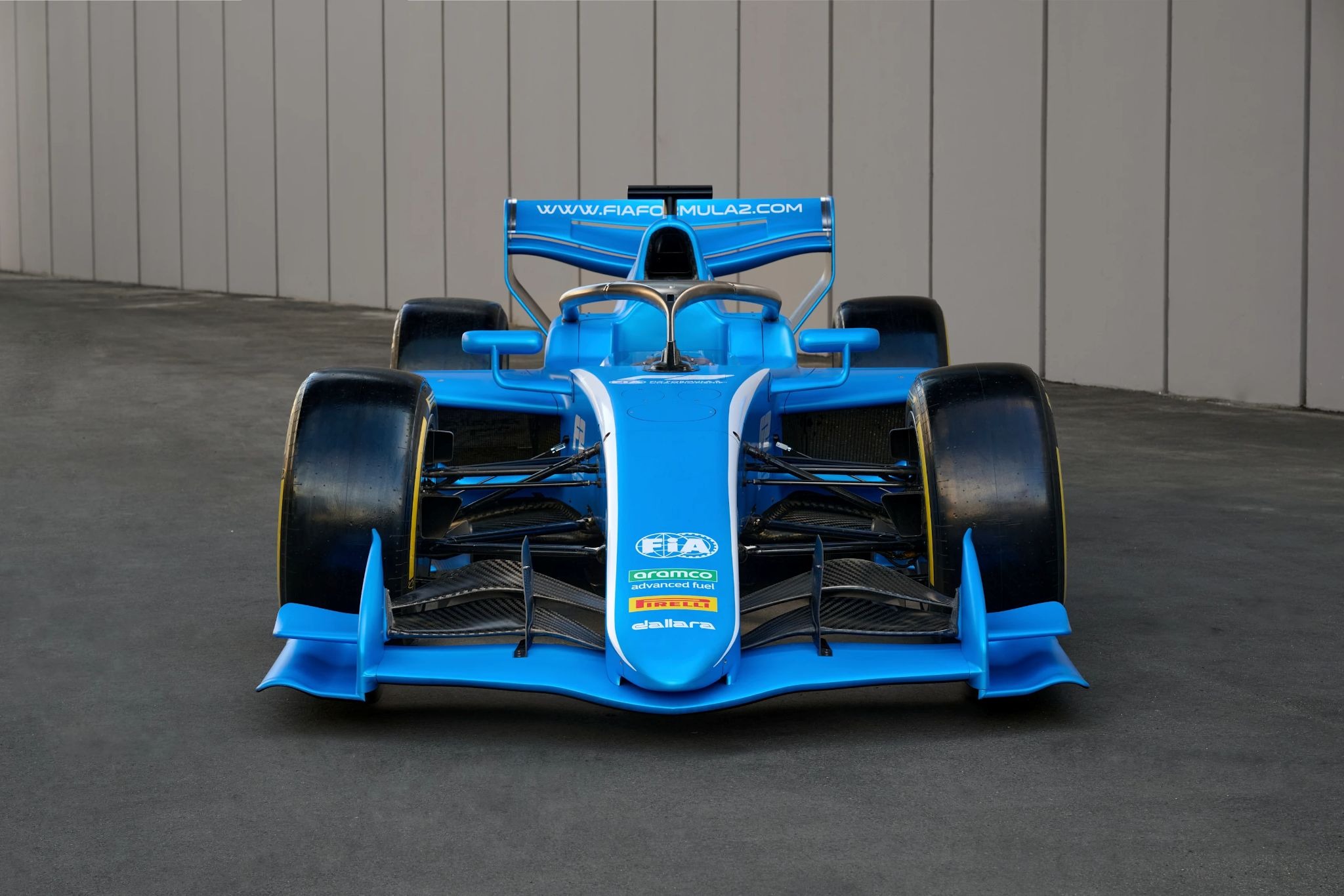
The incoming car took to the track in June with a shakedown around the Hungaroring, driven by F2’s 2024 third-place finisher and current Alpine F1 Team reserve driver Paul Aron. According to Michel, the Estonian’s experience in the championship proved vital in drawing comparisons between not only the current and future cars but also the Dallara F2 2018, which Aron raced in the 2023 season finale and post-season testing at the Yas Marina Circuit.
“We had very positive feedback. The good thing with Paul is that he’s been driving the former car as well, so he could have a very interesting comparison between the two cars,” Michel said. “He said that it was very pleasant to drive. He said that you could tell definitely that there was more downforce on this car. The little additional weight that you got because of the on-board starter, you couldn’t feel it at all, and that he thought that the races were going to be very interesting.
“Now, as long as we don’t have 22 cars on the track together, we don’t know, but we’re quite confident with all the work that has been done aerodynamically between the FIA and ourselves that we will have a very, very beautiful car to race.”
Testing is currently ongoing, with wind tunnel time scheduled to centralise data about the new car before it is passed on to the teams. The first car will be delivered to each team by the end of the year, with the second car expected at the end of January before pre-season testing.
“The Formula 2 teams give us feedback and we take that on board,” Tombazis told Feeder Series about the car design process. “But the main collaboration is with the actual team working to make this car and, of course, with the promoter [Formula Motorsport Limited].”
When the current iteration of the F2 car was introduced in 2024, alignment with the 2022 generation of F1 cars was likewise central to the redesign. Changes were made to the front and rear wings to mimic the ground-effect aerodynamics of the 2022 generation of F1 cars. Eighteen-inch tyres had already been introduced to F2 for the 2020 season, two years before their implementation in F1.
Joshua Dürksen and Nikola Tsolov are currently tied for the most wins in the Dallara F2 2024 era with six victories apiece. The car is still set to run 10 races this season, the next one being the F2 sprint race at Monza later today.
Header photo credit: Formula Motorsport Limited
Make a one-time donation
Make a monthly donation
Make a yearly donation
Choose an amount
Or enter a custom amount
Your contribution is appreciated.
Your contribution is appreciated.
Your contribution is appreciated.

