
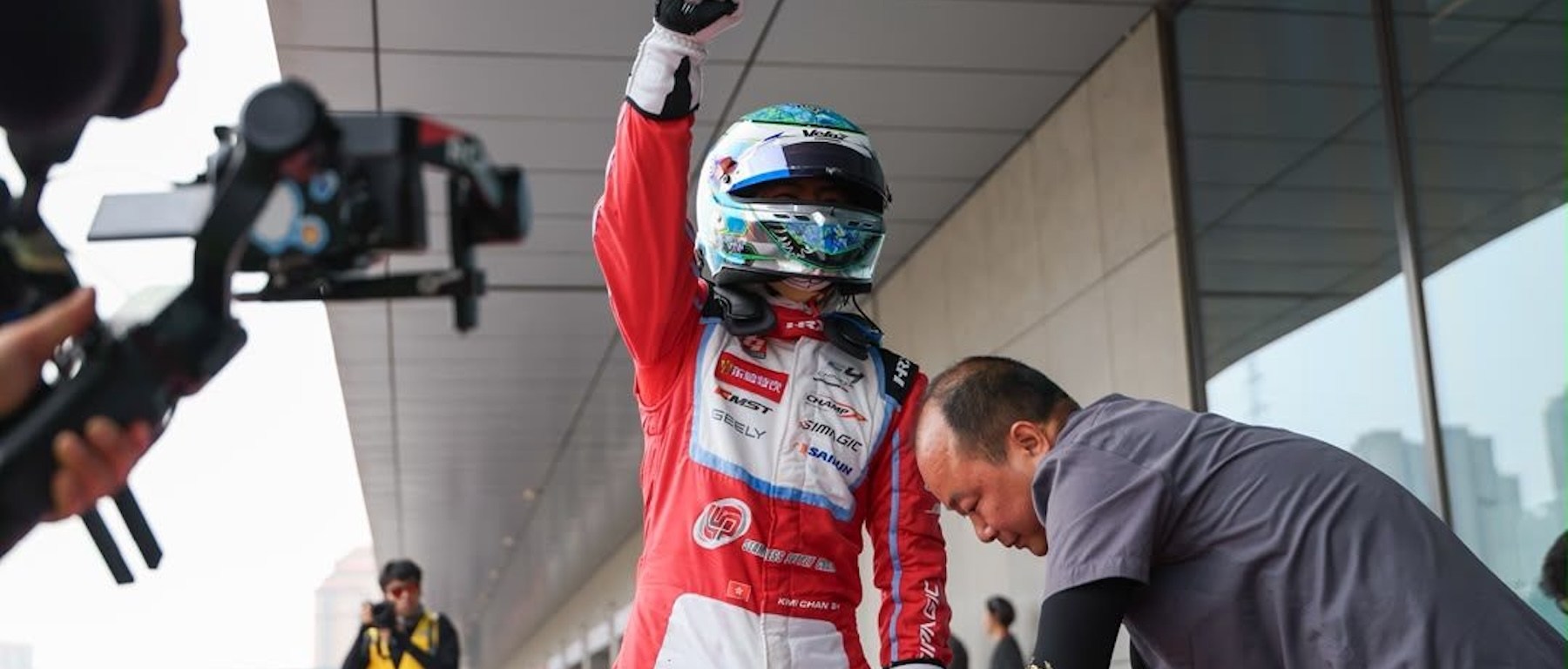
As the highest-placed returning driver on the Chinese F4 grid this year, Kimi Chan heads into the Chinese F4 season finale ready to battle it out for the championship title. The driver from Hong Kong spoke to Feeder Series before the round at Zhuzhou about his career so far, the Chinese motorsport scene and his plans for the future.
By Kaylene Lau
Coming into Chinese F4 as a rookie last season, Chan delivered week after week to finish second overall in the championship behind Simon Zhang. Chan never finished lower than sixth throughout his debut season in single-seaters, and entering the 2026 season, expectations were high for him to win his first championship.
The season, however, has gone a little differently than Chan would have liked. He kicked off the opening round in Shanghai with four podiums, three of which were wins. But misfortune at both Tianjin and Chengdu saw his championship lead erased and eventually snatched by Timur Shagaliev. A better performance at Zhuzhou helped Chan catch up to Shagaliev in the championship battle, but the Russian driver still leads by 18 points as the season finale approaches.
“I definitely cannot say it’s going too well, especially after the round in Chengdu,” Chan said on reflection. “We had a really good start to the season. Shanghai was really strong and I had better confidence and better pace overall compared to everyone else on the grid.
“Even in the second round in Tianjin, the pace was really good, but unfortunately I had two DNFs because I got taken out in both of them. I lost a lot of points there. Then going into Ningbo, I got disqualified in qualifying, so I had to start last. It was a really weird disqualification, but both me and my teammate got disqualified, so it was unfortunate.”
Chan’s performances this year have been hindered by two disqualifications. One was the disqualification in the second qualifying session in Ningbo, the other a disqualification from the first race in Chengdu, in which he originally finished second.
“There was something wrong with my teammate’s car on the data. So when they wanted to check my car, I ended up powering off the car, so I switched off the main thing,” Chan said about the disqualification in Ningbo. “So the data wasn’t really accurate for them to check, and then they just ended up disqualifying me.”
After Chengdu, the Champ driver said that it would be a ‘tough fight’ and told Feeder Series that he was debating whether or not to finish the season.
“We’re thinking if we should maybe try the SEA championship [Formula Trophy Malaysia] for the rounds before Macau just to know the Tatuus car better, and to work with other teams to prepare,” he said. “But even then, I think there’s still a good chance to win the championship in China, and it’s just a matter on how it goes, basically.
“To be fair, the pace and everything is still there to dominate in the rounds, but the reverse grid has just been really painful, and most of the tracks in China are not very easy to overtake [at]. So a lot comes down to how you manage the traffic and sometimes even just luck.”
Chan said that although winning the championship would definitely ‘mean something’, his eyes were still set on the Macau Grand Prix in November. This year’s F4 World Cup will use the Tatuus T-421 chassis instead of the Mygale M21-F4 used last year and in Chinese F4, leading Chan to seek extra preparations for the weekend.
“We’re also thinking about what we can do to better prepare for Macau because at the end of the day we’re driving a completely different car,” Chan explained. “I did testing with it during the summer, and it’s been pretty good. The four test days I did have been pretty good, but obviously it’s a different car so I’ll definitely need more experience with it.”
Two of the test days Chan completed with the Tatuus car were in Malaysia with Evans GP, who will be competing in the F4 World Cup this year.
Chan will still battle it out with Shagaliev for the championship title this weekend in Zhuhai.
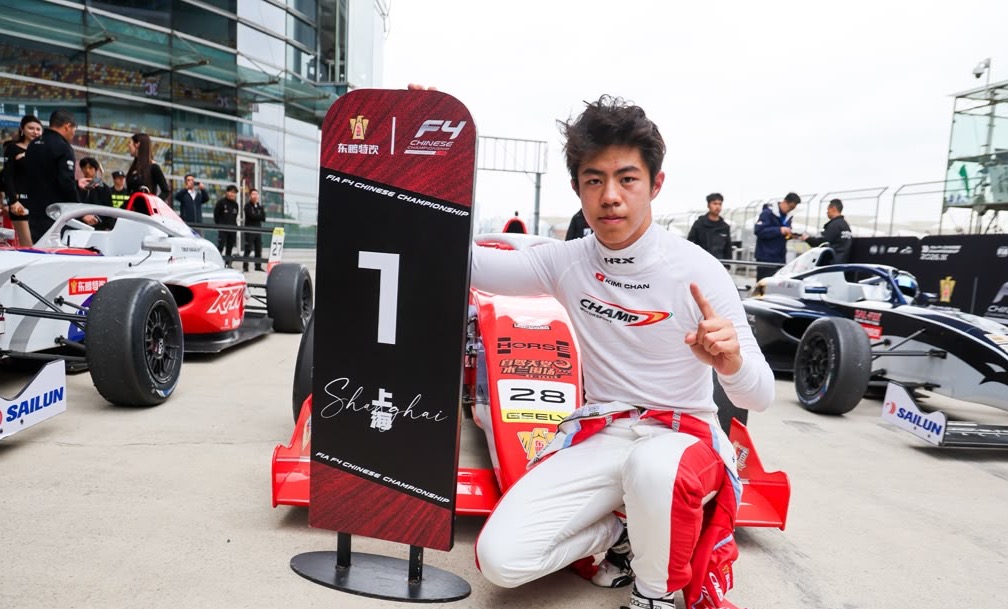
Inspired by his father’s love of cars, the Hong Kong–born driver watched his first F1 race in 2012. But it wasn’t until late 2020 during the partial COVID-19 lockdown in Shanghai that he was able to try karting for the first time.
“I got the chance to try karting, like the two-stroke ones. Then we decided to keep driving, and then eventually I got into national races. In 2025, half the time I was karting, and half the time I was making my step into formula racing. This year I’ve fully decided to focus on it, and I haven’t really done a lot of karting from then.”
In Chan’s single-seater career, he’s only ever stuck with one team. Champ Motorsport have been in the series since its inception, with two of their drivers winning the title – Julio Acosta in the 2015–16 season, and more recently Tiago Rodrigues in 2023.
Chan’s reason for working with Champ is Charles Leong, the 2017 Chinese F4 champion. Though Leong did not win the series with Champ, he has been serving as Chan’s coach and race engineer since the beginning of the 19-year-old’s single-seater career.
“Charles has always been my coach and race engineer from the start of my single-seater journey. He has very good connections with the team, and almost every team in China, because he’s been in the scene for a long time,” Chan explained. “Since he’s from Macau, and Macau is really close to Zhuhai and Champ is based in Zhuhai, that’s why we ended up choosing Champ to do our first year for the championship.
“Everything went pretty well considering that I went into my first race with only seven or eight test days. I’m quite happy with how everything went, and it’s been good working with the team. I improved a lot, and this year, there really wasn’t a reason to not go with Champ again, so obviously we chose to continue.”
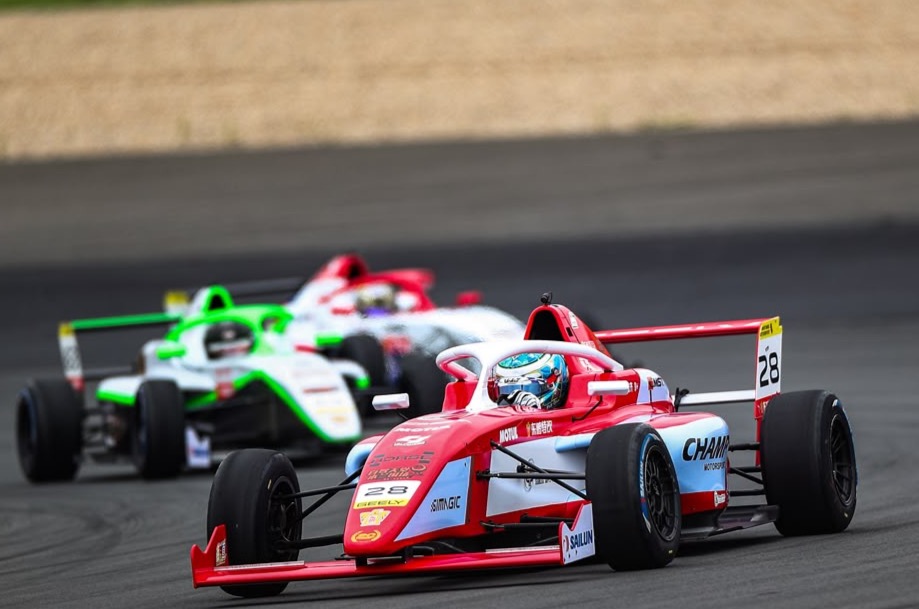
Chinese F4’s weekend format is relatively unusual in junior single-seaters, as each driver takes part in four races every weekend, two of which are reverse-grid races. The only other series to use this format is FR Oceania, though there, the grid for race three is set by the drivers’ combined fastest lap from the first two races. Chinese F4 instead reverses the top 12 finishers in races one and three to set the grids for races two and four. While FR Oceania switched to this format in 2026 to accommodate its shorter, more compact season, Chinese F4’s weekends are spread out throughout the year.
“In karting we have heat one, heat two, heat three, and then super heat final, so usually a weekend in karting is also quite packed,” he said. “Single-seaters is very different from karting. It’s a lot more physically demanding, and considering a lot of the drivers are 14 or 15 years old, so having four rounds in one weekend is definitely way more physically demanding than karting or even any other series.
“I’m definitely not the biggest fan of it, especially considering the reverse grid. Because the reverse grid, if you win, you still get 25 points, so the system works the same. But then you’re starting from P12 if you win the normal one in the morning, so that creates a lot of uncertainties and troubles for the drivers, not just for me but also for everyone who’s racing.
“It causes a lot more incidents, and I think there’s also a lot of masters and gentlemen drivers in Chinese F4 than other series. So the skill gap between the front-runners and the mid-pack, and if we’re talking about the people at the back – it’s a big skill gap, so it could become a bit of trouble on the reverse-grid for both the frontrunners, the masters and gentlemen drivers.
“But there are good things about it,” Chan added. “Especially in F4 China, you have to learn how to manage the traffic.”
Many young Chinese drivers race in the series as preparation for other F4 series in Europe, which is what 2022 series champion Gerrard Xie did before moving to GB3. Current GB3 driver Fu Yuhao competed in four rounds in 2024, and Cui Yuanpu, who last raced in the Eurocup-3 Spanish Winter Championship, entered one round the same year. Both Cui and Fu’s main campaigns in 2024 were in British F4, in which they finished ninth and 19th respectively.
Compared to other single-seater series worldwide, Chinese F4 has a large proportion of older drivers. Only nine drivers on the Chinese F4 grid this year are in the F4 class, consisting of drivers aged 15 to 20. The majority of the drivers on the grid this year are in the CFGP class, which consists of drivers aged 21 to 39. Six drivers on the grid are in the Masters class, consisting of drivers aged over 40.
It’s a stark difference from Europe, where most drivers in F4 are teenagers, or even Japan, where gentleman drivers and young talents compete in roughly equal numbers in the two-class Japanese F4. Chan, who turned 19 in June, highlighted that in order to strengthen the single-seater scene in China, there should be more of a focus on younger drivers.
“I don’t think the series is bad, but there definitely needs to be something that the organisers and the federation in China must do to improve the overall level and make it more focused on young talents. Because even for me, I’m 19. I’m quite old for F4. I also started quite late, and I couldn’t really get into it earlier, but even then, it’s not focused enough on young drivers,” Chan said.
“China, on a motorsport level, is definitely not as high as other countries, so if you really want to have a career in single-seaters, then you definitely have to move to Europe as soon as possible.”
“I don’t think the series is bad, but there definitely needs to be something that the organisers and the federation in China must do to improve the overall level and make it more focused on young talents. Because even for me, I’m 19. I’m quite old for F4. I also started quite late, and I couldn’t really get into it earlier, but even then, it’s not focused enough on young drivers.”
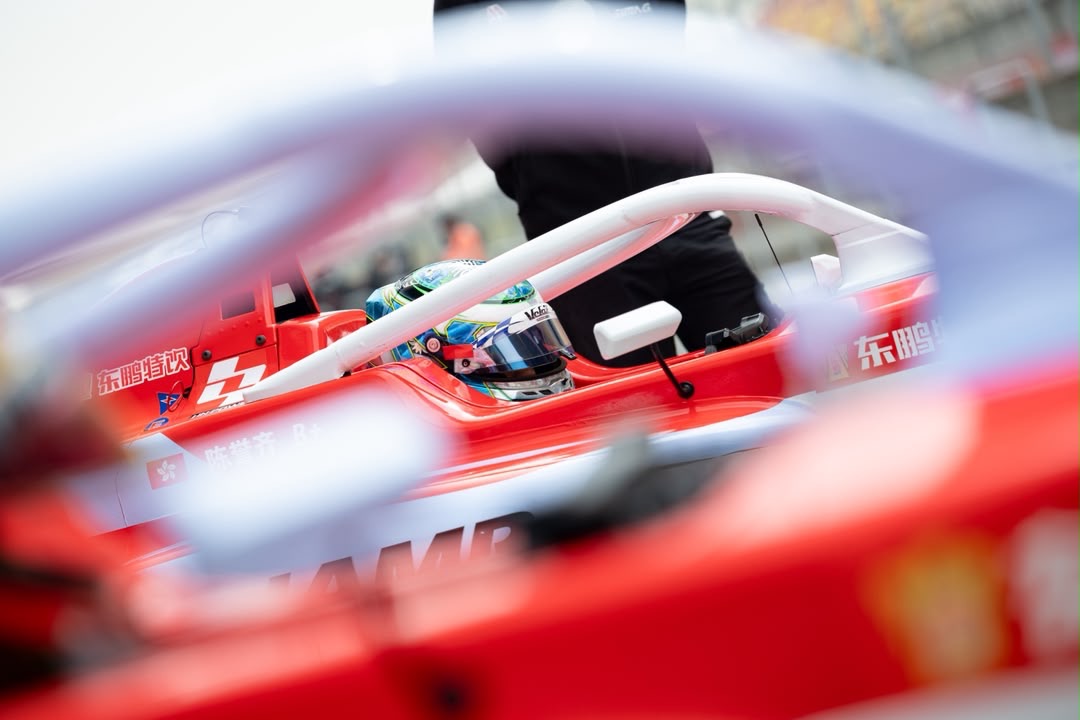
Chan’s target for this year is to race in Macau again in November. He got his first taste of the Guia Circuit last year, when he finished 13th in qualifying, fifth in the qualifying race and seventh in the main race. Chan said that he was ‘happy’ with where he finished but also thought he could’ve done better.
“Macau was definitely a big jump for me, because I got to experience racing with world-class drivers like [Kean] Nakamura-Berta and other drivers from Europe. Also the nature of the track – Macau, street circuit. Let’s just say it was a life-changing experience for me. That definitely gave me more confidence especially in terms of controlling, handling the car and pushing the limit of the car, and also learning a new track because we have limited test times.”
Chan said that Macau gave him a new perspective on his mindset when it came to approaching a race weekend.
“Regarding the results, I remember in the qualification race I was fifth, so I started fifth in the final. But if I don’t talk about the results, I think the main problem that I was struggling there was that I just wasn’t confident enough, I wasn’t pushing enough, because my mindset was like, ‘Oh, I’m racing against a lot of definitely better drivers than who I usually race with. The level is higher, and it’s a street circuit. If I make a mistake, I’m in the wall,” Chan said.
“So that ended up limiting me to not being able to push as much and then lap time–wise be competitive. But I think the mentality was shifting throughout the weekend, especially in the final round when I couldn’t see any cars in front because they had pulled away and I couldn’t see cars in the back because I pulled away. So that time, I was like, ‘I might as well just keep pushing more and more because if I don’t do that, I’m wasting my time here.’
“In the last five laps, I was just pushing way, way more, and ever since then, it kind of gave me a new perspective on what I need to do, and my mentality, my mindset and racing. So after Macau, when I did testing in China, I felt more confident when I was doing it and the lap time also reflected [that].
“That’s the reason why I wanted to do Macau again because obviously, Macau is a once in a lifetime opportunity for most drivers,” Chan said. “So I want to see how much I improved compared to last year and lap time–wise if I’m competitive compared to the European drivers.”
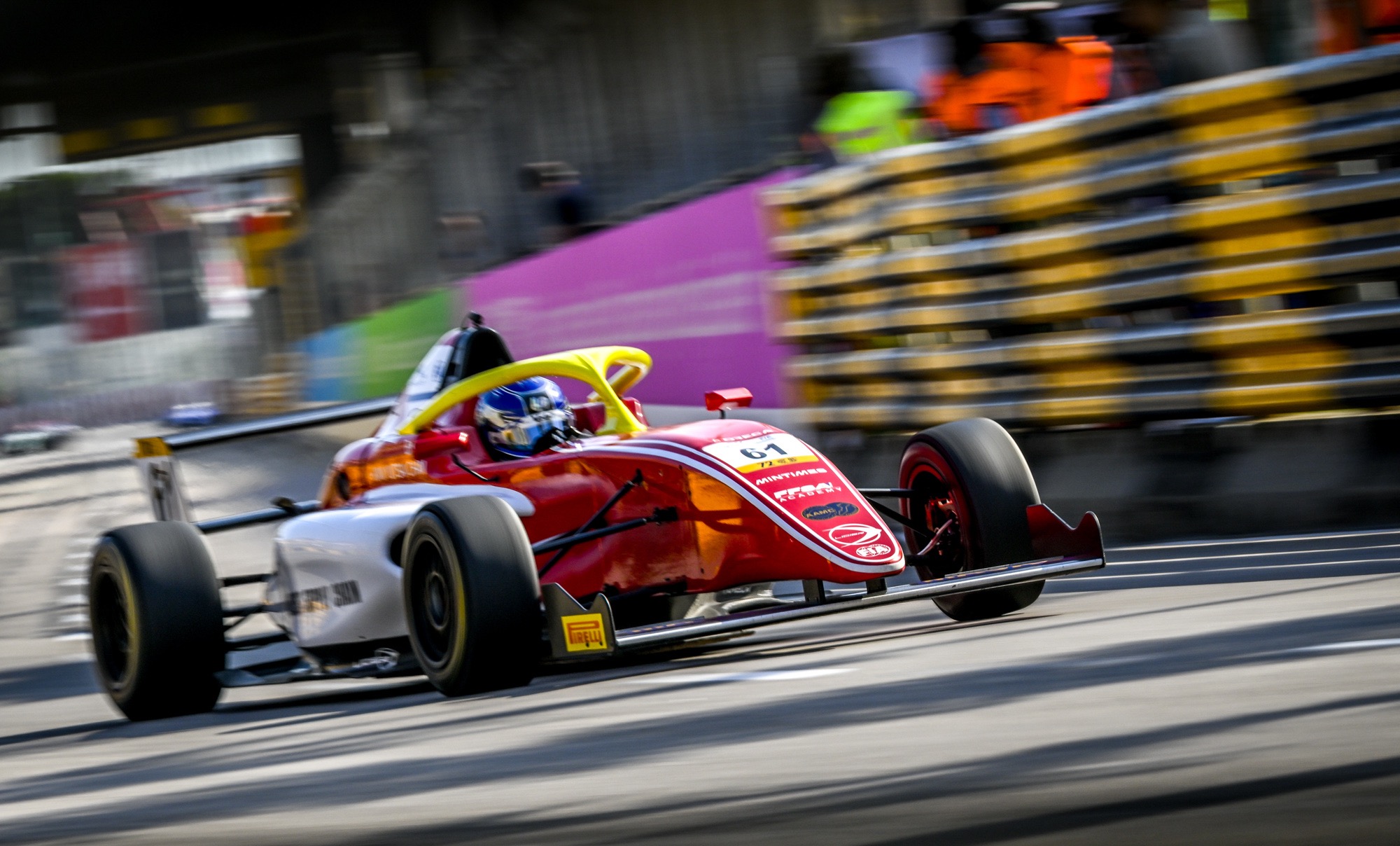
Chan, who started university this year in Hong Kong, will also be trying to balance his career with his studies. While he said he would consider staying in single-seaters ‘if an opportunity opens up’, doing so ‘wouldn’t be likely’, with a switch to GT cars in his sights.
“For next year, I don’t think we have a specific plan yet,” Chan said on his future in racing. “If it’s talking about the whole season, definitely not single-seaters because if you look at Middle East for example, those series over there, it’s only like a few months. So if I were to do that series, maybe Regional. But then I’d have to start testing really soon, and the preparation wouldn’t be enough to at least be competitive, right?
“But then, with that being said, I heard about the new Regional series in Asia, potentially in China. That’s also something that we’re also considering, but I think the chances aren’t very likely, because after I do the series, it’s like, ‘What’s next?’ So we’re probably more likely to make the switch to GT cars.
“But it’s a matter of GT3 or Porsche Cup, because if you look at Simon Zhang, he’s been really successful this year in GT cars. So I don’t see a reason why not to test GT cars by the end of this year and then see what to do next year.”
Header photo courtesy of Kimi Chan
Make a one-time donation
Make a monthly donation
Make a yearly donation
Choose an amount
Or enter a custom amount
Your contribution is appreciated.
Your contribution is appreciated.
Your contribution is appreciated.

