
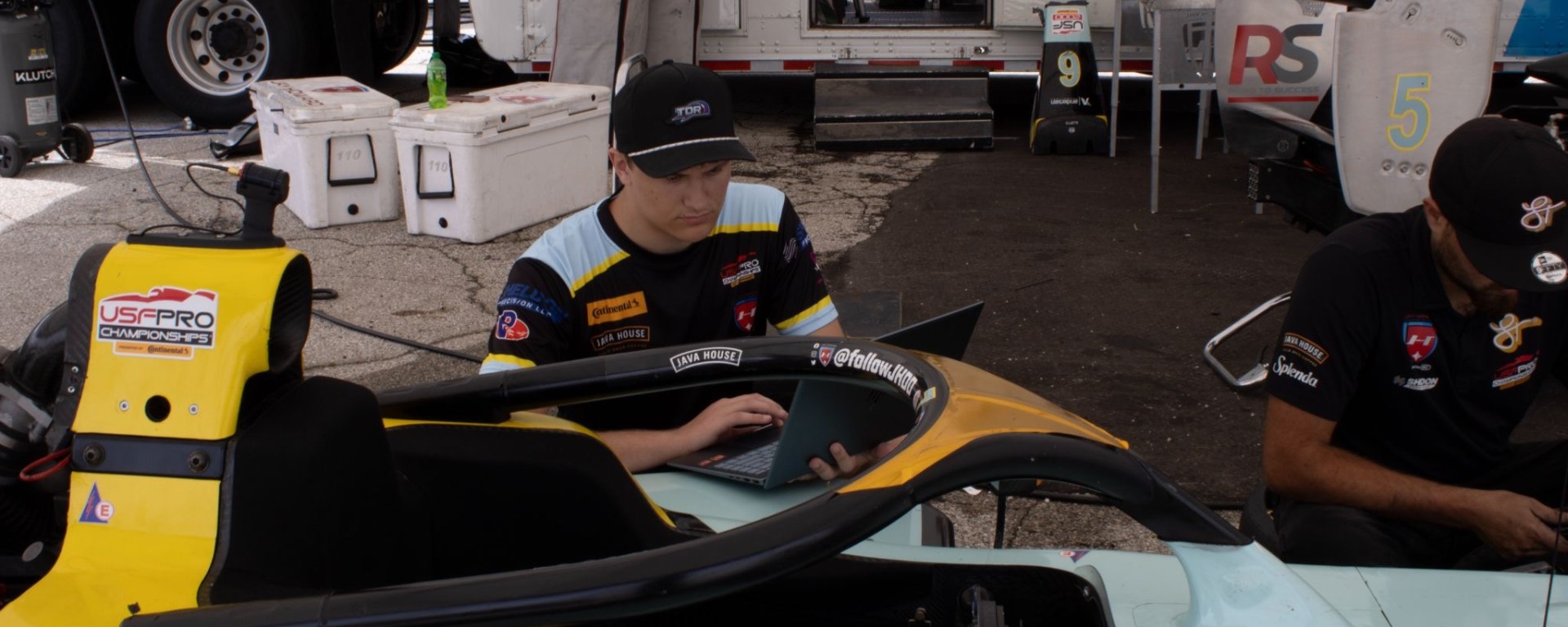
Tanner DeFabis burst onto the USF Pro Championships scene with a dominant win in the Freedom 75 in 2024, but budget restrictions have forced him to scale back his racing commitments and pivot towards data engineering. Feeder Series sat down with the Indiana native to learn more about his unconventional career path and what he’s spent the past year doing at Jay Howard Driver Development.
By Marco Albertini
In the 2024 USF2000 season, it was Max Garcia who secured the title in dominant style for Pabst Racing, proving himself hard to beat on street and road courses and finishing no lower than seventh all year. His worst result came at the only type of track the Floridian was unable to master: ovals, specifically Indianapolis Raceway Park.
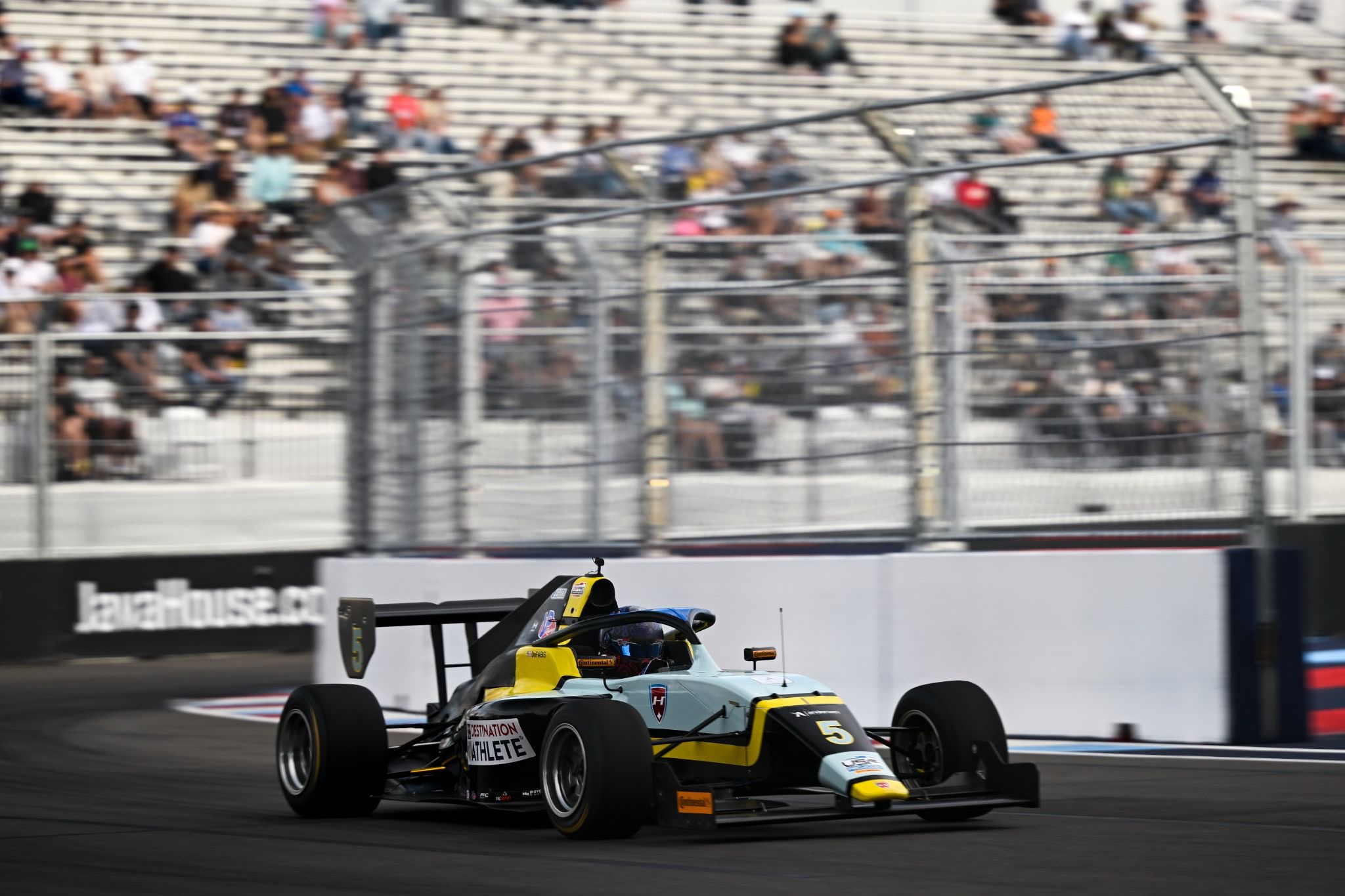
On that weekend, a surprise name stole the show, leading 64 of the 75 laps to take his maiden career win in single-seaters. That name was Tanner DeFabis, a rookie for Jay Howard Driver Development.
Heading into the weekend, few would’ve expected the then 18-year-old, who had only scored one top-10 finish in the previous seven races, to fight for the win at one of the most challenging tracks on the calendar, never mind triumph in such an imperious fashion.
DeFabis took an unusual path to his surprise victory and has had an unusual journey since then. His career has always been limited by money, not talent.
Running on a tight budget during his early years, DeFabis had limited karting experience, but was able to secure the K1 Karting League Teen and New Castle Motorsports Park TaG Senior titles in 2021 and 2022 respectively. The Indianapolis-born, Avon-based driver said his home state’s strong local scene helped ignite his career.
“It’s helped me quite a lot. I did a lot of karting out at New Castle Motorsports Park,” DeFabis told Feeder Series at Road America in June. “I’m a driver who doesn’t have as much experience in the car and in the seat, so that’s something that I’ve always struggled with myself. The experience, you learn a lot just from being local. Knowing all the teams and all the drivers and going to the track consistently is what helps you understand a lot.”
Since 2023, DeFabis has been a part of Jay Howard’s Driver Development squad, based just 45 minutes northwest of Avon by car. That year, DeFabis competed in F4 US with the team, and he took five points to end the year 24th overall. That season was his only full-time campaign in cars, however, as budget constraints meant he could only race on a part-time basis after moving to USF2000 in 2024.
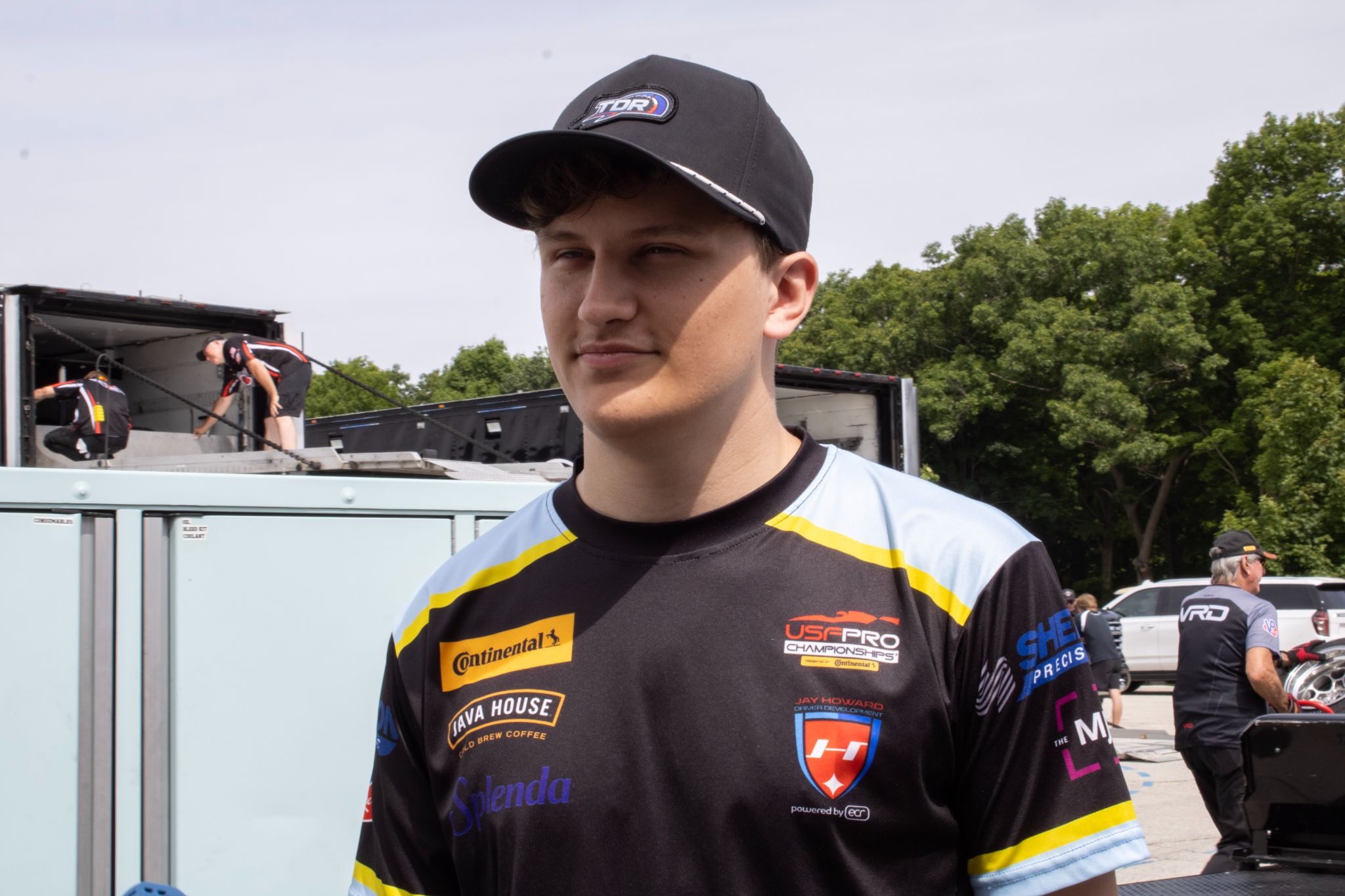
Before his surprise win, DeFabis’ season could have ended after IRP. Instead, the victory gave him a lifeline to race in the following round at Road America, his last USF2000 event of the season. DeFabis has since made sporadic appearances in USF Pro 2000, starting with his debut later that year at the Portland season finale.
After an encouraging ninth-place finish on his series debut, DeFabis raced in six of the 18 races last year, taking a best result of seventh at St. Petersburg and finishing in the top 10 in all but one of his starts. This year, DeFabis has had a quieter season, scoring a best result of 11th at Arlington among his three starts.
“I’ve been part-season for my third year now,” DeFabis said. “I’m consistently trying to stay on track, to keep the rust off and try to show results. Unfortunately, we haven’t shown the best results this year. It’s just one of those tough years and you’ll have those, but we’ve just got to keep pushing forward for better results.”
Since switching to USF Pro 2000 in late 2024, DeFabis has had to forgo several in-season tests because of his budget restrictions, finding himself on the back foot and having to play catch-up with his rivals on race weekends. DeFabis is therefore scrupulous about the rounds he enters, often choosing ovals or tracks new to the series calendar to minimise his experience deficit relative to the rest of the grid.
“I usually have the most challenge getting up to speed, [but] it depends on how long I’ve been out of the car and it also depends on the tracks as well,” DeFabis said. “Last weekend, everyone was here testing at Road America. If I did the race, I would have been at a disadvantage just because I didn’t have that track time. I wouldn’t have the seat time to really be up to speed just like everyone else.”
“We do try to pick out certain tracks that we think would suit us, such as Arlington and the ovals,” DeFabis added. “Arlington, nobody’s been there yet, and Milwaukee, USF hasn’t been there for 12 years. So we always try to look at tracks that we may have an advantage at just to show better results.”
Like most young drivers, DeFabis has support from his parents to pursue his racing goals, with his father helping arrange sponsorship and business and his mother handling his social media accounts. His dreams, however, have expanded in unusual ways beyond sitting behind a steering wheel.In the second half of 2025, DeFabis balanced racing and driver coaching with completing the data acquisition technician course at the Indianapolis-based Motorsport Technical School.
“It’s a technical course,” DeFabis explained. “You have a mechanics course, data course, composite course. They have a bunch of courses and they try to get you up to speed and give you a hands-on experience of what you’ll be doing in motorsports.”
“It’s a plan B,” DeFabis added. “I want to be in IndyCar and that’s my dream, but not all dreams come true, unfortunately. We try our best, and just to be working in racing would be awesome, so that’s part of why I started doing that.”
The Indiana native said his time at MTS helped his driving and off-track approach to motorsport. He parlays that training into a dual role at JHDD as a data engineer within their USF Pro Championships programme, enabling him to contribute to the team even when he’s not racing.
“It’s definitely helped me quite a lot driving,” DeFabis said. “I understand more of what I’m looking at now and I have a better grasp of what I need to do out on track and what the car needs.”
“The biggest thing I’ve learned is just the amount of different setups and channels you can use in the data course,” DeFabis said about the data acquisition course. “It’s always a huge learning curve because there’s a bunch of different data courses that we use, data systems we use at USF, like Marelli.”
DeFabis said that heading into 2027, he aims to partake in a full USF Pro 2000 season. Winning the title would come with a scholarship likely worth in excess of $500,000 US to compete in Indy NXT – but for DeFabis, perhaps the biggest win would be putting together a full campaign in the race seat in the first place.
Interview by Michael McClure
Header photo credit: Zyair Buckner
Make a one-time donation
Make a monthly donation
Make a yearly donation
Choose an amount
Or enter a custom amount
Your contribution is appreciated.
Your contribution is appreciated.
Your contribution is appreciated.

